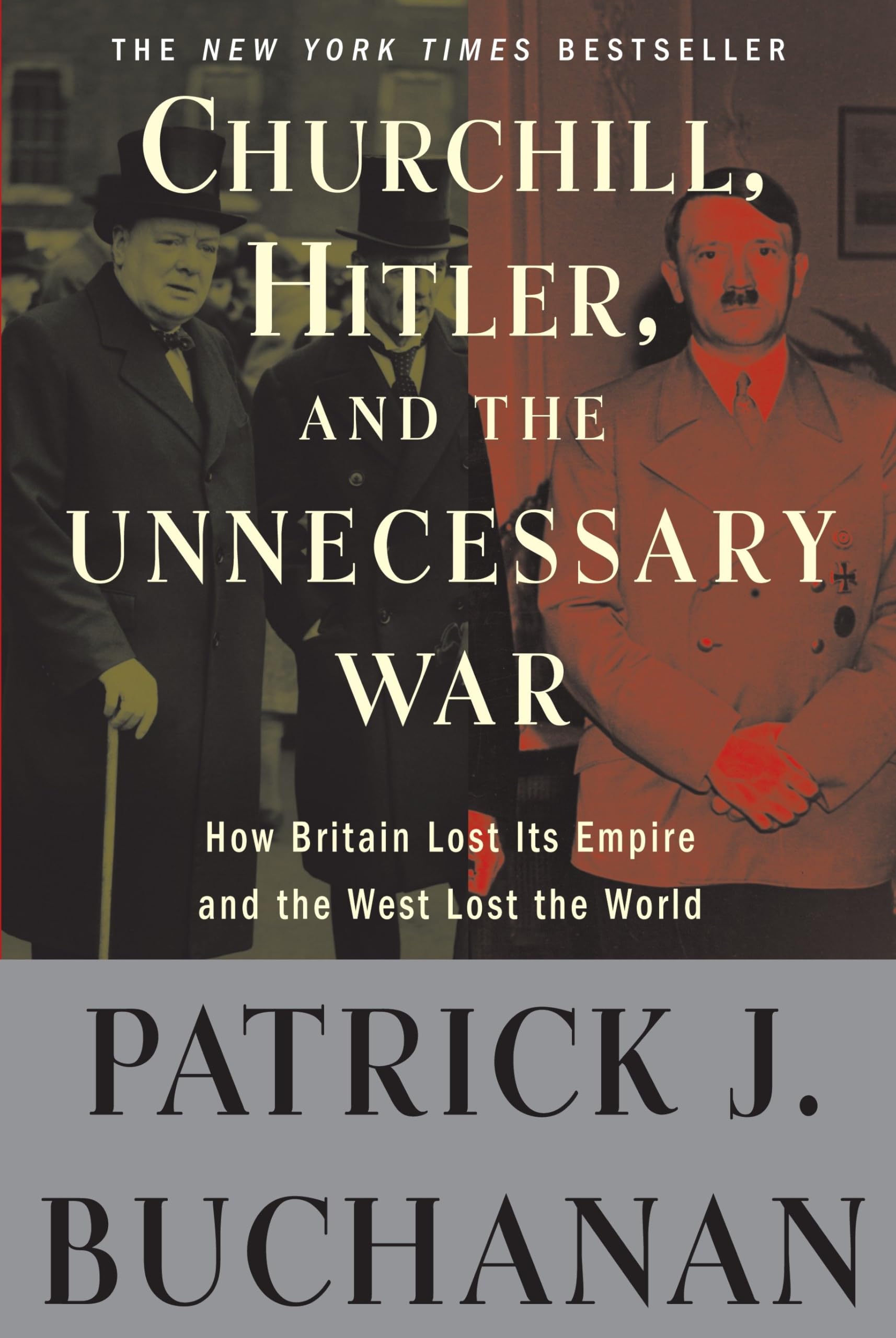
desertcart.com: Churchill, Hitler, and "The Unnecessary War": How Britain Lost Its Empire and the West Lost the World: 9780307405166: Buchanan, Patrick J.: Books Review: Missed chances and bad judgments equals tragedy! - In this excellent piece, Pat Buchanan makes some excellent points which conflict with the conventional wisdom about some of the most important events of the Twentieth Century. Many readers will disagree and perhaps even be offended by Buchanan's analysis. However, the author rigorously annotates his points, not just in footnotes but quotes of primary sources in the text of the book. Most readers have doubtless made up their minds about the causes of World Wars I and II. This book will, at the very least, challenge most readers to re-examine many of their opinions. While I do not accept all of Mr. Buchanan's arguments, they are worthy of respect, and can shake up one's settled beliefs. The first theme that Mr. Buchanan challenges is the notion that the First World War was essentially the product of German and Austrian aggression against the reluctant Allied Powers. While Austria is seen as the unwise bully that it was, Mr. Buchanan points out that in his 25 years as the German Kaiser, neither Kaiser Wilhelm or his nation had been involved in a single war. Britain, by contrast, had fought ten wars during this period including the bloody and recent Boer War. France had been involved in numerous bloody colonial wars as well. Buchanan provides copious evidence that the Kaiser was trying to avert war even at the eleventh hour, and that Britain could, and should, have averted war by simply refusing to commit to a war in continental Europe. Regarding this first theme, Winston Churchill comes in for savage criticism by Buchanan. Buchanan's theme is that Churchill's appetite and ardent desire for war was pivotal in causing England to guaranty Belgium's defense, which guaranty very likely made war inevitable. Buchanan documents in depressing detail the utter fecklessness of European diplomacy both before and after the First World War. Those who feel it necessary to take heed of the opinion of the elites of these countries would do well to study this component of the book. Buchanan documents, as have others before him, that both the First and Second World Wars are primarily the product of wretchedly incompetent management of international relations on the part of Britain, France, Germany, and others. Buchanan's main themes continue unto the Second World War. His main thesis is that it was Britain's guaranty to go to war if Germany attacked Poland that triggered the global war. He makes a strong case that this guaranty put the question of global war into the hands of a Polish government which immediately became intransigent once it received this guaranty. Buchanan believes that Hitler would have accepted terms over the question of Danzig and the Polish Corridor that Poland otherwise could, (and, he says, should) have found acceptable. Danzig was, after all, formerly a part of Germany until the Versailles Treaty, and its inhabitants almost to a person desired to be part of Germany. Given the facts that at the time Britain had only two battle-ready divisions, a minuscule air force, and that its Navy could not influence any German-Polish conflict in a meaningful way, Buchanan argues that the guaranty was essentially inexplicable. Once again, Buchanan savages Winston Churchill, who was again instrumental in causing Britain to make the guaranty that Buchanan believes triggered "the unnecessary war." Most readers, myself included, will not buy all of Buchanan's arguments. Regarding the fecklessness of European diplomacy, and the causes of the First World War, I think that Buchanan is on solid ground. Other researchers before Buchanan have found the First World War to have been an avoidable tragedy that the European states should have been able to avoid. Buchanan's Second World War arguments are somewhat more problematic. There is little evidence that any country anytime ever had much luck negotiating with Hitler, and it is far from clear that Britain's guaranty caused the German-Polish conflict or that its absence would have prevented it. Hitler seemed willing to invade neighboring countries on almost any pretext and with a complete disregard to ordinary Western standards of decency. Notwithstanding that fact, Buchanan makes a pretty good case that Hitler was an opportunist, and that he was not without justification in seeking return of the Sudetenland and of Bohemia. Had he stopped there, and negotiated return of Danzig without war (which Buchanan says would have happened absent the British guaranty) we might be living in a very different world. Who can say? Personally, I still think that Hitler was determined to fight a bloody war against Russia and persecute the Jews and other nationalities and ethnicities that he hated. Ultimately, it seems that Hitler was bound to fight such a war, but Buchanan makes some case that the world might have been better had Germany and Russia fought their war without the Western Allies being involved. Each reader must decide for him or her self. I don't accept this thesis. Mr. Buchanan's most insightful analysis is at the very end of this piece. He argues, as discussed above, that inept European diplomacy in which Great Powers went to war for non-vital reasons, was the cause of the World Wars. He then contrasts this with US diplomacy from World War I to the end of the Cold War. During this time American leaders refused to be easily drawn into conflicts and joined the World Wars only in their latter stages (particularly the First) thereby avoiding in significant degree, the horrendous casualties that many others suffered. Even more significantly, once America became the leading world power, American diplomacy repeatedly avoided war-starting confrontations by refusing, not without anguish, to fight wars for non-vital interests to America. Hence America's refusal to fight wars over Soviet interventions in Czechoslovakia and Hungary, or even the Cuban Missile Crisis. The contrast between the success of America in winning the Cold War without a World War (albeit with some sizable errors such as Vietnam) and European fecklessness in managing to start two world wars in 25 years, is stark. This is a truly fascinating insight which in my opinion is the major contribution of this book. This book is interesting, readable, and provocative. It will cause most readers to at the very least re-examine what they think about the causes of the two great wars of the Twentieth Century. For that, this one merits five stars. Highly recommended. RJB. Review: Misleading title, but great history - A more accurate title for this book would be something along the lines of, "Causes and Consequences of WWII, as Derived from Other Histories." In writing this book the author has taken the historical writings of about 200 different historical tomes and synthesized them into a single volume of a mere 420 pages (principle text only, and not including 75 pages of notes and bibliography). The book is an easy read, which is remarkable given the large number of references (sometimes conflicting) used by the author. Here's why I love this book: 1. The writing is superb - I found the book easy to read, and hard to put down. 2. Mr. Buchanan lays blame for WWII (as well as WWI) where he believes blame should be laid, as very well supported by his numerous citations and quotations. Accordingly, Mr. Buchanan's conclusions are well supported. 3. Mr. Buchanan raises questions that any observant reader should also be raising, and then provides essentially immediate answers to the questions. 4. The writing is about as unbiased as possible. Mr. Buchanan offers alternative explanations for the actions of individuals, and lets the reader decide what is the best explanation. This book should be read by anyone pondering the question of how and why WWII came about. It is not the end-all definitive tome on answering that question, but it does provide a critical piece to the puzzle, and perhaps more importantly, provides the reader with links (via the bibliography) for further study. (I purchased 9 books cited in the bibliography for my own further study.) Notwithstanding the title and forward in this book, it is not just a rant against Churchill - it is also an excellent history of the motivations and events that lead up to WWII. This book should be read along with "Freedom Betrayed" (by Herbert Hoover, re WWII and FDR). If you read "Churchill, Hitler, and the Unnecessary War" and "Freedom Betrayed", you will be enlightened as to the so-called "Good War". WWII was not a war against the alleged tyranny of Nazi Germany. Rather, the European part of the war was brought about primarily by the personalities of Churchill, Neville Chamberlain, Hitler and Beck (the Polish leader in 1939). Stalin merely facilitated the European part of the war. To make it a truly World war, FDR did everything he could to antagonize Germany and Japan into attacking the U.S., with successful results (and the loss of 400,000 American lives). If you have any thoughts about WWII being the "good war", ask yourself these two questions: (i) If the British objective of WWII was to fight German aggression, why did they turn a blind eye towards similar Soviet aggression?; (ii) If the U.S. objective of WWII was to fight Japanese and German threats to the U.S., what was the real threat to the U.S. from Germany and Japan in June 1941? If you look for answers to these questions, you will find that WWII was not a war against tyranny, but rather a war of personalities. I am a bit of an amateur historian, and have thus far primarily placed my study of the casus belli of WWII on investigating why FDR drug the U.S. into WWII (and to a lesser extent, why Britain gave Poland a guarantee in 1939 - but with no real satisfactory answer as to the latter question). This book provides at least one satisfactory answer as to why Britain decided to drag itself into WWII. As I've always contended, the more one can read on a subject, the better one will be facilitated in forming a reasoned opinion thereon. This book should be part of any study on the casus belli of WWII.

| Best Sellers Rank | #24,762 in Books ( See Top 100 in Books ) #37 in German History (Books) #59 in Political Leader Biographies #88 in World War II History (Books) |
| Customer Reviews | 4.6 out of 5 stars 1,057 Reviews |
R**N
Missed chances and bad judgments equals tragedy!
In this excellent piece, Pat Buchanan makes some excellent points which conflict with the conventional wisdom about some of the most important events of the Twentieth Century. Many readers will disagree and perhaps even be offended by Buchanan's analysis. However, the author rigorously annotates his points, not just in footnotes but quotes of primary sources in the text of the book. Most readers have doubtless made up their minds about the causes of World Wars I and II. This book will, at the very least, challenge most readers to re-examine many of their opinions. While I do not accept all of Mr. Buchanan's arguments, they are worthy of respect, and can shake up one's settled beliefs. The first theme that Mr. Buchanan challenges is the notion that the First World War was essentially the product of German and Austrian aggression against the reluctant Allied Powers. While Austria is seen as the unwise bully that it was, Mr. Buchanan points out that in his 25 years as the German Kaiser, neither Kaiser Wilhelm or his nation had been involved in a single war. Britain, by contrast, had fought ten wars during this period including the bloody and recent Boer War. France had been involved in numerous bloody colonial wars as well. Buchanan provides copious evidence that the Kaiser was trying to avert war even at the eleventh hour, and that Britain could, and should, have averted war by simply refusing to commit to a war in continental Europe. Regarding this first theme, Winston Churchill comes in for savage criticism by Buchanan. Buchanan's theme is that Churchill's appetite and ardent desire for war was pivotal in causing England to guaranty Belgium's defense, which guaranty very likely made war inevitable. Buchanan documents in depressing detail the utter fecklessness of European diplomacy both before and after the First World War. Those who feel it necessary to take heed of the opinion of the elites of these countries would do well to study this component of the book. Buchanan documents, as have others before him, that both the First and Second World Wars are primarily the product of wretchedly incompetent management of international relations on the part of Britain, France, Germany, and others. Buchanan's main themes continue unto the Second World War. His main thesis is that it was Britain's guaranty to go to war if Germany attacked Poland that triggered the global war. He makes a strong case that this guaranty put the question of global war into the hands of a Polish government which immediately became intransigent once it received this guaranty. Buchanan believes that Hitler would have accepted terms over the question of Danzig and the Polish Corridor that Poland otherwise could, (and, he says, should) have found acceptable. Danzig was, after all, formerly a part of Germany until the Versailles Treaty, and its inhabitants almost to a person desired to be part of Germany. Given the facts that at the time Britain had only two battle-ready divisions, a minuscule air force, and that its Navy could not influence any German-Polish conflict in a meaningful way, Buchanan argues that the guaranty was essentially inexplicable. Once again, Buchanan savages Winston Churchill, who was again instrumental in causing Britain to make the guaranty that Buchanan believes triggered "the unnecessary war." Most readers, myself included, will not buy all of Buchanan's arguments. Regarding the fecklessness of European diplomacy, and the causes of the First World War, I think that Buchanan is on solid ground. Other researchers before Buchanan have found the First World War to have been an avoidable tragedy that the European states should have been able to avoid. Buchanan's Second World War arguments are somewhat more problematic. There is little evidence that any country anytime ever had much luck negotiating with Hitler, and it is far from clear that Britain's guaranty caused the German-Polish conflict or that its absence would have prevented it. Hitler seemed willing to invade neighboring countries on almost any pretext and with a complete disregard to ordinary Western standards of decency. Notwithstanding that fact, Buchanan makes a pretty good case that Hitler was an opportunist, and that he was not without justification in seeking return of the Sudetenland and of Bohemia. Had he stopped there, and negotiated return of Danzig without war (which Buchanan says would have happened absent the British guaranty) we might be living in a very different world. Who can say? Personally, I still think that Hitler was determined to fight a bloody war against Russia and persecute the Jews and other nationalities and ethnicities that he hated. Ultimately, it seems that Hitler was bound to fight such a war, but Buchanan makes some case that the world might have been better had Germany and Russia fought their war without the Western Allies being involved. Each reader must decide for him or her self. I don't accept this thesis. Mr. Buchanan's most insightful analysis is at the very end of this piece. He argues, as discussed above, that inept European diplomacy in which Great Powers went to war for non-vital reasons, was the cause of the World Wars. He then contrasts this with US diplomacy from World War I to the end of the Cold War. During this time American leaders refused to be easily drawn into conflicts and joined the World Wars only in their latter stages (particularly the First) thereby avoiding in significant degree, the horrendous casualties that many others suffered. Even more significantly, once America became the leading world power, American diplomacy repeatedly avoided war-starting confrontations by refusing, not without anguish, to fight wars for non-vital interests to America. Hence America's refusal to fight wars over Soviet interventions in Czechoslovakia and Hungary, or even the Cuban Missile Crisis. The contrast between the success of America in winning the Cold War without a World War (albeit with some sizable errors such as Vietnam) and European fecklessness in managing to start two world wars in 25 years, is stark. This is a truly fascinating insight which in my opinion is the major contribution of this book. This book is interesting, readable, and provocative. It will cause most readers to at the very least re-examine what they think about the causes of the two great wars of the Twentieth Century. For that, this one merits five stars. Highly recommended. RJB.
J**D
Misleading title, but great history
A more accurate title for this book would be something along the lines of, "Causes and Consequences of WWII, as Derived from Other Histories." In writing this book the author has taken the historical writings of about 200 different historical tomes and synthesized them into a single volume of a mere 420 pages (principle text only, and not including 75 pages of notes and bibliography). The book is an easy read, which is remarkable given the large number of references (sometimes conflicting) used by the author. Here's why I love this book: 1. The writing is superb - I found the book easy to read, and hard to put down. 2. Mr. Buchanan lays blame for WWII (as well as WWI) where he believes blame should be laid, as very well supported by his numerous citations and quotations. Accordingly, Mr. Buchanan's conclusions are well supported. 3. Mr. Buchanan raises questions that any observant reader should also be raising, and then provides essentially immediate answers to the questions. 4. The writing is about as unbiased as possible. Mr. Buchanan offers alternative explanations for the actions of individuals, and lets the reader decide what is the best explanation. This book should be read by anyone pondering the question of how and why WWII came about. It is not the end-all definitive tome on answering that question, but it does provide a critical piece to the puzzle, and perhaps more importantly, provides the reader with links (via the bibliography) for further study. (I purchased 9 books cited in the bibliography for my own further study.) Notwithstanding the title and forward in this book, it is not just a rant against Churchill - it is also an excellent history of the motivations and events that lead up to WWII. This book should be read along with "Freedom Betrayed" (by Herbert Hoover, re WWII and FDR). If you read "Churchill, Hitler, and the Unnecessary War" and "Freedom Betrayed", you will be enlightened as to the so-called "Good War". WWII was not a war against the alleged tyranny of Nazi Germany. Rather, the European part of the war was brought about primarily by the personalities of Churchill, Neville Chamberlain, Hitler and Beck (the Polish leader in 1939). Stalin merely facilitated the European part of the war. To make it a truly World war, FDR did everything he could to antagonize Germany and Japan into attacking the U.S., with successful results (and the loss of 400,000 American lives). If you have any thoughts about WWII being the "good war", ask yourself these two questions: (i) If the British objective of WWII was to fight German aggression, why did they turn a blind eye towards similar Soviet aggression?; (ii) If the U.S. objective of WWII was to fight Japanese and German threats to the U.S., what was the real threat to the U.S. from Germany and Japan in June 1941? If you look for answers to these questions, you will find that WWII was not a war against tyranny, but rather a war of personalities. I am a bit of an amateur historian, and have thus far primarily placed my study of the casus belli of WWII on investigating why FDR drug the U.S. into WWII (and to a lesser extent, why Britain gave Poland a guarantee in 1939 - but with no real satisfactory answer as to the latter question). This book provides at least one satisfactory answer as to why Britain decided to drag itself into WWII. As I've always contended, the more one can read on a subject, the better one will be facilitated in forming a reasoned opinion thereon. This book should be part of any study on the casus belli of WWII.
J**R
Excellent review of the diplomacy of the two world wars
I am no fan of Pat Buchanan, considering him to be just another blow hard. I was impressed by his opposition to Gulf War II (unlike John Kerry and Hillary Clinton), and his pungent statement after the war was over, "Well, Mr. President. Where are the weapons of mass destruction?" On a blog site I was doing my usual thing of defending Chamberlain from the charge of appeasement when I was attacked as being under the influence of the ideas in this book. Having not read the book, I thought why not? It was only $1.99 on Amazon. Buchanan is no historian, but he has read a lot of history. This book is logical, well written, and well referenced. About 2/3'rds is a well written account of the diplomacy of the world wars, or better said, the mistaken diplomacy which led to those wars, and their unhappy aftermaths. I have read quite a bit about this, and what he writes is consistent with what I have read elsewhere. This is a nice account though with many details I had overlooked or forgotten. I highly recommend this book for that alone. The other 1/3rd is a critique of Winston Churchill. It is quite negative. Thus, this book has been highly criticized. The negative reviews I have read are essentially attacks on Buchanan, not on anything he actually says in his book. Very briefly, Buchanan puts the blame on England for the global nature of what would have been wars confined to the European mainland. I did not know that England had no treaty to come to the aid of anybody in Europe if they were attacked prior to WW I. What existed was a small clique of English and French politicians and military people (Churchill was very prominent in this clique) to come to the aid of France in case of war. Nobody else knew this. They used the excuse of the violation of Belgium neutrality to come into the war, but that would not have mattered in any event. Germany would have defeated France if not for English intervention, and the war dragged out for four bloody years. The upshot was the breakup of the Austro-Hungarian empire and the coming to power in Russia of the Communists. The Versailles treaty was an abomination. Nobody disputes that today. When Hitler came to power, he demanded revision of that treaty. Nobody could dispute the merits of his arguments. The treaty had unfairly penalized Germany and all German ethnics, millions of whom had lived in the Austro-Hungarian Empire. The demand that all ethnic Germans should be incorporated into a modern German state was in complete accordance with Wilson's principles, but only the Germans were denied this opportunity, and Hitler pushed it. The big mistake was allowing the Germans to re-militarize the Rhineland, which could have been easily prevented. Anyhow, after incorporating Austria and the Sudetenland, without firing a shot, he demanded the Polish corridor through eastern Prussian be given up to Germany. It was Germany territory. The Poles at this time were ruled by a military junta. They balked. Hitler threatened. It is claimed, and there is ample documentation, that Hitler had no intention of going to war over this. He wanted Poland as an ally against Russia, and up until now he had gotten what he wanted by bluffing. Out of the blue, England offered Poland a guarantee of its "independence." The Poles hadn't asked for it and gave nothing in return. This promise morphed into an unconditional promise to come to its aid if attacked. The Germans were astounded. England had just made the same error the Kaiser had made in giving Austria a blank check to handle its Serbia problem. So, Poland refused to discuss the Polish corridor, Hitler attacked, thinking that England would be crazy to honor its promise. Hitler had made it very clear that he wanted no war with England. England then dragged in its Empire into the war, and WW II, which could have been confined to Eastern Europe, became a global war. Otherwise, Hitler would have kept going East and finally gotten into a war with the Russian Communists. At the end of WW II, Germany was destroyed, tens of millions were dead, 19 million Germans were ethnically cleansed from Eastern Europe, Communist USSR controlled all of Eastern Europe, and China fell to the Communists. Polish independence was a joke, and millions of Poles had died in the war. And, the English Empire was destroyed. There is a MUCH, MUCH, more. Read the book if interested in this period of history. Churchill played a prominent rule in pushing England into both these wars. When Churchill got into English politics in about 1901, the English Empire was at its zenith. When he left politics in 1955, the English Empire was no more. This is the basis for the harsh critique. The fact that by today's standards he was a complete racist and imperialist just adds to the irony. The supreme irony is that Hitler was a supporter of the English Empire. He offered England a peace deal which was very generous to England. FDR and Stalin both wanted to see the English Empire destroyed. Today we say that WW II is justified by the Holocaust. Keep in mind that the Holocaust, in 1939, was still in the future. That would be like the Japanese saying that they were justified in bombing Pearl Harbor because we bombed Hiroshima. The fate of the Jews in Europe played no role in the march to war nor in the conduct of the war. And, it is clear, that the Nazi's used the war as a cover for their Final Solution.
C**S
Great Historical Read!
Interesting book. Author does a great job piecing historical fact from mythological WW2 fiction. Though this book centers on the tragic diplomatic decisions of Great Britain in WW1 and 2, and specifically on Churchill and Hitler, I would highly recommend reading Freedom Betrayed by president Herbert Hoover, as a companion to this book. Hoover captures in real time American sentiment of the times and reports in detail his analysis of the crisis based on an extensive tour and consultation with the heads state of Europe in 1938. Hoover’s conclusions are similar but somewhat different. Hoover saw 2 “bad guys” Hitler and Stalin and felt the British/Polish blunder described by Buchanan prevented Hitler and Stalin from their inevitable confrontation. This would have allowed more time to prepare to battle who was left. Buchanan briefly touches on the Communist infiltration of the US and FDR administration, but Hoover goes into great detail showing who was involved, and those eventually outed as spies, as well as spies within the British Government. Hoover believed these individuals affected FDR’s decision to offer Lend Lease to Stalin, though Buchanan shows Churchill came to admire Stalin for totally different reasons. Buchanan rightly clarifies the “Isolationist” sentiment of post WW1 America, and Hoover again gives great detail dispelling fact from fiction. In today’s world of hyperbolic political use of Isolationism, Fascism , National Socialism, and Communism, Buchanan does a great job of putting these terms into their true definition and historical perspective. It would be most beneficial regardless of political orientation to read this account along with Hoover’s. Buchanan’s bibliography is extensive and provides the reader with great opportunities for further study. The book is a “page turner.” Highly recommended!
D**E
Stirring the Pot
Buchanan stakes out some pretty controversial positions here. But, agree or not, he raises questions seldom dealt with in public, and ones that go to the heart of the West's presumed moral authority in its two wars with Germany. Crucially, his is not an apologia for Hitler or the Third Reich. Their wretched horrors during WWII are acknowledged without reserve. Rather, it's an effort to put the diplomatic moves preceding WWII into a more balanced and accurate perspective than the American public is accustomed to. The results amount to a much more ambiguous mix than the history books usually allow, and should come as an eye-opener, particularly regarding Churchill's punitive role. Churchill is often treated as a god, and not a minor one at that. A reckoning with the British politician's career is long overdue. I doubt that any non-American head of state has been more lionized in our press than the former prime minister. Of course, the focal point of hagiography is Churchill's undeniable role as a wartime leader. It's a role the author Buchanan doesn't dispute. What the author does dispute is the wider context, particularly Churchill's vaunted reputation as a statesman. It's here within an unfolding sixty-year period that Buchanan lays bear the actual record--and contrary to legend, a dismal one it is. From the British politician's earliest service through 1955, the author records again and again gross errors of judgment that helped propagate WWI, instigate WWII, facilitate Soviet expansion, and finally terminate the British Empire. It's a sobering account, to say the least, darn near the equivalent of saying Jesus erred on the Mount of Olives. Nonetheless, it's an account that can't be ignored. Then too, Hitler is viewed less as a demonic force than as a rabid nationalist intent on retrieving German lands wrongfully expropriated by the treaty of Versailles, and as a dictator ultimately backed into a corner by Britain's reckless guaranteeing of Poland's 1939 borders. Contrary to received wisdom, Buchanan asserts that war with Hitler's Reich was not made necessary by mad global designs, the usual formula for blame. Instead, primary blame is laid on a series of British missteps originating at the ministerial level. The author's thrust here depends on accepting the view that the German Chancellor was interested only in extending influence eastward as a bulwark against the Reich's true enemy, the Soviet Union, leaving the West and their colonial holdings basically intact. This too amounts to a revisionist account and a more difficult one to substantiate. Nonetheless, the author forces a key question usually passed over as an article of faith, viz. was war with the Reich in some sense inevitable or rather the unfortunate result of diplomatic blunder. Now, all of this would remain academic were it not for the lessons drawn from that 40-year period. Most notably, Britain's empire collapsed from accumulated reversals brought about by blundering diplomacy and the two global disasters that resulted. Britain could no longer support her maritime holdings, resulting in a loss of global primacy and a junior partnership with an ascendant USA. Pivotal in this chain is a myopic vision of where Britain's vital interests lay. They certainly didn't lie in meddling in the disposition of Central Europe, the traditional sphere of Russo-German rivalry. Yet Britain fought two debilitating wars over that disposition, when a truer view of vital interest would have counseled a more detached policy. Wisdom here would appear to lie in being able to separate the essential from the inessential, a distinction apparently muddled by several generations of British leaders. Now, Buchanan draws lessons from this for American policy. Is meddling in such non-traditional spheres as Central Asia, Russian border regions, and across the Mid-East, producing a distinctly American brand of imperial over-stretch. A pretty strong case is made for viewing America's strength as resting on the wisdom of her forefathers in avoiding foreign adventures. It's not a return to isolationist policy that he's advocating; rather, I take it as a return to separating essential interests from non-essential and not confusing the two in fits of bravado or imperial hubris. Certainly the disastrous adventures in Iraq and Afghanistan suggest an over-stretch with the ominous consequences that follow. Nonetheless, the distinction raises the complex question how to define `vital interests' and how to calibrate them in a world of perhaps unprecedented flux following the Soviet collapse. Add to that an economic dimension surely a big part of vital interest and we glimpse the quandary of current American policy. Understandably, the book doesn't take up the economic dimension. On the other hand, sacrificing commercial factors remains a pitfall for any purely diplomatic history such as Buchanan's. In short, to what extent were the blunders of the book the result of economic imperative rather than the ministerial myopia emphasized here. After all, a financial dimension has the potential of converting the seemingly reckless into the understandably rational, particularly where national self-interest is at stake. Nonetheless, the author has produced a provocative and worthwhile work, deserving of wide readership.
M**R
Very Informative, and Depressing
I had numerous questions about WWII because a lot of what we have been taught doesn't add up. For example, Britain and France gave Poland a war guarantee against invasion, but then after the war is over, they screw Poland by letting Russia have it. Another one, so WWII was about saving western civilization, I had read blurbs that Hitler did not want war with England or France or the US, but we are told the English would be speaking German if the Allies lost. There are many more such questions if you look at WWII with a discerning eye. Anyway, well this books answers these questions and many more. A couple tidbits from the book, apparently, and Buchanan has this well documented, Hitler only wanted the Russian communists and Bolsheviks (who had formerly mainly been Jews) and did not want war with the 'west.' In fact, he would have allied with them if he could have. Hitler did not even want to attack Poland, he wanted to ally with Poland (which was not a democracy, funny how NO ONE mentions that) to get at the communists. Another tidbit, I had also heard it was the UK which had started bombing civilians, and yes, this is true, Germany retaliated in kind after their civilians had been bombed multiple times. There are many more shocking details in the book, again backed up and documented. People will lose their minds over these comments in this review, but I suggest you READ the book and do other independent research, looking into details glossed over by 99% of historians or believed by most everyone. I said the book was depressing in the title, because the facts back Buchanan's thesis, and if this is true, which I think it is, we have been lied to about so many things and WWII was unnecessary.
J**I
A must read for those interested in the 20th century Eurpoean conflagration.
What is it about popular opinion that ossifies the mind making it impervious to view points that do not conform to the prevailing orthodoxy. Buchanan has been vilified here and elsewhere for daring to suggest that in order to understand the calamities of the 20th century one must revisit the World War I. He has dared to suggest that the Hun may not have been exclusively guilty for World War I and that the costs of World War II can be attributed to the titanic political failures of British statesmanship throughout the first 40 years of the 20th century. He does not exonerate the Germans, merely points out the other side of the story. No one comes under more scathing criticism than Winston Churchill who has long been one of my heroes (I felt for instance he should have been named man of the century by Time magazine). Churchill, when his country was careening towards the precipice of WWI was positively giddy with excitement overwhelming cooler heads in the Cabinet at the time. For daring to suggest an alternative perspective Buchanan has been smeared as an anti-Semite, a Germanophile, a Holocaust denier, a hater, a bigot, a racist - you name it, the left has pulled out the stops to discredit him. But, despite being a great admirer of Churchill, I believe this is an important book that should be read by anyone interested in this period of history. Buchanan writes clearly and engagingly. Even if you don't agree with everything Buchanan says, I certainly do not, this book is certain to shake up your thinking. Buchanan asks at the beginning of the book why European world hegemony was destroyed over 30 years at the beginning of the 20th century. Throughout the book he reminds us of the costs in lives, treasure and cultural confidence of the European 30 year war (World Wars I & II). Buchanan does enjoy the benefit of 20/20 hindsight and exploits that advantage relentlessly. I also am of the opinion that Buchanan gives short shrift to the "other side of the argument." He is also not above a little distortion. For just one instance, Churchill made the comment that WWII was "an unnecessary war" and Buchanan uses that comment to buttress his argument that the war was unnecessary which is not at all what Churchill was saying. Churchill was saying that had we intervened EARLIER that the war could have been avoided. Also, had the Allies addressed the legitimate grievances raised by the Versailles Treaty we could have eliminated the seething resentment of the German people. Buchanan never suggests that Hitler was not an odious despicable creature or that he should have been allowed to dominate the European continent but rather that the Allies, through their alliance with Poland created a "trip wire" that served only to undermine the interests of Britain, France and the United States. Instead, Germany should have been allowed to dissipate her energies to the East with the dual scourges of the 20th century destroying one another. Buchanan is not a Hitler apologist, but simply suggests that there were better ways to deal with Hitler than the diplomatic choices that were made. From the book: "Thus did the British government, in panic over a false report about a German invasion of Poland that was neither planned nor prepared, give a war guarantee to a dictatorship it did not trust, in part of Europe where it had no vital interests, committing itself to a war it could not win. . . . In the Great War, Britain, France, Russia, Italy, Japan and the United States put together almost failed to prevent Germany from occupying Paris. Now, without Russia or America, and with Japan and Italy hostile, Britain and France were going to keep the German army out of Warsaw. . . . Britain a half-year earlier had resisted going to war for a faraway country with democratic institutions, well-armed military forces, and strong fortifications (Czechoslovakia), now promised to go to war for a dictatorship with less-than-modern armed forces and wide-open frontiers." I recommend this book very highly despite it's controversial perspective. This book manages to flesh out the geopolitical complexities of dealing with Hitler giving context to diplomatic actions taken by Britain during this period. My only suggestion is to avoid the temptation to "pile on" and pigeon hole Buchanan as a Holocaust denier and anti-Semite. For the record, neither, in my opinion, is true.
D**N
The horrible lessons of an excess of veneration
In studying history one must differentiate between history as a "collection of facts" and historical analysis. History as a "collection of facts" does it best to present the flow of events from as unbiased a vantage point as possible. Complete freedom from bias is of course impossible, if only due to the reason that time and space constraints in the final manuscript force historians to select the facts that they deem the most important. Historical analysis on the other hand attempts to analyze the motives and goals of historical figures with the intent of shedding light on their characters and ethical standards. By doing so it is thought that the successes or mistakes made by these figures will serve as a lesson or guide for present decision-making. Historical analysis follows the dictum (or cliché) that one must "learn from history". Historians and historical analysts have a very important (even the most important) role to play in the modern world, and their importance has skyrocketed in recent decades due to the influence of individuals who want to rewrite or "deconstruct" history in order to reconcile it with their own personal philosophy or worldview. This book should definitely be classified as historical analysis, for it takes a counterfactual stance as to the role of Great Britain in the two world wars of the twentieth century. Its author clearly has an axe to grind with respect to Winston Churchill, a figure who he believes was responsible for the unnecessary carnage that resulted from these wars. His analysis is compelling, thought-provoking, and very convincing, and perhaps without intent gives strong evidence for the view that an excess of veneration regarding Churchill, Hitler, Stalin and other world "leaders" encourages too much of a willingness to believe in their abilities and expertise, even though their decisions are leading the populace down a precipice. Churchill clearly has been venerated beyond rational measure, and the moral, political, and historical pedestal that he occupies needed to be knocked down. The author of this book has done this successfully, and has refrained from indulging himself in the vituperation that is characteristic of so much historical analysis of late. But the book also includes very interesting historical facts and tidbits that some readers may be unaware of. Some of these include: * Britain had an alliance with Japan before WWII and this was broken up by US demands. * Kaiser Wilhelm II was a grandson of Britain's Queen Victoria. * The Serbs referred the matter of the murder of the archduke to the International Court of Justice. * Churchill was "buoyant" over the possibility of the First World War. * Germany was not involved in any wars between 1871 and 1914, whereas Britain, Russia, Italy, Japan and the United States were. * Churchill mined the North Sea and imposed a starvation blockade against Germany during the First World War. * Woodrow Wilson believed that citizens were responsible for the acts of their government (his attitude reminds one of the philosophy of "collective guilt" that is adhered to by modern-day terrorists, who murder citizens who are "supporting" their government through taxes, etc). * The United States Congress refused Herbert Hoover's request for food aid to Germany after the First World War. * Germany signed the Treaty of Versailles under the threat that it would be invaded if it did not. * Churchill thought it odd that Americans participated in the First World War. * The German SS were launching terrorist attacks against the Austrian government before the Anschluss. * Lloyd George of Britain compared Hitler's `Mein Kampf' to the Magna Carta. * There were German officers before Munich that had planned to arrest Hitler, Himmler, Goring, and Goebbels. There are many more of these facts, all of them fascinating, and which all of course must be checked as to their accuracy and their legitimate historical context. The author has provided an extensive list of notes at the end of the book for the skeptical reader who demands further details. Such skepticism is proper considering the loose propaganda that is sold as history these days. The Second World War has been called the "people's war" and is one of the few that has been considered to be morally legitimate. This book, and a few others that have come out in recent years, has the effect, perhaps without intending to do so, of questioning this legitimacy. Considering the number of lives that were lost in both World War I and II, it is difficult to come to terms with the moral status of these wars. It makes one very uncomfortable to take a stand that those who died did so for no good reason. But to avoid future conflicts, every citizen should learn from the unintended premise of this book that an unquestioned excess of veneration for the world's leaders may result in death and destruction. We must deny the conservative premise that we respect our institutions and hierarchies, and we need to analyze their occupants with extreme skepticism. If we do not, we end up face down in a sandy or muddy battlefield, the victims of our sycophancy for world leaders, fighting a war with no sound moral foundation, and leaving these leaders and their families comfortable and alive and maybe grinning as to their ability to have manipulated us to do their evil bidding--to paraphrase Churchill: "to view us as being worms, but themselves as being glow-worms."
Trustpilot
4 days ago
2 weeks ago