
DOWNLOAD THE APP


Customer Services
Copyright © 2025 Desertcart Holdings Limited
DOWNLOAD THE APP

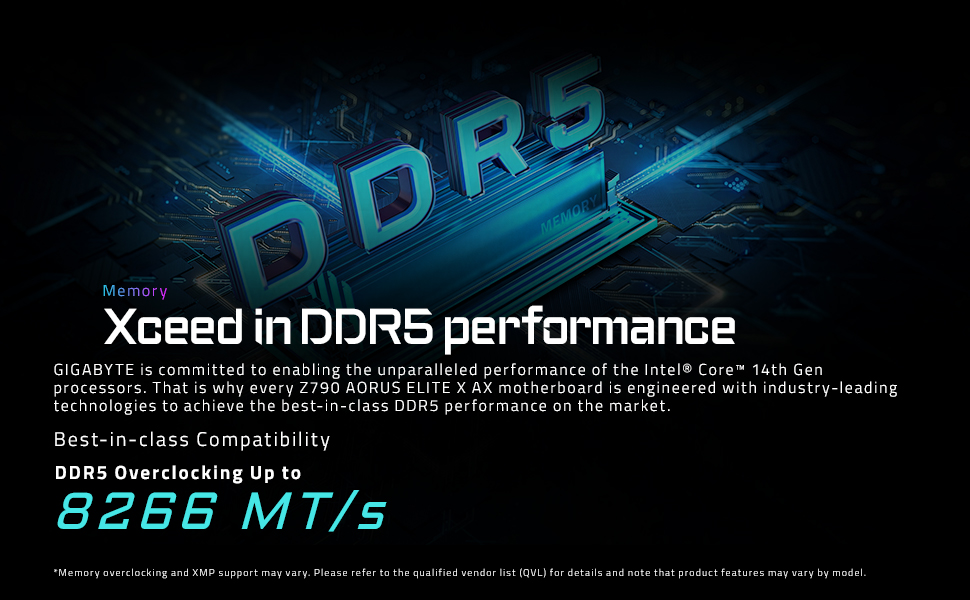
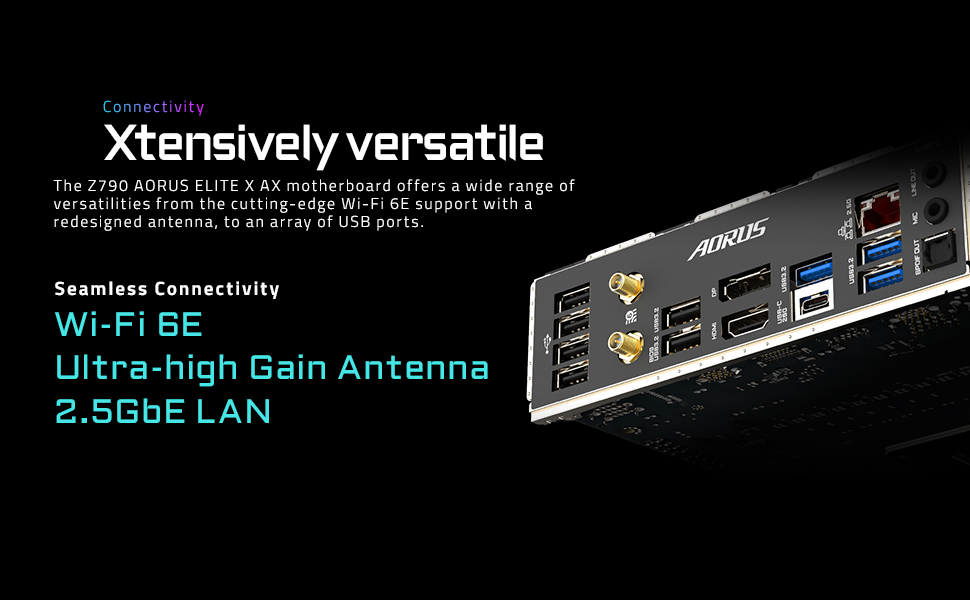
Intel LGA 1700 Socket: Supports 13th and 12th Gen Intel Core Series processors. DDR5 compatible: 4 x SMD DIMM with XMP 3.0 memory module. Control power support: Dual 16+1+2 phase digital VRM solution with 70A Power Stage Advanced thermal design: M.2 Thermal Guard III, fully covered MOSFET heatsinks, PCIe Ultra Armor durable, 60cm - Next-gen PCB connectivity: SMD PCIe 5.0, 4 x PCIe 4.0 x4 M.2, USB 3.0 .2 Gen 2 x2 Type-C EZ-Latch: PCIe 5.0 EZ-Latch with quick release and screwless design Fast network: 2.5GbE LAN, Intel WiFi 6E 802.11ax, 2T2R and BT. 5 with AOR. US Antenna Dynamic Audio: High-end Audio Capacitor, Audiophile WIMA Capacitors Fine tuning Features: RGB Fusion 2.0, supports addressable LED and RGB strips, Smart Fan 6, Q-Flash Plus Update BIOS without installing the processor, memory and GPU. Take the throne of the game with the Z790 AORUS ELITE AX. The Z790 AORUS ELITE AX supports 13th and 12th Gen Intel Core processors for unmatched performance. Unleash your gaming potential with GIGABYTE Z790 motherboards. GIGABYTE Z790 motherboards come with an improved power design, high-quality storage standards, and exceptional connectivity that allows you to optimize your performance. Claim what is yours. Review: No issues so far - Running smooth with intel gen 13 i5 no issues so far.. Review: Gigabyte UEFI bios settings is easy to use - The PBC and heat sink materials are good.


| ASIN | B0BH9DXY38 |
| Are Batteries Included | No |
| Best Sellers Rank | #15,030 in Computers ( See Top 100 in Computers ) #86 in Motherboards |
| Brand | Gigabyte |
| Connectivity Type | Wi-Fi |
| Customer Reviews | 4.4 4.4 out of 5 stars (3,102) |
| Date First Available | 17 November 2022 |
| Form Factor | ATX files. |
| Graphics Card Interface | PCI Express |
| Item Weight | 1.97 Kilograms |
| Item model number | Z790 AORUS ELITE AX |
| Manufacturer | Gigabyte |
| Maximum Memory Supported | 128 GB |
| Memory Clock Speed | 7600 MHz |
| Memory Technology | DDR5 |
| Number of Ethernet Ports | 2 |
| Number of USB 2.0 Ports | 2 |
| Processor Socket | LGA 1700 |
| Processor Type | Core i7 |
| Product Dimensions | 33.48 x 26.97 x 7.98 cm; 1.97 kg |
| Series | GIGABYTE Z790 AORUS Elite AX |
| Wireless Type | 802.11ax |
A**D
No issues so far
Running smooth with intel gen 13 i5 no issues so far..
A**I
Gigabyte UEFI bios settings is easy to use
The PBC and heat sink materials are good.
R**R
This Gigabyte Z790 UD AC version motherboard with 6 PCI-E slots has ~200+ reviews, while the Gigabyte Z790 UD AX version with one less PCI-E slot has only ~65 reviews. Both motherboards apparently released at the same time, but with AX only have a more recent wireless chipset. I would say, most people desire more PCI(-E) slots than anything else or any other feature, as quite obviously, motherboard manufacturers likely dislike motherboards being easily upgraded. I found, almost all motherboards on the market to date using-up all of the numerous PCI-E port/lanes with mostly undesirable hardware features, with most features commonly being out-dated within a year or so. Although the Gigabyte UD AC version has the extra PCI-E slot near the graphics 16x's slot and mostly being covered/unused by the primary add-in graphics card, if ever falling back to CPU integrated graphics, the port next to the primary 16x's slot would then be accessible. The extra slot would likely be usable either prior to somebody purchasing a graphics card, or later within the board's lifetime. One significant downside, most of the PCI-E slots are only 1x's speed. PROS 1) Motherboard provides several extra PCI-E slots, except minus the PCI-E slot #2 if using a typical large size discrete graphics card within slot #1. CONS 1) Very tight or little room for plugging in cables into the SATA side ports! 2) Motherboard pins are likely a larger diameter than typical motherboard pins, more durable however plugging in connectors will be very difficult or tight fitting. Using a thick coating of De-Oxit oil helped a little with tight fitting adapters/plugs. 3) Most CPUs of this period lack CSM integrated graphics, only EFI/UEFI graphics, so the BIOS/EFI CSM option will constantly revert to disabled until adding a discrete PCI-E graphics card with CSM/EFI capability. 4) Several other Gigabyte AMI BIOS/EFI options tend to be elusive and mysteriously toggling on and off. The Gigabyte AMI BIOS/EFI has a really dumb upfront menu called "Tweak" menu. No options for disabling NVME storage devices, for hiding while installing operating systems on other storage drives. 5) BIG PROBLEM, the onboard motherboard Ethernet RTL8125 is loosing/dropping/reverting it's MAC address to 00:00:00:00:00:00 after random periods of linked network usage and occurring upon warm reboots! Gigabyte support claims there's nothing wrong, returned the board and had the RTL8125 chip replaced, upon return Support claimed documentation did not cite chip replacement! And continues denying a problem. Regardless, just purchased a separate/discrete (Intel 2.5Gbps) Ethernet adapter and the unit is performing excellently about two months later, and as long as the onboard RTL8125 is not physically connected to the Ethernet network via cable, MAC address remains assigned/default/stable. Loss of RTL8125 MAC address could be due to non-standard TCP/IP packets, or something with the firmware or drivers, occurred both using explicitly either Linux and Windows though. Again, regardless, likely happier with separate Ethernet card, due to the amount of network usage here. Workaround, pull the electrical power cord, then cold boot, RTL8125 MAC address returns to original OEM address. Likely not heat related, has a 120mm fan pointed directly at the RTL8125 chip, so heat is likely ruled-out completely, and laser thermometer reads chip temperature well within OEM specified operational limits. Seems the manufacturer is replacing the chips upon RMA, without documenting, however I strongly believe this is firmware and/or possibly upper level driver software created, due to a recent driver update release, possibly including a firmware change or update. WITHOUT A MAC ADDRESS, WakeonLAN will require using 00:00:00:00:00:00 address for broadcast wake-up packet, and is likely a minor security flaw. Usually I see these errors, within my past 20 years with Intel, with Ethernet hardware failing, sometimes they limp along like this, but really believe, so far, this is software induced due to multiple chip model numbers being affected. INSTALLING WINDOWS 7 FOR LICENSE MIGRATION 1) If the CPU you're using does not have CSM/BIOS integrated graphics/display (eg. Intel Core i7-12700K does not have CSM inigrated graphics, only EFI graphics!), will need an add-in PCI-E CSM/BIOS compatible graphics/display card. And to be able to enable the BIOS/EFI CSM boot option/capabilty, will also need a more recent video card capable of UEFI/CSM boot capabilities, as the Windows 7 installation may hang on a more recent CSM/UEFI graphics/displays. For example, I have two discrete PCI-E graphics/display add-in cards. One being EVGA nVidia GTX 670 (used on Windows XP and Windows 7) and the other a more recent Intel Arc 750 for Windows 10 and later. The Intel Arc would allow viewing the BIOS/EFI settings and enabling CSM boot options, but would either hang or freeze during the initial Windows 7 boot CD install. (eg. Frozen or endless pulsating color Windows icon.) Installed my old nVidia GTX 670 PCI-E graphics card with BIOS/EFI CSM still activated, I was able to boot further into the Windows install CD process. NOTE: Turn-off CPU integrated graphics, else graphics/display will be corrupted/blurry and the Windows 7 not start at all! 2) Once you've rebooted approximately a million times, finally getting the right incantation for enabling CSM booting and Windows 7 CD-ROM is also now booting, will need a PS/2 mouse (or keyboard), as Windows 7 install CD (and operating system) will deactivate/drop USB keyboard/mouse hardware due to incompatible motherboard USB port/hub BIOS/EFI drivers. Having a PS/2 plugged in also averts the long undesirable boot delay! Windows 7 install CD should now be starting along with the on-screen keyboard if using a PS/2 mouse. ac 3) After installing Windows 7, the following reboot(s) the motherboard BIOS/EFI may not automatically find the boot partition on the drive, and I happened to have The rEFInd Boot Manager installed on one of my USB drives and using BIOS/EFI F12 key/boot options during BIOS/EFI starting, the rEFInd boot manager will readily detect the Windows 7 100MB FAT partition, and allow booting the installed Windows 7 installation. 4) Once Windows 7 install has booted and running, first install KB4474419 for fixing SHA1/SHA2 driver signing, and subsequently download the Windows 7 RTL8125 2.5GB ethernet network adapter driver from the RealTek website. I happened to also deactivate driver signing via bcdedit and gpedit, but likely not required. 5) Internet should automatically start working using DHCP configuration, with subsequently being able to readily activate your Windows 7 operating system. Should also be able to upgrade over the Windows 7 install, with probably more preferably using an older version of Windows 10 install CDs. However, still resulted with no Windows 10 license error codes. Possibly I first need to upgrade to Windows 8, using the included Windows 8 key only for re-provisioning the motherboard/licensing. But it is very doubtful. WINDOWS 10/11 UPGRADE LEGALITIES FUNNY. I have a valid Windows 7 Professional RETAIL license purchased (just prior to microsoft.com store being standardized, but purchased from Microsoft) and used on a Gigabyte Z77UP7 motherboard, now after successfully installing and properly activating Windows 7 on my Gigabyte Z790 UD motherboard, subsequently performing an upgrade over Windows 7 with an older Windows 10 v1903 CD, I still get an error during activation, 0xC004F213! Subsequent license key changes result in my usual 0x803fa067 hex error code. Likely something about not having a license! This is bate and switch! There is a scenario where the official Windows 7 license is migrated to a digital license being physically attached to the motherboard, making installing Windows 10/11 with the digital license supposedly not possible. However, the official Windows 7 retail license should still be transferable to other motherboards. My first error was another hex error, associated with not having a license, now after all this, I get another different hex error code. After looking over my notes, I see possibly skipped first upgrading to Windows 8 and using the Window 8 license key only for the license/motherboard re-provisioning. I doubt upgrading first with Windows 8 will resolve this, as I think Microsoft intentionally forcing all official retail licenses to be attached to the motherboard, regardless of whether or not the retail versions boost of such feature. Nothing but headaches with Windows, and Microsoft wants another $100-200 for a newer key. (Always been really funny how users owning multiple license keys, cannot easily manage or keep track of their keys.)
M**L
Excelente Motherboard!! para su precio es de las mejores opciones Z790
E**H
This ATX motherboard has excellent features for its price. I am running an i7 13700k , with a 3070ti, 16 GB of 5600MT/s DDR5. Overall- Twin 16+1+1 Phases Digital VRM, with 2 x8 pin CPU power supply. Which is perfect for overclocking I cannot find another reputable branded motherboard that had both Wi-Fi and Bluetooth and 18 VRM for less than 450$ CAD not to mention DDR5 as well. The heat sinks are of solid, matte heavy aluminum, making the board looks sleek and of high quality. The wifi is 802.11ac, WIFI 5. I am getting 238 Mbps on a 1000Mbps network, about 20 feet from the modem. Bluetooth 4.2. There is a programable "CMOS" button and Bios Flash button soldered to the board. Some issues- I have had issues getting the system to post with XMP enabled on stock settings (5600), I'm thinking that with later BIOS versions the issues will be fixed as I made sure to select compatible RAM from manufacturarers website. Currently am running at 4800, which is the native speed for the motherboard, but not a big deal for the time being, will update my review if this changes. I personally would like to have more than 6 fan headers, and a separate CPU water pump header, not one that doubles as a fan header, which takes you down to 5. Connectivity- 1 x USB Type-C port on the back panel, with USB 3.2 Gen 2x2 support 1 x USB Type-C port with USB 3.2 Gen 1 support 1 x USB 3.2 Gen 2 Type-A port, 6 x USB 3.2 Gen 1 ports, 8 x USB 2.0/1.1 ports There is a 5.0 PCie x16 slot, and 1x 4.0 PCIe x16 slot and 2x 3.0 Pcie x16 slots and two PCie x4 slots. 4 DIMM Dual Channel DDR5 Ram, supporting up to 128gb, at MT ratings up to 7200Hz. 3x PCIe 4.0 M.2 slots, one with a built in heatsink. Features a "Display Port" and HDMI port on the back side of the motherboard. Has 6 Fan headers one doubling as a water pump header, 4 LED headers, two are addressable. There is a 3 x 3.5mm MIC/LINE IN/LINE OUT ports. PS/2 mouse port.
M**R
Well it is working fine so far , can get you going with the cheapest price yet no compromise over VRM. But lacks some stuff I was used too like debug panel , SPDIF/out. wireless is a + , didnt have it before. Some printing are so tiny and not so clear where you connect the power switch and leds. It just gave me a hard time as I have old GPU and it wouldnt pick up signal ang the vga led was always on. I paniced but searched the forums and it was a BIOS thing to adjust took me a while though as I had to order a DP Adaptor to HDMI. Yes beware! you need a DP Cable or Adapter
I**.
Packing was great , all components are there , thanks seller delta computer supplies
Trustpilot
3 days ago
4 days ago