
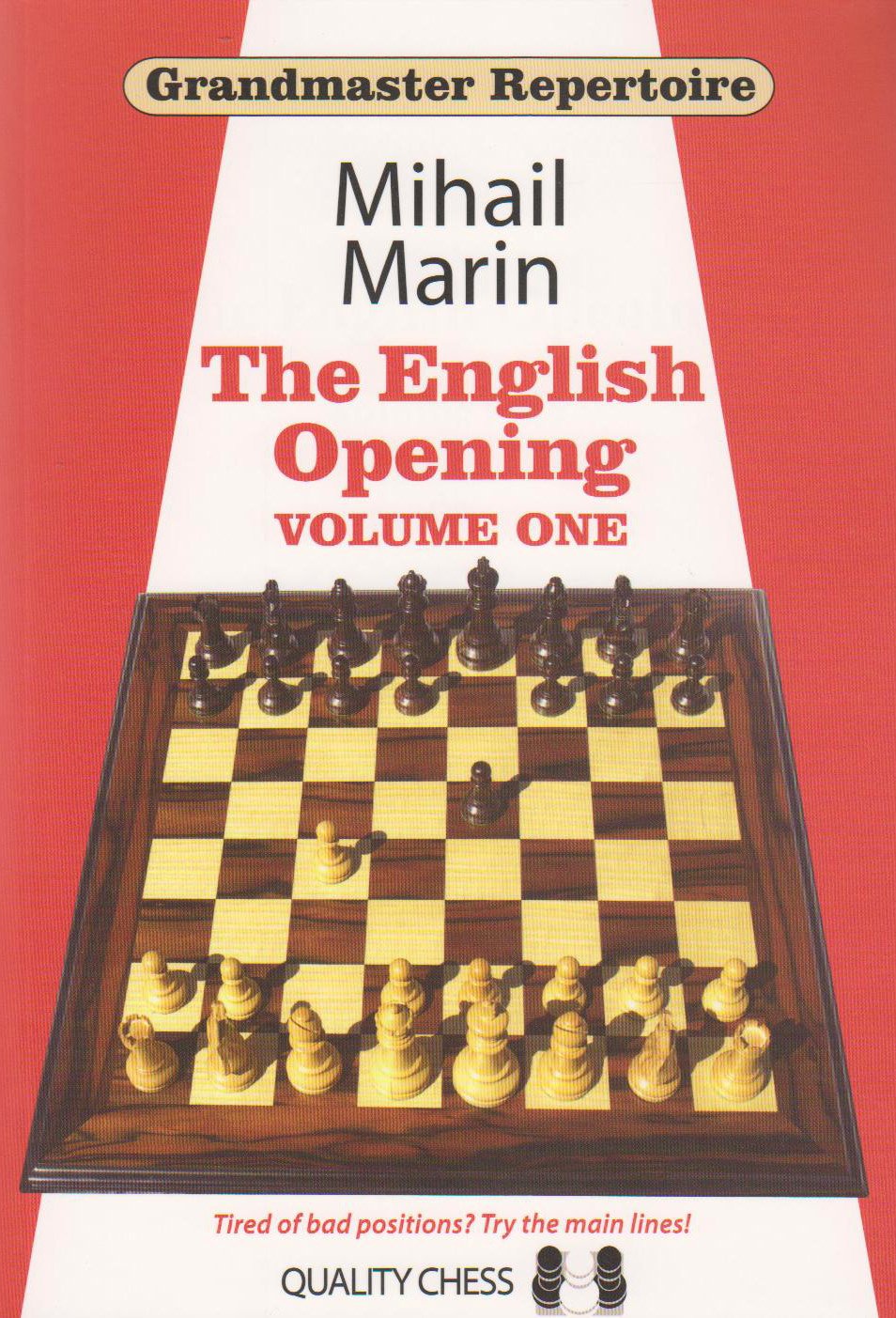
Grandmaster Repertoire 3 [Marin, Mihail] on desertcart.com. *FREE* shipping on qualifying offers. Grandmaster Repertoire 3 Review: English with g3 vs 1...e5 - Despite Marin's formidable reputation as a chess writer, this is my first book by this author. I can now say that his fame is well-deserved. Marin writes with great clarity and thoroughness, and his understanding of the subject is terrific. I give this book my highest recommendation, but read on to see if this masterpiece is appropriate for you. Let me start with some notes about the opening system that is the focus of Marin's book. I play the English with g3 regularly, and I am quite satisfied with this opening. This approach to the English is rather positional, with most lines achieving small but long-term pressure on the Black position. In general, there is a lack of early contact, which avoids simplification and results in rich middlegames where both sides have a wide range of possible plans. Given the lack of tactical melee in the opening, the play normally relies on understanding typical structures, avoiding the memorization of variations to a large degree. This same claim is often made by the authors of opening manuals to lure club players, but I can guarantee that it is true in this case. My main source for this opening so far has been Kosten's The Dynamic English : The aggresive player's guide to a traditional chess opening , which has aged remarkably well. It is also critical to point out that the English with g3 as interpreted by Kosten and Marin is a strategically ambitious system, that strives to achieve a significant positional advantage against every Black reply. As a result, the White player must master a large number of pawn structures and associated plans, with plenty of examples of subtle play and hypermodern counterattacks against the Black center. To be frank, I have found this difficult to digest, despite some hard work looking for related games and multiple readings Kosten's book. I cannot recommend the English with g3 as a quick fix of your repertoire with White, as Black has many choices and White has to avoid many positional pitfalls to reach a good position. I learnt to play the Colle/Stonewall Attack much faster for example, and I sometimes miss all those rapid King side attacks against unprepared opponents. Here is where Marin's book reveals itself as a phenomenal contribution. There are two things that really shine in Marin's writing. First, he bothers to explain with words many moves that are difficult to understand for the average club player. Second, he often examines every legal (and sensible) reply by Black, which gives me great confidence in his choices and makes it very clear how to utilize the general ideas to obtain a concrete advantage. Given the subject matter, such a presentation is priceless. My heavy use in the last two weeks since I received this volume has lead me to many new insights in difficult variations that I could never understand from Kosten alone. To go over the contents more in detail, this volume focuses on 1...e5. It is divided in 8 main parts and 33 chapters. The first two parts explore the early Bishop developments Bc5 and Bb4. In the former, I was pleasantly surprised by the delay of e3 and a3, which I never found fully convincing in Kosten's. Marin's d3 favors faster development and it is probably easier to play. The next part focuses on the Botvinnik, and Marin does an excellent job explaining this system. The Botvinnik is the cornerstone of the repertoire, being the primary way to tackle King's Indian structures with e5, and it is far more difficult to play than most players think. Next comes the Reserve Sicilian, where Marin chooses 5. Nc3. My results with Kosten's Nf3 are so good that I haven't examined this part yet. The remaining material looks at the Keres, the accelerated Keres and some minor lines. I was eagerly waiting for Marin's take on the accelerated Keres, which featured as a refutation of the English with g3 in Palliser's Dangerous Weapons: Flank Openings: Dazzle Your Opponents! . Marin's logical and incredibly thorough analysis of these lines is well worth the price of the whole book. I also would like to mention the production qualities of this outstanding book. It is simply a pleasure to stare at the pages, which employ a very readable two-column layout in a pleasant serif font. Main lines and variations are always easy to distinguish, and no page feels crammed or underutilized. Almost every page has two or three diagrams, and the use of slightly smaller variation diagrams is a very nice touch. Overall, Quality Chess fully honors its own name with this edition. Review: desertcart info and picture are deceptive ... but Marin is still a five star author (review updated April 2011) - This review is to provide the information that the desertcart description does not accurately describe the contents of the book. The book is on the English opening, but it is part I of a two part series on the English by the author. The first book is strictly on the response 1.c4 e5 and nothing else. The description does not include this very important information. In addition, the picture on the desertcart ommitted the words Part 1 under the title. Why is this important? First, I'm most interested in transpositions from openings starting with 1.Nf3. Basically, in this situation, the response e5 is no longer a consideration. Now, Marin in his foreward starts to make an argument that 1.Nf3 is flawed because of the response 1...d5 followed by a slav type of setup. He's not providing the hard evidence for that opinion until part 2 of the book. Second, I thought I was purchasing an entire volume and feel a bit cheated that now I need to buy a whole additional volume to get full coverage. At lease after reading this review, you (the potential buyer) can decide for yourself whether you want to do that. Few other notes .... I've really just begun reading the book, but I can already tell that the volume is written in Marin's same high quality, clear style with emphasis on education rather than what I'll call "variation regurgitation". I am a bit suspicious on how exhaustive the book is but I'll update my review when I complete the read. One thing that I'm sure of is that I'll understand the English Opening considerably better than I do now. Also, the book is presented variation based (instead of emphasis on illustrative games). I don't take a hard position like others on this topic because I have a tendency to understand openings better from complete games. This is true because you can actually see how opening ideas manifest themselves in middlegame plans and result in endgame consequences. The main drawback is that not all variations are exhaustively covered and very problematic if you're trying to play correspondence chess or prepare for a high caliber opponent. If you look at my other reviews, I rarely can enough good things about Marin as an author. This book is slightly different in that he does not provide as much critical and in-depth analysis on legitimate alternatives to mainstream responses. This in my opinion is the difference between a book targeted for the middle of the road club player and someone aiming for the master level skill level. UPDATE April2011: I now own all three of Marin's book and very much look forward to putting his analyses to the test. As noted by one of the comments to this review, there are in fact THREE volumes to this set devoted to the English Opening. The volumes in general do not overlap with responses to 1.c4 e5 in volume one as already noted in this review. The second volume handles most other responses but primarily addresses 1.c4 Nf6 leading to a variety of setups such as King's Indian, Queen's Indian, Reti/English setups (amongst others). It should be noted that the response to the Dutch is rather light with references to Volume 1 as a transposition. The third and final volume deals with the symmetrical English. In my opinion, this is the toughest material because it's so difficult to gain any appreciable advantage as white in the symmetrical English. Players that know what they're doing, understand the nuances well, but going over the material, it's safe to say that the finesses required a lot of work and probably an advanced understanding of chess. In general, Marin is not afraid of the exchange sacrifice leading to an advantage. Understanding the benefits and potential of the exchange sacrifice is highly advanced for two reasons: first, often the advantage is temporal and requires excellent skill in piece coordination (not basic by any means), second, for situations where the advantage is structural requires a great skill in technique. What this illustrates is that Marin is attempting to reach an audience from advanced club player to GM. Overall, the books are excellent and require a great deal of attention to understand the nuances of the opening. One observation that I've made is that Marin is so talented at providing narrative assessment of the positions that the sections are highly readable (mostly without the use of a chess set because Analysis diagrams are frequent). The one problem with the material (and not the author) is that the subtle difference between the play really requires expert/master understanding of the positional transitions. Finally, Marin definitely prefers the English (c4) over a Reti (Nf3) on the first move because Nf3 doesn't allow the Botvinnik setup against the King's Indian (type setups). I can appreciate this problem because the alternative if you play Nf3 is to either accept quick equality or play something like the Classical King's Indian as white. I can say that playing the classical KI as white against strong players is tough because the King side attack for black can be aggressive and difficult to defend.
| Best Sellers Rank | #2,490,185 in Books ( See Top 100 in Books ) #2,555 in Chess (Books) |
| Customer Reviews | 4.7 4.7 out of 5 stars (54) |
| Dimensions | 6 x 1.2 x 9 inches |
| Edition | First Edition |
| ISBN-10 | 1906552045 |
| ISBN-13 | 978-1906552046 |
| Item Weight | 1.99 pounds |
| Language | English |
| Print length | 480 pages |
| Publication date | September 1, 2009 |
| Publisher | Quality Chess UK Ltd |
F**3
English with g3 vs 1...e5
Despite Marin's formidable reputation as a chess writer, this is my first book by this author. I can now say that his fame is well-deserved. Marin writes with great clarity and thoroughness, and his understanding of the subject is terrific. I give this book my highest recommendation, but read on to see if this masterpiece is appropriate for you. Let me start with some notes about the opening system that is the focus of Marin's book. I play the English with g3 regularly, and I am quite satisfied with this opening. This approach to the English is rather positional, with most lines achieving small but long-term pressure on the Black position. In general, there is a lack of early contact, which avoids simplification and results in rich middlegames where both sides have a wide range of possible plans. Given the lack of tactical melee in the opening, the play normally relies on understanding typical structures, avoiding the memorization of variations to a large degree. This same claim is often made by the authors of opening manuals to lure club players, but I can guarantee that it is true in this case. My main source for this opening so far has been Kosten's The Dynamic English : The aggresive player's guide to a traditional chess opening , which has aged remarkably well. It is also critical to point out that the English with g3 as interpreted by Kosten and Marin is a strategically ambitious system, that strives to achieve a significant positional advantage against every Black reply. As a result, the White player must master a large number of pawn structures and associated plans, with plenty of examples of subtle play and hypermodern counterattacks against the Black center. To be frank, I have found this difficult to digest, despite some hard work looking for related games and multiple readings Kosten's book. I cannot recommend the English with g3 as a quick fix of your repertoire with White, as Black has many choices and White has to avoid many positional pitfalls to reach a good position. I learnt to play the Colle/Stonewall Attack much faster for example, and I sometimes miss all those rapid King side attacks against unprepared opponents. Here is where Marin's book reveals itself as a phenomenal contribution. There are two things that really shine in Marin's writing. First, he bothers to explain with words many moves that are difficult to understand for the average club player. Second, he often examines every legal (and sensible) reply by Black, which gives me great confidence in his choices and makes it very clear how to utilize the general ideas to obtain a concrete advantage. Given the subject matter, such a presentation is priceless. My heavy use in the last two weeks since I received this volume has lead me to many new insights in difficult variations that I could never understand from Kosten alone. To go over the contents more in detail, this volume focuses on 1...e5. It is divided in 8 main parts and 33 chapters. The first two parts explore the early Bishop developments Bc5 and Bb4. In the former, I was pleasantly surprised by the delay of e3 and a3, which I never found fully convincing in Kosten's. Marin's d3 favors faster development and it is probably easier to play. The next part focuses on the Botvinnik, and Marin does an excellent job explaining this system. The Botvinnik is the cornerstone of the repertoire, being the primary way to tackle King's Indian structures with e5, and it is far more difficult to play than most players think. Next comes the Reserve Sicilian, where Marin chooses 5. Nc3. My results with Kosten's Nf3 are so good that I haven't examined this part yet. The remaining material looks at the Keres, the accelerated Keres and some minor lines. I was eagerly waiting for Marin's take on the accelerated Keres, which featured as a refutation of the English with g3 in Palliser's Dangerous Weapons: Flank Openings: Dazzle Your Opponents! . Marin's logical and incredibly thorough analysis of these lines is well worth the price of the whole book. I also would like to mention the production qualities of this outstanding book. It is simply a pleasure to stare at the pages, which employ a very readable two-column layout in a pleasant serif font. Main lines and variations are always easy to distinguish, and no page feels crammed or underutilized. Almost every page has two or three diagrams, and the use of slightly smaller variation diagrams is a very nice touch. Overall, Quality Chess fully honors its own name with this edition.
I**D
Amazon info and picture are deceptive ... but Marin is still a five star author (review updated April 2011)
This review is to provide the information that the Amazon description does not accurately describe the contents of the book. The book is on the English opening, but it is part I of a two part series on the English by the author. The first book is strictly on the response 1.c4 e5 and nothing else. The description does not include this very important information. In addition, the picture on the Amazon ommitted the words Part 1 under the title. Why is this important? First, I'm most interested in transpositions from openings starting with 1.Nf3. Basically, in this situation, the response e5 is no longer a consideration. Now, Marin in his foreward starts to make an argument that 1.Nf3 is flawed because of the response 1...d5 followed by a slav type of setup. He's not providing the hard evidence for that opinion until part 2 of the book. Second, I thought I was purchasing an entire volume and feel a bit cheated that now I need to buy a whole additional volume to get full coverage. At lease after reading this review, you (the potential buyer) can decide for yourself whether you want to do that. Few other notes .... I've really just begun reading the book, but I can already tell that the volume is written in Marin's same high quality, clear style with emphasis on education rather than what I'll call "variation regurgitation". I am a bit suspicious on how exhaustive the book is but I'll update my review when I complete the read. One thing that I'm sure of is that I'll understand the English Opening considerably better than I do now. Also, the book is presented variation based (instead of emphasis on illustrative games). I don't take a hard position like others on this topic because I have a tendency to understand openings better from complete games. This is true because you can actually see how opening ideas manifest themselves in middlegame plans and result in endgame consequences. The main drawback is that not all variations are exhaustively covered and very problematic if you're trying to play correspondence chess or prepare for a high caliber opponent. If you look at my other reviews, I rarely can enough good things about Marin as an author. This book is slightly different in that he does not provide as much critical and in-depth analysis on legitimate alternatives to mainstream responses. This in my opinion is the difference between a book targeted for the middle of the road club player and someone aiming for the master level skill level. UPDATE April2011: I now own all three of Marin's book and very much look forward to putting his analyses to the test. As noted by one of the comments to this review, there are in fact THREE volumes to this set devoted to the English Opening. The volumes in general do not overlap with responses to 1.c4 e5 in volume one as already noted in this review. The second volume handles most other responses but primarily addresses 1.c4 Nf6 leading to a variety of setups such as King's Indian, Queen's Indian, Reti/English setups (amongst others). It should be noted that the response to the Dutch is rather light with references to Volume 1 as a transposition. The third and final volume deals with the symmetrical English. In my opinion, this is the toughest material because it's so difficult to gain any appreciable advantage as white in the symmetrical English. Players that know what they're doing, understand the nuances well, but going over the material, it's safe to say that the finesses required a lot of work and probably an advanced understanding of chess. In general, Marin is not afraid of the exchange sacrifice leading to an advantage. Understanding the benefits and potential of the exchange sacrifice is highly advanced for two reasons: first, often the advantage is temporal and requires excellent skill in piece coordination (not basic by any means), second, for situations where the advantage is structural requires a great skill in technique. What this illustrates is that Marin is attempting to reach an audience from advanced club player to GM. Overall, the books are excellent and require a great deal of attention to understand the nuances of the opening. One observation that I've made is that Marin is so talented at providing narrative assessment of the positions that the sections are highly readable (mostly without the use of a chess set because Analysis diagrams are frequent). The one problem with the material (and not the author) is that the subtle difference between the play really requires expert/master understanding of the positional transitions. Finally, Marin definitely prefers the English (c4) over a Reti (Nf3) on the first move because Nf3 doesn't allow the Botvinnik setup against the King's Indian (type setups). I can appreciate this problem because the alternative if you play Nf3 is to either accept quick equality or play something like the Classical King's Indian as white. I can say that playing the classical KI as white against strong players is tough because the King side attack for black can be aggressive and difficult to defend.
M**I
Along the road, I met a teacher
GM Mihail Marin is perhaps the finest chess author and instructor whom I have ever had the pleasure of discovering. This initial volume on The English is the very best that I have studied. The gentleman and his analysis is to be trusted. Of course, one must commit effort, but if you love The English as I do, your time will be well rewarded with an understanding of the nuances of the opening and maybe even with a full point in your games as white, and an understanding of what may be the best lines for black. I would also highly recommend Mr. Marin's "Beating the Open Games" and "A Spanish Repetoire for Black." They have served me well.
M**S
Absolutely worth buying!
Very eazy to understand, shows every way how you can play this opening. Good both for beginers and advanced players. Shows not only the moves you can play but also IDEAS on how you can play in the future without memorising every move. Also a lot of illustrations of every key positions.
D**E
One of the best written chess books I have ever read
I am not going to repeat what has already been written about this book other than to say it is one of the finest written chess books I have ever read. If volume 2, which is supposed to cover all the responses to C4 other than E5, is written with the same clarity and detail as the prose in this book, one will have the best grounding in the English opening short of taking lessons from the author.
S**L
Four Stars
I got waht I expected.Not for lower rated player
T**D
Deep Analysis of c4, e5
Exhaustive coverage of 1. c4, e5 lines, the most frequently encountered response to 1. c4. Don't think you know the English Opening without the analysis in this book! Have not ordered the other two volumes, to round out this author's work on the English, but this one is so good, I will eventually have them all.
K**R
A very analytical and free from computers analysis ( it does not mean that the authors have not taken help from computers) as many lines are different from Computer suggestions. The book is written for Grandmasters but is equally helpful for all players other than beginners. A must book for English Opening players.
B**E
As a 1500 ish player I wondered if a book with such a title (grandmaster ) would be over my head . I tried it out for three weeks from the library and loved it . I've been using my iPad with an opening app to play thru the moves . This is better than two boards . The ideas so far in book (140 ) pages in are helping my game a lot . Even when I get out of the lines covered I am left with a pretty clear idea of where my advantages lie . Very glad I bought this book .
M**L
Ein Top-Buch ! Sehr ausführliche Darstellung mit Varianten bis tief in das Mittelspiel oder gar Endspiel. Der Schwerpunkt des Buches liegt aber nicht in den konkreten Zugfolgen selber, sondern in der Vermittlung der typischen strategischen und taktischen Ideen der Eröffnung (erfolgt in Textform). Besonders wertvoll ist, dass auch in den Nebenvarianten zu jeder Zugfolge ausführliche Erklärungen in Textform gegeben werden. Reihenweise gibt der Autor Neuerungen an, die bisher nicht in der Turnierpraxis vorkamen. Ich habe mal ein paar Varianten mit Houdini geprüft, ich habe nur einen Fehler gefunden, wo der Autor eine andere Analyse zitiert. Ich habe die englische Ausgabe gelesen, Schulenglisch reicht dafür, ansonsten kann man ja mal ein Wort nachschlagen. Das Buch ist ein Repertoire-Buch, es werden nicht alle weißen Aufbauformen behandelt. An einigen Stellen gibt der Autor Alternativen an und man kann nach Geschmack wählen. Der Autor erklärt warum seine Wahl auf diesen oder jenen Aufbau gefallen ist und was er als kritische Erwiderung auf die anderen weißen Aufbaumöglichkeiten ansieht. Auf den gewählten weißen Aufbau werden aber so ziemlich alle schwarzen Aufbaumöglichkeiten dargestellt. Englisch ist sicher keine Eröffnung für Anfänger, die Eröffnung ist reich an strategischen und taktischen Ideen, der erste Figurenkontakt tritt manchmal erst ab dem Zug 15 oder später ein. Daher würde ich als Adressatenkreis Spieler ab DWZ 1800 ansetzen. Man kann das Buch wohl auch mit geringerer Spielstärke lesen und die Einschätzung des Autors nachvollziehen, aber die Frage ist, ob man die Ideen dann auch in der Praxis so umsetzen kann. Dass einige Großmeister behaupten sie würden das Buch benutzen klingt mir glaubhaft, da die Darstellungstiefe der Varianten sehr detailliert ist und jede Menge Neuerungen angegeben werden.
R**E
This is another excellent book by M.Marin of opportunities and problems in the English opening [this one of 1c4..e5 variations] It deals with the Botvinnik System c4,g3,e4 , ,the Reversed Dragon [...e5...d5,] Keres Variation [.....e5.c6] the Karpov [...e5....Nc6...Nf6... Bc5]. and reversed Rossolimo [e5..Nc6...Nf6...Bb4] and some minor lines I have not finished this book ,it is over 400 pages. The ideas and moves are clearly explained and I would recommend it to any 1c4 player over 160 ECF For a shorter introduction I would recomend Kosten's Dynamic English
S**V
Mihail Marin est l'auteur le plus pédagogique que je connaisse. Cette série de livres de Quality Chess est vraiment excellente. L'auteur s'arrête au sortir de l'ouverture et des variantes avec pas mal de nouveautés et des explications très claires. Cette première série de 3 livres sur l'Anglaise aborde surtout 1. c4 e5 2. g3 qui est l'arme favorite moderne qui marche très bien. Beaucoup de théorie, mais les schémas et principes sont les mêmes. J'ai laissé 1. d4 et 1. Cf3 pour les parties rapides pour choisir 1. c4 pour les parties lentes. Amusant de voir que 1. Cf3 supprime pas mal de possibilités que 1. c4 permet notamment avec la structure en Triangle de Botvinnick contre les schémas Est-Indienne avec g6, particulièrement redoutable pour avoir battu des plus de 2000 elo avec ! A recommander, de même que les deux autres livres du même auteur.
Trustpilot
3 days ago
2 months ago