🧪 Calibrate like a pro — because your readings deserve lab-grade precision!
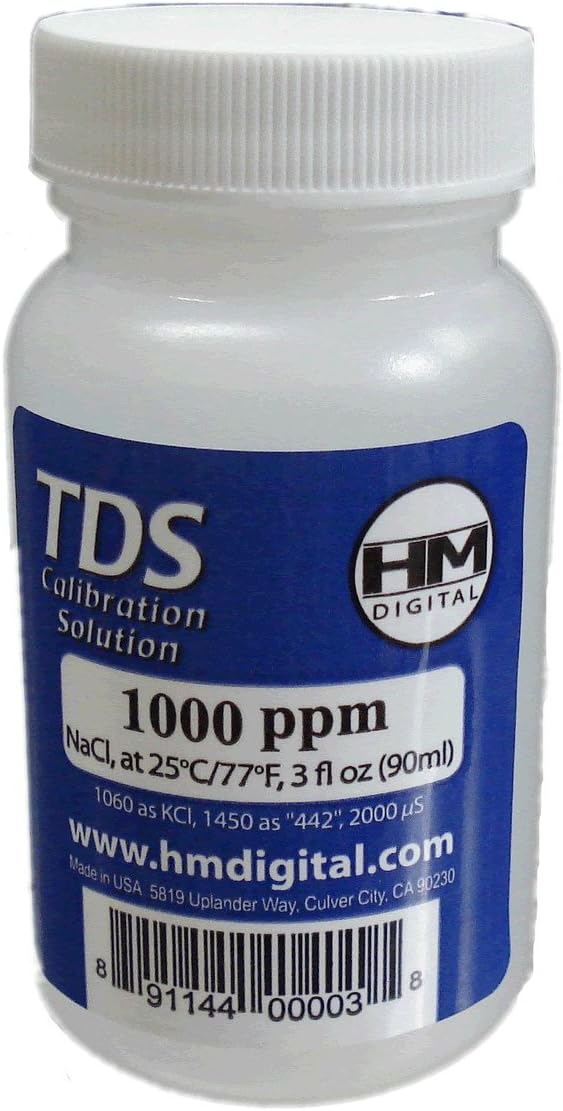
The HM Digital 1000ppm TDS Calibration Solution is a laboratory-quality, NIST-traceable liquid designed to recalibrate any brand of TDS or EC meter. Packaged in a lightweight, wide-mouth HDPE bottle sealed with a foam liner, it ensures easy, contamination-free use and reliable, professional-grade accuracy for water quality testing.
| ASIN | B001FD6WZ8 |
| Global Trade Identification Number | 00891144000038 |
| Item model number | 716170 |
| Manufacturer | HM Digital, Inc. |
| Product Dimensions | 3.3 x 8.38 x 3.3 cm; 90.72 g |
| UPC | 891144000038 |
A**R
Came on time and does as described if used as directed.
E**S
I use an EC meter to check the salinity level of nutrients for my indoor grow. This test liquid will check a meter for EC as well as PPM and it works well for that purpose. I prefer this over the packets you mix yourself because it's laboratory grade and made using pure RO water. So unless you have access to RO water, this it a better option then mixing your own. On that alone I can recommend this product for checking your meter's accuracy and recommend getting the 342 PPM solution as well, so you can test against a range. If you are interested in a little advice on using this product, read on. It does not take much to contaminate this liquid and throw off the accuracy. And yes, I realize the manufacturer states you can put the meter right into the wide mouth bottle, but IMO you take a chance on contaminating the test solution over time even if you rinse it in distilled water between uses. So you need to make sure you pour out what you need to test with, and not pour it back into the container. I use those small paper cups that you might use in a bathroom. They are inexpensive and good to have for calibration checking and also for holding samples of the water you are testing with your meter. If you use the same container all the time and don't rinse it well, it can build up salts in the form of solids that might raise the EC/PPM levels of the water you are testing. It's also a good idea to keep some distilled water around to rinse off your meter between uses and change that water often to avoid cross contamination. It may sound like overkill and a little paranoia on my part, but it really comes down to how accurate your readings need to be. In my case I want the readings to be be +/- maybe 2%. So if you take into account the accuracy of these meters, which is anywhere from a 2-5% deviation, having good calibration solution and a good process for keeping things uncontaminated ensures you are testing the meter without introduction a significant margin of error. As I mentioned this liquid will test for PPM levels as well as EC. I prefer using EC levels to measure salinity versus PPM which is just a mathematical equation (programmed into the meter) using EC, which is the base number. So measuring using EC is more accurate. Although for measuring drinking water levels and fish tank water, PPM is probably fine to use. Hope this helped some. The End
S**N
Hope it works cause no way to properly ensure how accurate it is unless taken to a hydroponics store to use professionals TDS testers and compare stores recommended tds calibration solution. I am trusting this solution and will continue to use. Plant food seems to be making the plants healthier so plant foods ppm/tds is must be good.
E**D
exellent
A**R
NÉCESSAIRE POUR LA CALIBRATION DE MON TDS METER, MESURES PRÉCISES ET FIABLES
Trustpilot
1 day ago
2 months ago