We remain fully operational. Our teams are working around the clock to ensure your deliveries continue safely.

DOWNLOAD THE APP


Customer Services
Copyright © 2025 Desertcart Holdings Limited
DOWNLOAD THE APP
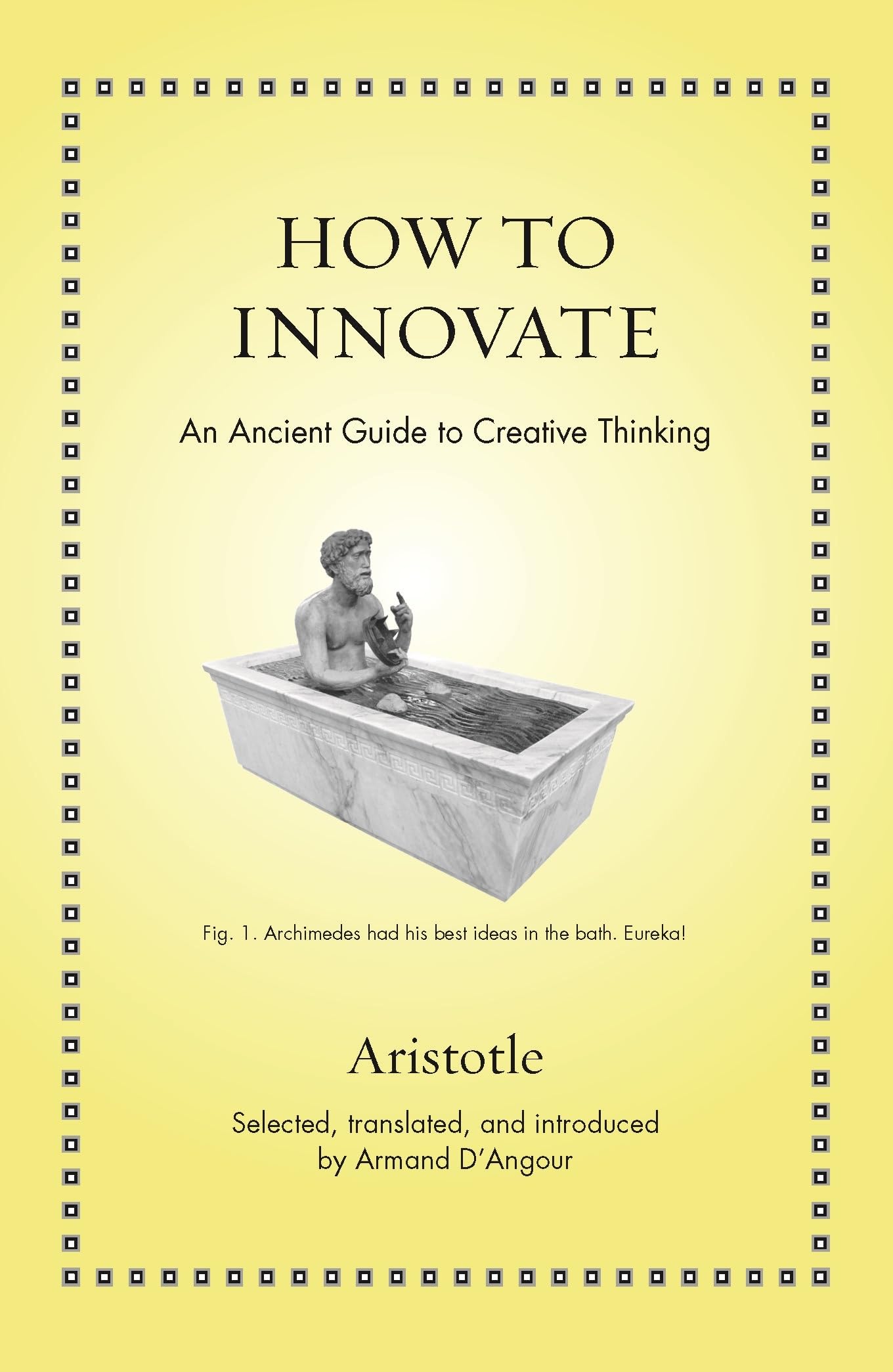
How to Innovate: An Ancient Guide to Creative Thinking (Ancient Wisdom for Modern Readers) [Aristotle, D'Angour, Armand] on desertcart.com. *FREE* shipping on qualifying offers. How to Innovate: An Ancient Guide to Creative Thinking (Ancient Wisdom for Modern Readers) Review: A lot of good ideas - Professor Armand D’Angour’s “How to Innovate” is part of a series of new translations of ancient texts of practical wisdom, which "Ancient Wisdom for Modern Readers" has made accessible to modern readers. Between 800 and 300 BCE, the Greeks innovated, changed, and improved virtually everything, including democracy and philosophy. They knew they had to alter the primitive notions of the past. ”How to Innovate” offers readers selections from the writings of some of these ancient Greeks. We read the story told by Vitruvius in the first century BCE about how Archimedes leaped from his bath and ran naked through the streets of Syracuse, yelling “Eureka,” the Greek for “I’ve got it,” I found a solution to the problem. We see how General Epaminondas changed his people’s battle strategy in 371 BCE and won the war and how King Dionysius invented new battle weapons in the early fourth century BCE. We also read an abridgment from Aristotle’s (383-322 BCE) book Physics 1, where he refutes the view of Parmenides that change is impossible. He states that change is necessary. It requires a situation or substance from which change can develop. In essence, the new depends on and builds upon the old. We also read a selection from Physics 2 in which he writes, “[I]t is clear that some occasions and some laws call for change. But from another point of view, great caution should be thought required…. The law has no power to secure obedience other than the power of habit, which needs time to take effect, so that a readiness to change from old to new laws weakens the power of the law. And even if we accept that the laws should be changed, should they be changed…by anybody who likes, or only by certain persons?” In short, while change is necessary, it cannot be rushed. People cannot change simply because someone wants them to change. It takes time to get people ready to do things differently. Aristotle’s understanding of change and the need to not implement it until people are ready to accept it was understood by the Hebrew Bible centuries before the birth of the great philosopher. The Bible needed to address the Israelites' understanding, behaviors, and habits when taught to them. The laws given at that time helped improve the people, but not enough. So the Bible includes multiple hints that the practices, such as slavery, sacrifices, the treatment of women, and superstitious ideas, need change. Therefore, the Bible is written obscurely to prompt readers to realize the need to change and improve their lives and society. Review: Waste of Time. - This book was book was written to sell; not to communicate a meaningful message. The book is TINY! It is not a full-size book. It's content is stretched to 133 pages, but many of these pages are nothing but ancient Greek transcript and ALL of the pages are only filled half-way with text. The book would be 50 pages or less if formatted properly. Many of the chapters are completely incoherent. The chapter on disruption is a meaningless story about a Spartan battle that fails to transition into any meaningful message. As a reader, I expect a story like this to transition into a takeaway message that will leave me with tactics to apply to my own work. This is not the case. The chapter about conditions of creation is the same; a story about a ship that is constructed to grand scale, but the story again fails to provide the reader anything to takeaway and apply to his/her own life. The story just ends. It's not even a good or interesting story. Also the author fails to specify when he is quoting Aristotle or writing from his own accord, often leaving the reader in a daze of confusion. Too bad this book can't help me innovate a way to get my time back.


| Best Sellers Rank | #427,317 in Books ( See Top 100 in Books ) #360 in Social Philosophy #648 in Ancient Greek & Roman Philosophy #1,170 in Creativity (Books) |
| Customer Reviews | 3.6 3.6 out of 5 stars (22) |
| Dimensions | 5 x 1 x 7 inches |
| ISBN-10 | 0691213739 |
| ISBN-13 | 978-0691213736 |
| Item Weight | 2.31 pounds |
| Language | English |
| Part of series | Ancient Wisdom for Modern Readers |
| Print length | 168 pages |
| Publication date | November 2, 2021 |
| Publisher | Princeton University Press |
I**N
A lot of good ideas
Professor Armand D’Angour’s “How to Innovate” is part of a series of new translations of ancient texts of practical wisdom, which "Ancient Wisdom for Modern Readers" has made accessible to modern readers. Between 800 and 300 BCE, the Greeks innovated, changed, and improved virtually everything, including democracy and philosophy. They knew they had to alter the primitive notions of the past. ”How to Innovate” offers readers selections from the writings of some of these ancient Greeks. We read the story told by Vitruvius in the first century BCE about how Archimedes leaped from his bath and ran naked through the streets of Syracuse, yelling “Eureka,” the Greek for “I’ve got it,” I found a solution to the problem. We see how General Epaminondas changed his people’s battle strategy in 371 BCE and won the war and how King Dionysius invented new battle weapons in the early fourth century BCE. We also read an abridgment from Aristotle’s (383-322 BCE) book Physics 1, where he refutes the view of Parmenides that change is impossible. He states that change is necessary. It requires a situation or substance from which change can develop. In essence, the new depends on and builds upon the old. We also read a selection from Physics 2 in which he writes, “[I]t is clear that some occasions and some laws call for change. But from another point of view, great caution should be thought required…. The law has no power to secure obedience other than the power of habit, which needs time to take effect, so that a readiness to change from old to new laws weakens the power of the law. And even if we accept that the laws should be changed, should they be changed…by anybody who likes, or only by certain persons?” In short, while change is necessary, it cannot be rushed. People cannot change simply because someone wants them to change. It takes time to get people ready to do things differently. Aristotle’s understanding of change and the need to not implement it until people are ready to accept it was understood by the Hebrew Bible centuries before the birth of the great philosopher. The Bible needed to address the Israelites' understanding, behaviors, and habits when taught to them. The laws given at that time helped improve the people, but not enough. So the Bible includes multiple hints that the practices, such as slavery, sacrifices, the treatment of women, and superstitious ideas, need change. Therefore, the Bible is written obscurely to prompt readers to realize the need to change and improve their lives and society.
S**N
Waste of Time.
This book was book was written to sell; not to communicate a meaningful message. The book is TINY! It is not a full-size book. It's content is stretched to 133 pages, but many of these pages are nothing but ancient Greek transcript and ALL of the pages are only filled half-way with text. The book would be 50 pages or less if formatted properly. Many of the chapters are completely incoherent. The chapter on disruption is a meaningless story about a Spartan battle that fails to transition into any meaningful message. As a reader, I expect a story like this to transition into a takeaway message that will leave me with tactics to apply to my own work. This is not the case. The chapter about conditions of creation is the same; a story about a ship that is constructed to grand scale, but the story again fails to provide the reader anything to takeaway and apply to his/her own life. The story just ends. It's not even a good or interesting story. Also the author fails to specify when he is quoting Aristotle or writing from his own accord, often leaving the reader in a daze of confusion. Too bad this book can't help me innovate a way to get my time back.
W**D
A brief introduction to timeless ideas
How to Innovate: An Ancient Guide to Creative Thinking by Aristotle and selected, translated, and introduced by Armand D’Angour would make a lovely gift for anyone in product development, new product design, or who simply wants to think more creatively about a service or a product. Armand D’Angour is professor of classics and a fellow of Jesus College at the University of Oxford. He is the author of Socrates in Love: The Making of a Philosopher and The Greeks and the New: Novelty in Ancient Greek Imagination and Experience. He has lectured on innovation at business schools and he managed a family manufacturing business before becoming a classics professor. He lives in London. He makes the point in his Introduction that “Despite largely conducting their lives within the bounds of a traditional agrarian society, the classical Greeks were responsible for creating a series of world-changing innovations.” These innovations included democracy, the alphabet, philosophy, logic, rhetoric, mathematical proof, rational medicine, coins, architectural canons, drama, lifelike sculpture, and competitive athletics. How did they do it? It was a question Aristotle (384-322 BCE) wondered about and analyzed the logic of change on different levels: natural, metaphysical, and political. D’Angour sketches the ideas of earlier thinkers—Parmenides, Thales of Miletus, Heraclitus, Anaximander, Empedocles, and Democritus, who “proposed that the universe is made from tiny particles that he called atoms (from atoma, ‘indivisibles’).” Because nothing can arise from nothing, the first principle is that “change cannot take place without the existence of some underlying thing that will be the subject of that change.” The second principle is “to allow creative connections to emerge successfully,” often “by stepping back and shifting perspective.” The classic example of this is Archimedes’s “Eureka!” moment when he realized how to measures whether a finely wrought crown was pure gold or adulterated by lead. The third principle is to do the unexpected, to be a contrarian. “In creating change,” D’Angour writes, “there is value in thinking and acting in a way that does not follow the common trend, but opposes it.” Or as the Theban general Epaminondas won a spectacular (and unexpected) victory over a Spartan army in the Battle of Leuctra in 371 BCE. The fourth principle is to stimulate competition, “whether public or personal, contemporary or transgenerational.” Athletic, artistic, and political competition “was recognized and utilized in Greek antiquity as a mechanism for creating change,” says D’Angour. “Commercial and technical competition remain the key drivers of innovation in the modern world.” A final chapter discusses the uses and abuses of innovation. A number of ancient Greek thinkers described ideal political arrangements, most famously Plato’s Republic and his legalistic blueprint in the Laws. “Although Aristotle takes a somewhat scattergun approach to Plato’s carefully worked-out theoretical proposals,” says D’Angour, “his recognition that no innovative constitution can succeed that does not accord to human desire for property ownership is psychologically astute and has stood the test of time.” How to Innovate is a small book physically (no bigger than a paperback and only 138 pages) made thinner for those of us who do not read Greek (all the translations, about half the text, include the original on facing pages). Its size, however, is deceptive because while it is possible to read in an hour the influence of its ideas can—should—influence readers for years.
O**A
Wanting more
This work summarized important activities and ideas about innovation and change in antiquity. Focusing on Aristotle was interesting, especially this criticism of the proposals presented by others. The question of equity seems to occupy the creative investments of the late antiquity thinkers. But why is equality important for creativity and innovation? Good summary but I was left wanting more.
P**L
THE AUTHOR Armand D’Angour - I teach Classics at Oxford and play the cello in a piano trio. A tip of the hat to Harvey Schacter for getting this author’s work on my must be purchased list. BOOK STRUCTURE – Preface, Introduction, Principals of Change, Conditions of Creation, The Principal of Disruption, The Benefits of Disruption, The Uses and Abuses of Innovation, Further Reading. REVIEWS - The seven reviews yielded a rating of four stars; my rating was five. The further reading section was excellent in fulfilling the promise of the continuing value of ancient wisdom for modern readers. PRESS See Princeton Press’s material. AMAZON “There is an unfathomable mystery at the heart of innovation. But the ancient Greeks knew how to analyze it better than anyone, and this book explains its principles with novel and unprecedented clarity. Anyone interested in innovating should read it.”―Satoshi Nakamoto, cryptocurrency innovator INNOVATION COMMERCIALIZATION PERSPECTIVE Number of Highlights/Annotations - Over the one hundred plus pages a total of about two hundred highlights were made. I particularly enjoyed, Necessity it is said, is the mother of invention, so perhaps competition could be called its father.”, with all that implies about the evolution of ideas and the role of chance in successful commercialization endeavors. “When it comes to innovation and creative thinking, we are still catching up with the ancient Greeks. Between 800 and 300 BCE, they changed the world with astonishing inventions—democracy, the alphabet, philosophy, logic, rhetoric, mathematical proof, rational medicine, coins, architectural canons, drama, lifelike sculpture, and competitive athletics. None of this happened by accident. Recognizing the power of the new and trying to understand and promote the conditions that make it possible, the Greeks were the first to write about innovation and even the first to record a word for forging something new. In short, the Greeks “invented” innovation itself—and they still have a great deal to teach us about it.” This quote makes clear that innovation is no Eureka moment but the summation of multiple sources within a society and external to it. These writings illuminate and illustrate timeless principles of creating something new—borrowing or adapting existing ideas or things, cross-fertilizing disparate elements, or criticizing and disrupting current conditions.” “How to Innovate is an engaging and entertaining introduction to key ideas about—and examples of—innovation and creative thinking from ancient Greece. Armand D’Angour provides lively new translations of selections from Aristotle, Diodorus, and Athenaeus, with the original Greek text on facing pages. “From the true story of Archimedes’s famous “Eureka!” moment, to Aristotle’s thoughts on physical change and political innovation, to accounts of how disruption and competition drove invention in Greek warfare and the visual arts, How to Innovate is filled with valuable insights about how change happens—and how to bring it about.” This book’s content underscored my belief that the central question for any early-stage enterprise is, how can we best build profitable sales, next quarter, over the next two years, and during the next decade. Absent the unbidable approval of the gods, it won’t happen by chance.
Trustpilot
4 days ago
2 weeks ago