We remain fully operational. Our teams are working around the clock to ensure your deliveries continue safely.

DOWNLOAD THE APP


Customer Services
Copyright © 2025 Desertcart Holdings Limited
DOWNLOAD THE APP
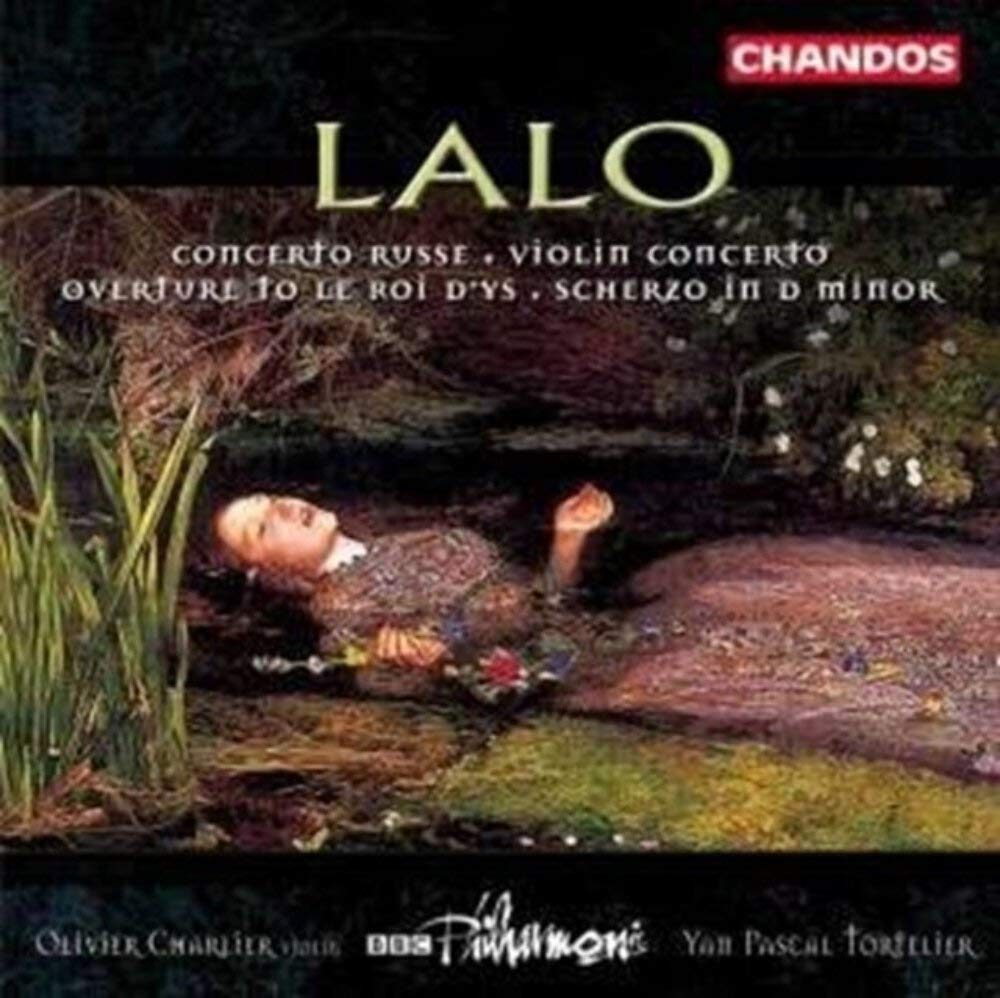
.com Terrific performances and spectacularly faithful recordings of some instantly appealing repertory. Still best known for his justly popular Symphonie espagnole for violin and orchestra, Frenchman Edouard Lalo (1823-92) in fact composed two other concertos for the legendary Spanish fiddler, Pablo de Sarasate. The F major concerto of 1873 predates the Symphonie espagnole by a year and proves a thoroughly engaging find, its central "Andantino" radiating a most touching wistfulness. Despite Lalo's passionate pleadings, however, Sarasate strangely shunned the Concerto russe of 1879, an even more alluring confection, crammed full of delicious melodies and always felicitously scored. Olivier Charlier is the neat, supremely affectionate soloist, who Tortelier supports with uncommon sympathy. However, the BBC Philharmonic really comes into its own in the two purely orchestral works. The swaggering Scherzo in D minor actually began life as the second movement of Lalo's Third Piano Trio (1880). It receives exhilarating treatment here, as does the slumberingly atmospheric and vividly dramatic overture to Lalo's magnum opus, the opera Le Roi d'Ys. Another Tortelier/Chandos winner! --Andrew Achenbach
M**A
Listen Up! Some Unknown Lalo
The music of Edouard Lalo is often darkly passionate, some even call it melodramatic. He has a penchant for minor keys (as in his Scherzo and his only symphony--in G Minor) and lunging rhythms. It must be his Latin blood. Though a Frenchman, Lalo was of Spanish extraction, and of course the Spanish connection shows up in his most famous work, Symphonie espagnole, but also in the lilting second movement of his Cello Concerto and in his piece for solo violin "Guitarre." Even his Rhapsodie norvegienne has a Spanish inflection, especially the rambunctious last movement (in the minor key).But while melodically and rhythmically his music may tend south, his chief musical influences were Germanic, especially his beloved Schumann. You can hear that influence in the lovely chorale-like trio of the Scherzo with its pizzicato strings. And while Lalo is a much finer orchestrator, he shares a dark-hued orchestral palette with his mentor Schumann. The highly dramatic overture to Le Roi D'Ys sounds like it might have been penned by Schumann if he had survived into the 1880s and had learned a thing or two about orchestration from the likes of Berlioz. Schumann's own Faust and Bride of Messina Overtures have the same dark drama and thrusting rhythm.So Lalo is rara avis in the terra inhabited by French composers. He's also rare for having devoted himself assiduously to chamber music (so much slighted by the French that Lalo was the first French composer of the 19th century to write a string quartet--in 1859!) That he is chiefly remembered for his orchestral music is also a rarity among French composers, most of whom wanted their names linked with the stage. I'm not sure if all these contradictions in Lalo's musical makeup explain his relative obscurity, or is it the fact that he had to live up to the success of the Symphonie Espagnole, though lightning didn't strike twice for Edouard Lalo? In that regard he's like Max Bruch, whose First Violin Concerto is just about all you ever hear. Why not the symphonies and the other concerti of Bruch, also very fine? And why not the other concertos of Lalo, for that matter? Olivier Charlier and Yan Pascal Tortilier obviously asked themselves that question and make amends very convincingly with this collection.The Concerto russe has much of the charm of the Symphonie espagnole about it, including a jaunty scherzo-like intermezzo with tambourine that might have fit into the Symphonie just as well. The Concerto's Russianness stems from the use of two authentic Russian folk songs taken out of Rimsky-Korsakov's collection and from a darkly brooding Slavic quality in their working out. The piece has good melodies, is well constructed, is expertly written for the violin (Lalo was a violinist himself), and is colorfully orchestrated. Why doesn't any violinist program it instead of the 300th version of the Tchaikovsky Violin Concerto to be heard in a given season?The Violin Concerto in F is not quite in the same class, but it is not a negligible work either. Like the Concerto russe, it has a lively, even fiery, last movement in which there is as much shade as there is sun (typical of Lalo--even when he writes in the major key, the minor often seems to predominate), a stern and dramatic first movement, and a tender Andantino second movement whose calm is a perfect foil to the other two movements. It's a very satisfying work; again, it should be aired once in a while in the concert hall. Both these pieces are, I think, the equal of Lalo's much more frequently heard Cello Concerto.The performances here are about all one could ask for. Charlier's tone is sweet, his quiet playing perfectly controlled and his intonation and bow work all bespeak a first-rate violinist. And Lalo's dark drama is obviously Tortelier's meat. Chandos's sound, as it always seems to be when it comes to the BBC Phil, is excellent. So take a chance on this recording; you won't go wrong on any score.
G**.
Splendid performances of some fine music
This is a very fine disc of some pretty unusual but rewarding repertoire - these are the `other' violin concertos of Eduard Lalo, that is, other than the ubiquitous Symphonie espagnole (both of these were also written for Sarasate), and I don't think they're far inferior. Perhaps they lack the striking melodic material of that more famous work, but in the case of the Concerto Russe, at least, it isn't far away. Lushly scored with brilliant solo passages (and there is no doubt that Lalo was a master at writing for violin) and some very memorable melodic turns, the work does indeed feature two genuine Russian folk melodies, but doesn't sound very `Russian' apart from that. Still this is a work that deserves life, at least as much as the espagnole does.The F major work isn't quite in the same league, but it is still a very fine, melodic work and features a touching and memorable slow movement. Again, Lalo's skill in writing for the violin is never in doubt, and the orchestration is colorful and attractive. The two couplings are outstanding works - the original overture to the opera Le Roi d'Ys is moving and with real dramatic flair, and the Scherzo in d - an orchestration of the scherzo of his third piano trio - is an engaging affair; with flowing, symphonic sweep, it is expertly scored with lots of color and panache.The performances by the BBC Philharmonic under Yan Pascal Tortelier are superb; sometimes lacking a little weight, perhaps, but for the most part able to conjure up some glorious sounds, in particular in the concertos. I cannot imagine more satisfying playing than Olivier Charlier's either, who produces dazzling pyrotechnics and colors as appropriate without losing sight of the greater picture - but he is actually most impressive in the quieter, more wistful passages. Sound quality is great as well, and, in short, this is a thoroughly recommendable disc.
C**D
Lalo: The Violinists Dream?
When you've become bored of the Symphonie Espagnole or Lalo's Cello concerto, listen to this. Lalo must have been quite a force in France in those days writing for violin so beautiful as he does here.And when the performance and recording are exemplary, you'll get a disc with 2 new violin works, which deserve better understanding and more public performances. The 2 shorter works are nice too. It's unbelievable that record companies like Chandos (and Hyperion) must lead the way by giving us these unknown works. I've never heard this performed in concert, why not impresarios and violinists?
M**N
what a difference a day makes
Imagine my delight at discovering two Lalo violin concertos other than the spectacular Symphonie espagnole! Imagine my chagrin at hearing the Concerto in F major, a disjointed display of technique written expressly for de Sarasate. Olivier Charlier's anemic fiddling, often drowned out by the blaring BBC, was anything but complementary to this concerto. The Concerto russe fares better. Although only one recording producer and sound engineer are noted in the liner notes, I believe they were both taken out and shot between the two days of recording. The balance between the violinist and orchestra in the Concerto russe was grealy improved, and some saintly person involved in this recording got Charlier to play this piece entirely in tune. As for the Overture and Scherzo...they're swell, but really, who would buy this for those works?
Trustpilot
1 week ago
1 month ago