
DOWNLOAD THE APP


Customer Services
Copyright © 2025 Desertcart Holdings Limited
DOWNLOAD THE APP
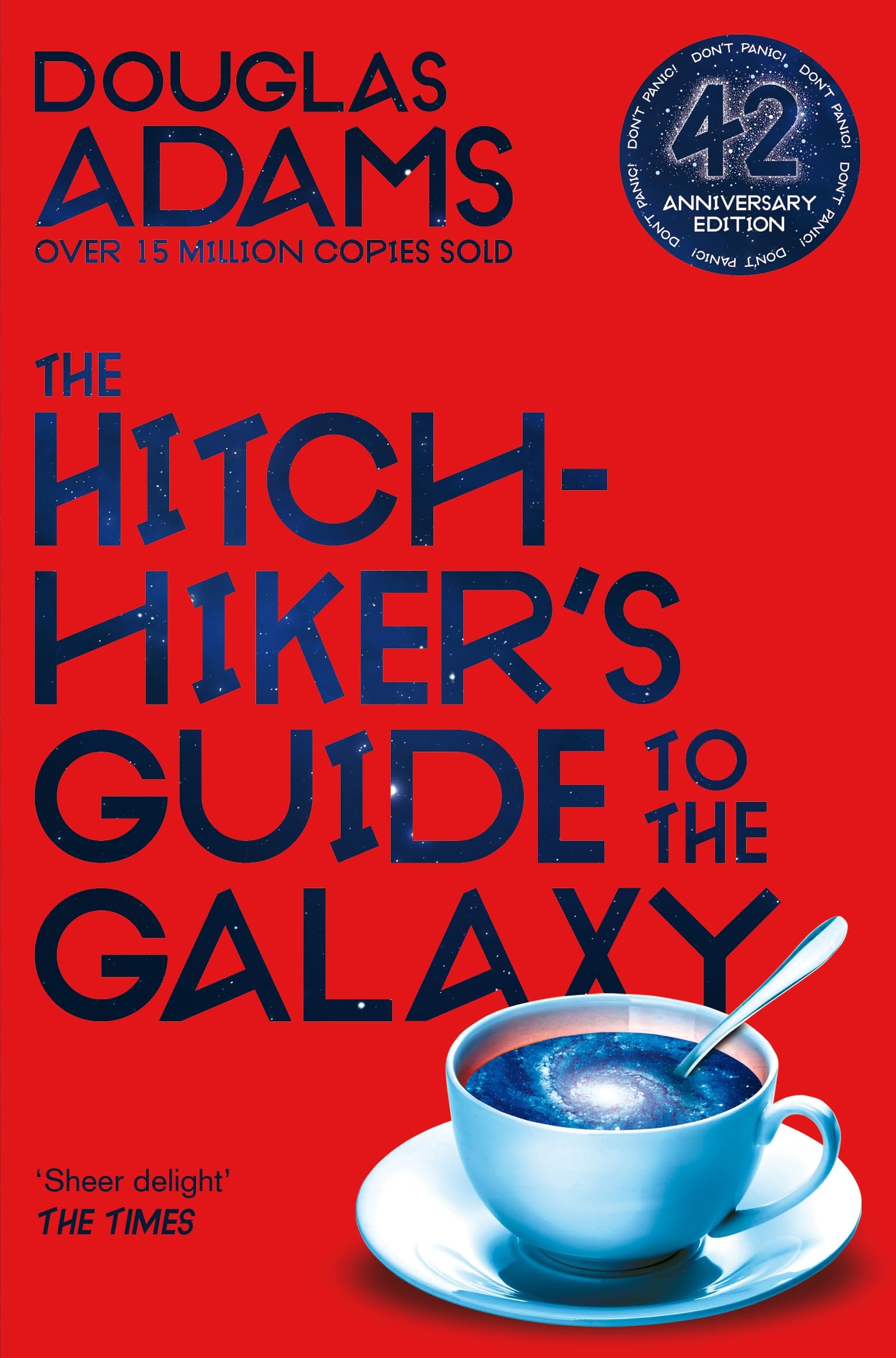
Pan The Hitchhiker's Guide to the Galaxy: 42nd Anniversary Edition : Adams, Douglas: desertcart.ae: Books Review: Hilarious - Bought it on a whim and don't regret it a bit Could have been chaper for the quality of the book The spine gets a split on it during my second read Review: Poor quality - The mass market paperback is a small poorly presented incarnation of this classic. If time permits, order the full paperback which at the time of writing had a 10-14day delivery estimate, verses the mass market paperback that was available for same day delivery with Prime.


| Best Sellers Rank | #20,622 in Books ( See Top 100 in Books ) #4 in Humorous Science Fiction #6 in Science Fiction Adventures #18 in Alien Invasion Science Fiction |
| Customer reviews | 4.7 4.7 out of 5 stars (6,628) |
| Dimensions | 12.6 x 1.4 x 19.4 cm |
| Edition | Main Market |
| ISBN-10 | 1529034523 |
| ISBN-13 | 978-1529034523 |
| Item weight | 158 g |
| Language | English |
| Print length | 224 pages |
| Publication date | 5 March 2020 |
| Publisher | Pan Books |
| Reading age | 18 years and up |
S**A
Hilarious
Bought it on a whim and don't regret it a bit Could have been chaper for the quality of the book The spine gets a split on it during my second read
N**S
Poor quality
The mass market paperback is a small poorly presented incarnation of this classic. If time permits, order the full paperback which at the time of writing had a 10-14day delivery estimate, verses the mass market paperback that was available for same day delivery with Prime.
Z**Y
its not what you expect
The website says that it has more than 400 pages but it does not
Z**A
Bra bok
J**Z
Lovely item. Tq AmazonSG
O**B
Douglas Adams’ bestselling book The Hitchhiker’s Guide to the Galaxy published in 1979 is witty, occasionally complex, and accessible to the average reader. The protagonist, Arthur Dent, is a befuddled Englishman and his friend, Ford Prefect, is a hitchhiking alien doing research for the latest edition of The Hitchhiker’s Guide to the Galaxy. The two narrowly escape destruction with the rest of planet Earth when Ford catches wind of its impending demolition by intergalactic civil servants and beams them to the nearest accessible spaceship--the Vogon demolition fleet’s mothership. Inside, they encounter murdered mattresses, ruthless bureaucrats, and torture by poetry. They are soon ejected into space and twenty-nine seconds later (one second short of death), the president of the universe and his girlfriend rescue them in their recently stolen state-of-the-art spaceship, The Heart of Gold. In the remaining pages, Adams prioritizes unpacking the absurdity of bureaucracy, politics, and religion over a strong plot and whimsically manipulates grammar and rhetoric to inspire in the reader a sense of his disregard for the possibility of any sense or meaning to life. Entries peppered throughout the book from the “real” The Hitchhiker’s Guide inform the reader of non-essential historical, cultural, and always humorous tidbits about the universe and its inhabitants. For example, the popular drink the Pan Galactic Gargle Blaster makes the drinker feel like their brain is being “smashed out by a slice of lemon wrapped round a large gold brick” (Ch 2). Ford hopes to update the electronic guide with how one can see the wonders of the universe for 30 Altarian dollars a day, but due to being stuck on Earth for 15 years his signature contribution remains his description of Earth as “mostly harmless”. Arthur Dent is more the butt of every joke than the hero of the story and simply plays the role of baffled human encountering the unknown. The president, Zaphod Beeblebrox, who happens to be Ford’s cousin, has two heads, three arms, and the ego of a true politician. He steals almost everyone’s thunder, but that’s probably because, while only six people know it, he’s succeeding phenomenally at his presidential mandate of distracting everyone’s attention away from power instead of wielding it. Zaphod is accompanied by his human girlfriend, Trillian, who acts as the token female character in the typically male-dominated sci-fi tale. Smart and sexy, she is mostly disregarded by her boyfriend while dutifully following him into every folly. Marvin is a pet robot of sorts with a serious depression problem which proves to have tremendous utility. On account of the Heart of Gold’s Infinite Improbability Drive, the serendipitous crew encounters and escapes from a series of unthinkable situations, the most notable being the discovery of the fabled planet of Magrathea. Believed to now be dead, it supposedly designed and constructed luxury planets at the behest of ultra-wealthy clients until closing up shop with the collapse of the intergalactic economy some ten million years ago. At this point in the book a loosely coherent plot begins to emerge. After narrowly evading the planet’s automatic defense missiles, the crew land the Heart of Gold on the surface and Zaphod leads the bunch on a hunt for the unfathomable riches he is certain must be hidden there... somewhere. Instead, he comes to a shocking realization about the key to his wildly successful career of misconduct, Arthur learns of the mysterious nature and fate of his late beloved Earth, Trillian loses her two pet mice, and Marvin unwittingly saves everyone’s lives just by being himself. Adams playfully goads the reader closer and closer into agreeing that “The Universe is almost certainly being run by a bunch of maniacs” (Ch 31) by poking fun at bureaucracy and politics with amusing analogies. Much like the local bureaucrat trying to tear down Arthur’s house, the Vogons respond to Earthlings’ protests before imminent destruction by stating, “All the planning charts and demolition orders have been displayed in your local planning department in Alpha Centauri for fifty of your Earth years” (Ch 3). Zaphod Beeblebrox is the posterchild for theatrical two-faced politics. His wild antics make him the most successful president in history and he possesses two heads, and therefore two faces, one of which is more popular than the other (Ch 4). Adams then picks apart religion and philosophy without being overtly insulting due to his use of their very own arguments. A small but exceedingly sophisticated fish proves God’s existence and is therefore the final and clinching proof of his nonexistence. God “promptly vanishes in a puff of logic” because “without faith I am nothing” (Ch 6). Philosophers protest the creation of a supercomputer they fear will put them out of a job if it is able to answer the questions of the Universe, thus they demand the “total absence of solid facts” (Ch 25). Adams’ deft criticism of these topics threatens to elicit not much more than a self-deprecating chuckle from the very people he is poking fun at. Absurd similes and outrageous statements infuse the writing style with charming humor while occasionally reminding the reader that reality can in fact be quite ridiculous. “For a few seconds Ford seemed to ignore him, and stared fixedly into the sky like a rabbit trying to get run over by a car” (Ch 1), and, “The ships hung in the sky much the same way that bricks don’t” (Ch 3), are clearly very foolish things to say, yet confer upon the reader a precise picture of the given situation that Adams wants them to have. In a similar vein, a police ship commits suicide after hearing Marvin’s depressing view of the universe (Ch 34), letters of the alphabet can be “friendly” (Ch 1) or “unfriendly” (Ch 34), and the answer to life, the universe and everything is simply the number “42” (Ch 27). Adams makes clear to the reader exactly how seriously he takes his subject matter. Poking fun at politics and religion and making ludicrous statements are the more obvious of Adams’ tactics to discourage the reader from taking life, or really anything, very seriously. Less obvious, but equally effective, is his manipulation of grammar and rhetoric. By rendering the familiar structure of language malleable in his expert hands, he reminds the reader at every turn that all is not as it seems. He breaks commonly accepted rules of writing by blatantly using redundant vocabulary and pairing oxymoronic words. Arthur wakes up blearily then gets up and wanders blearily around his room (Ch 1), Ford Prefect is not conspicuously tall and his features are striking but not conspicuously handsome (Ch 1), and Zaphod rides a thoroughly ridiculous form of transport, but a thoroughly beautiful one (Ch 4). The windows on Arthur’s soon to be destroyed home are “of a size and proportion which more or less exactly failed to please the eye” (Ch 1), and there is something “very slightly odd” about Ford Prefect (Ch 1). With these deviances from the norm and by slipping in a clever grammar joke here and there, “...to boldly split infinitives that no man had split before” (Ch 15), Adams taunts the grammar police and then scoffs when their powerlessness and lack of creativity are exposed. By deftly rendering malleable the familiar institution of language, Adams bring home his deeper message that societal constructs are the mere product of a human desire to invent order out of chaos. While Adams can boast a nimble sense of humor and a clever mind, obvious plot holes emerge as the story progresses. For example, the Vogons dump Arthur and Ford millions of lightyears away from Earth but then Trillian and Zaphod pick them up in the same vector as Earth. This could be due to the fact that Adams was a legendary procrastinator who would often leave manuscripts unfinished until the last minute. His biographer, M.J. Simpson, author of Hitchhiker: A Biography of Douglas Adams says that Adams also had problems following the traditional structure of a story. He shares that, “Adams was good at writing beginnings, middles, and endings, but when he got to the middle he’d thought of another good beginning and wanted to write that instead of the ending”. Adams’ habit of making things up as he went along is uncomfortably apparent to the reader who craves consistency and resolution, especially from a book some say holds a place in the sci-fi genre. Therefore, his book might more accurately fall under the category of comic science fiction. While he falls short of producing the next great science fiction series of our time, Adams succeeds remarkably in demonstrating how a truly inquisitive mind works. He breaks the rules of fiction writing, but rather than being his downfall, these bold deviations add to his appeal. By weaving together intelligence, humor, and slapstick, he reaches a broad audience without sacrificing his unique voice and underlying message. So much so that the reader is left almost certain that “the chances of finding out what really is going on are so absurdly remote that the only thing to do is to say hang sense of it and just keep yourself occupied” (Ch 30).
M**T
This is an excellent and hilarious book. This edition is very nice, hard back, with quality paper and all
T**E
Amazing book. Sci fi and humor combined. Between the search for meaning and recognition lies Doughlas. Worth reading. I gifted it to a friend too and he liked it.
Trustpilot
2 weeks ago
1 month ago