
DOWNLOAD THE APP


Customer Services
Copyright © 2025 Desertcart Holdings Limited
DOWNLOAD THE APP
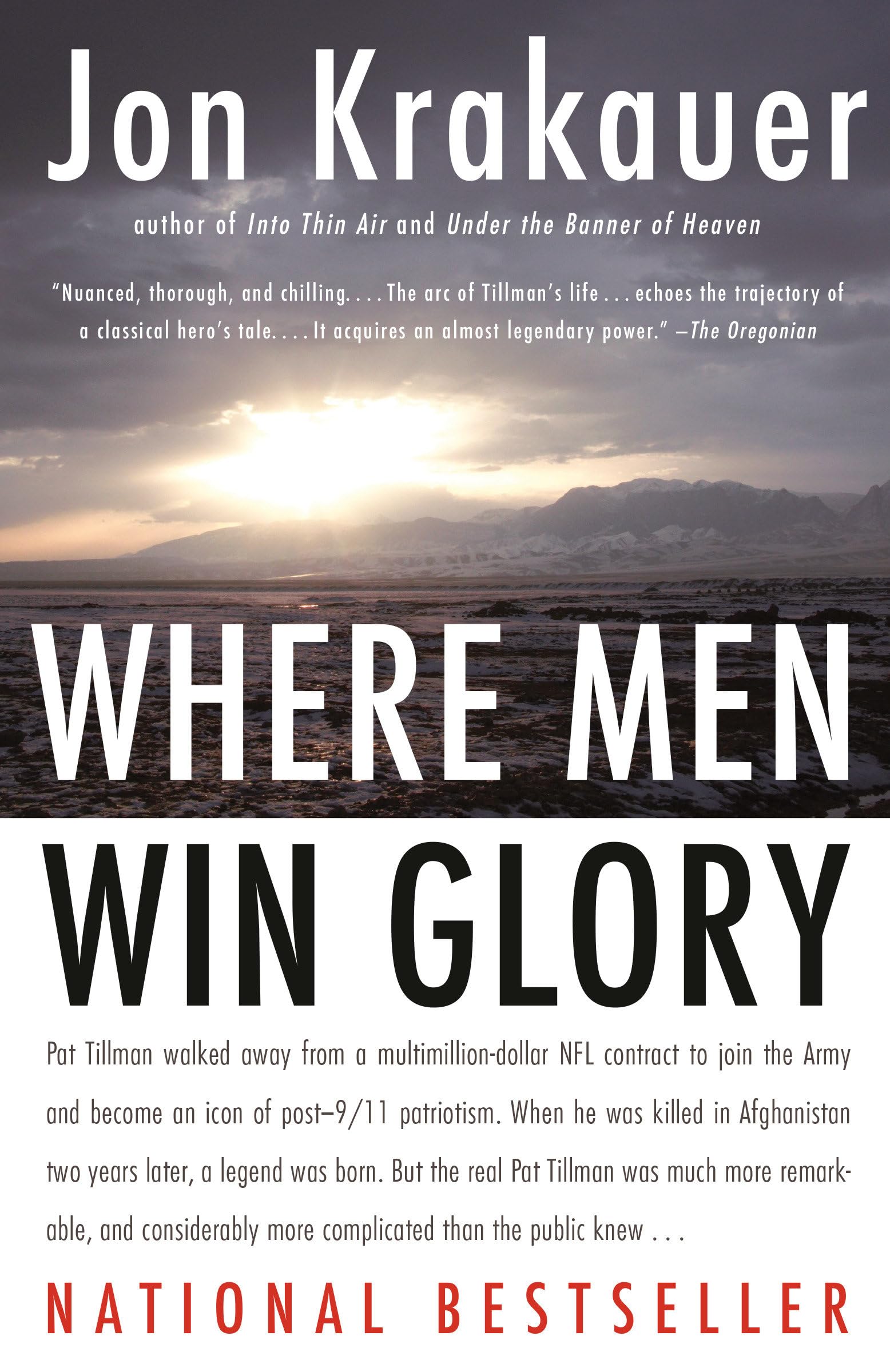
desertcart.com: Where Men Win Glory: The Odyssey of Pat Tillman: 9780307386045: Krakauer, Jon: Books Review: Another Superb Book by Jon Krakauer - Krakauer once again tells a very engaging, wide-ranging, complex story of an interesting and unusual character. The book switches back and forth between the life of Tillman and the events in the world and especially Afghanistan, as they (in hindsight) inexorably grind toward that day when all the stories intersect on the battlefield and result in Tillman's death. It's brilliantly done and I think you will love it. Much of my review will be made in reaction to some of the complaints against the book: Because I specifically disagree with them, in detail. Some have complained that this book is either not a well-told story or not up to Krakauer's usual standards. To me, this is nonsense. This book was every bit as much a page-turner as any other of his books. The way he weaves the story of Afghanistan, US policy and actions, Al Qaeda's increasingly bold series of attacks, and Tillman's life is skillful and does not come off as contrived as it so easily could have. Krakauer frequently makes direct linkages in time between Tillman's life and events in Afghanistan (and elsewhere), for instance on p. 79, "In the predawn hours on the day of that game, as Pat was asleep in his hotel room, a Toyota delivery truck appeared at the entrance to a parking lot behind the American embassy in Nairobi, Kenya." The history of Afghanistan Krakauer provides, admirably brief, is needed to set the stage on which Tillman will eventually play. (I have read extensively on Afghanistan and the rest of central Asia; and, based on my conversations with others, the vast majority of Americans need this historical overview to make sense of the events in the book.) This is not a narrowly-focused biography of Tillman that plops him (surprise!) into an unknown Afghanistan to die in a meaningless way. Setting the stage in Afghanistan gives great meaning to flow of events that brought him there and his motivations. In spite of the complaints that it's not a straight biography of Tillman (it wasn't intended to be), it chronicles Tillman's post-adolescent life, especially his post-enlistment life, in great detail (almost too much for me.) There are frequent long quotes from his journals. Many direct quotes of Tillman's own public and private statements. Frequent quotes from interviews with his friends, family, wife, coaches, roommates, fellow students, fellow soldiers, his commanders. I doubt more detail could have been written about his service in the army and still remain readable. Many of the negative comments on the book complain about Krakauer's "criticism of the Bush Administration." A book about a man whose death was part of a large public cover-up and whose very exposure to combat was part of a controversial set of geo-political actions by the US Administration (our first preemptive war, for one thing, a decision that will haunt us into the distant future), inevitably MUST be in part political. However, the plain facts about who took what decisions and the results of those decisions are laid out in a very dispassionate way. In no way does the book devolve into a political diatribe. (Anyone familiar with Krakauer's writing knows that understatement is one of his strengths.) Some of those decisions were clearly bad blunders. I'm sure that burns in certain political quarters. Bush, Rumsfeld, Wolfowitz, Cheney, et al. are rarely mentioned. Clinton comes off as a weak CinC, crippled into inaction against Al Qaeda by his affair with Ms. Lewinsky. All of our failings come off looking bad, because of course they were bad. We did fail, as a nation, to react correctly to Al Qaeda and the Taliban. These are plain facts. Several reviewers have commented that Krakauer, since he is not a combat veteran, cannot have the perspective to make any valid commentary on the actions of men in combat. I respectfully assert that this is nonsense. He can't give a soldier's personal perspective; but there is a long and distinguished history of non-military writers on military subjects, including personal combat. Mainly they do it by interviewing soldiers and reading their journals: Which is exactly what Krakauer has done. I refer the reader to Blackhawk Down by Mark Bowden, Thomas Ricks' Making the Corps, and John Keagan's books, in particular The Face of Battle, among many other excellent books on combat (or being a soldier) by non-combatants. The Face of Battle (Hardcover) Black Hawk Down: A Story of Modern War [ILLUSTRATED] (Hardcover) Making the Corps: 10th Anniversary Edition with a New Afterword by the Author (Paperback) Krakauer has made some quite extreme technical climbs in remote mountains. I have never been in the military nor in combat (I'm grateful to say.) However, one of my closest climbing partners of many years was one of the LRRP soldiers in Vietnam: They were dropped behind enemy lines in small groups every 10-14 days to search and destroy for 4-9 days at a time. He saw plenty of "action." He tells me that the only thing that had the intensity of combat is the intensity and peril of difficult technical mountaineering (at least this was true for him.) He also noted that the camaraderie of the rope was comparable to the unit cohesion of the military: The trust and comradeship. I met Krakauer on Mt. McKinley while he was soloing the mountain: He's a solid customer and quite bold. I can say for myself that difficult, exposed climbing in remote places have been the most riveting experiences of my life. You get completely into "the zone" where nothing is in your mind except the here and now, this concrete second in your life. The comradeship and trust of the rope are peak experiences. Your partner, their hands on your rope, literally holds your life in their hands. The point is: Krakauer does have some perspective on life-and-death high-stress situations, even if he hasn't been in combat. Some have complained that Krakauer notes Tillman's lack of religion: "I am also unclear as to why Krakauer feels the need to tell everyone Tillman was an agnostic/atheist" This is bizarre to me. Would they be complaining if it were noted that Tillman were a Christian (he wasn't)? Is one's religious stance not important to one's motivations? Are not Tillman's motivations for enlisting some of the main points of his story? There are two pertinent quotes: p. 34 "[in his diary, Tillman] opined that religion was inadequate to elucidate the mysteries of existence." p. 116 "But there was more to his decision than he shared with ESPN. Pat was agnostic, perhaps even an atheist, but the Tillman family creed nevertheless imparted to him an overarching sense of values that included a belief in the transcendent importance of continually striving to better oneself - intellectually, morally, and physically." And there is also: p. 16 "When [Tillman and his brothers] had to be indoors, they engaged in clamorous discussions about current events, history, and politics with their parents and each other. Almost no subject was off-limits. Encouraged to think critically and be skeptical of conventional wisdom, Pat learned to trust in himself and be unafraid to buck the herd." These all seem quite on topic in a discussion of Tillman's life and what motivated him to enlist in the army. Many American Christians seem to believe that none of their non-co-religionists are in possession of morals or proper values (viz.: Lt. Col. Kauzlarich, pp. 314, 315). The point is directly pertinent to that attitude. Review: A great read! Uber inspiring for any and all! - A must read for any patriotic american, athlete, or history buff. Tillman’s tale is uber inspiring! The Aaron Rodgers book club has a new number one novel!


| Best Sellers Rank | #31,303 in Books ( See Top 100 in Books ) #12 in Afghan War Biographies #17 in Afghan War Military History #23 in Football (Books) |
| Customer Reviews | 4.5 out of 5 stars 3,393 Reviews |
J**E
Another Superb Book by Jon Krakauer
Krakauer once again tells a very engaging, wide-ranging, complex story of an interesting and unusual character. The book switches back and forth between the life of Tillman and the events in the world and especially Afghanistan, as they (in hindsight) inexorably grind toward that day when all the stories intersect on the battlefield and result in Tillman's death. It's brilliantly done and I think you will love it. Much of my review will be made in reaction to some of the complaints against the book: Because I specifically disagree with them, in detail. Some have complained that this book is either not a well-told story or not up to Krakauer's usual standards. To me, this is nonsense. This book was every bit as much a page-turner as any other of his books. The way he weaves the story of Afghanistan, US policy and actions, Al Qaeda's increasingly bold series of attacks, and Tillman's life is skillful and does not come off as contrived as it so easily could have. Krakauer frequently makes direct linkages in time between Tillman's life and events in Afghanistan (and elsewhere), for instance on p. 79, "In the predawn hours on the day of that game, as Pat was asleep in his hotel room, a Toyota delivery truck appeared at the entrance to a parking lot behind the American embassy in Nairobi, Kenya." The history of Afghanistan Krakauer provides, admirably brief, is needed to set the stage on which Tillman will eventually play. (I have read extensively on Afghanistan and the rest of central Asia; and, based on my conversations with others, the vast majority of Americans need this historical overview to make sense of the events in the book.) This is not a narrowly-focused biography of Tillman that plops him (surprise!) into an unknown Afghanistan to die in a meaningless way. Setting the stage in Afghanistan gives great meaning to flow of events that brought him there and his motivations. In spite of the complaints that it's not a straight biography of Tillman (it wasn't intended to be), it chronicles Tillman's post-adolescent life, especially his post-enlistment life, in great detail (almost too much for me.) There are frequent long quotes from his journals. Many direct quotes of Tillman's own public and private statements. Frequent quotes from interviews with his friends, family, wife, coaches, roommates, fellow students, fellow soldiers, his commanders. I doubt more detail could have been written about his service in the army and still remain readable. Many of the negative comments on the book complain about Krakauer's "criticism of the Bush Administration." A book about a man whose death was part of a large public cover-up and whose very exposure to combat was part of a controversial set of geo-political actions by the US Administration (our first preemptive war, for one thing, a decision that will haunt us into the distant future), inevitably MUST be in part political. However, the plain facts about who took what decisions and the results of those decisions are laid out in a very dispassionate way. In no way does the book devolve into a political diatribe. (Anyone familiar with Krakauer's writing knows that understatement is one of his strengths.) Some of those decisions were clearly bad blunders. I'm sure that burns in certain political quarters. Bush, Rumsfeld, Wolfowitz, Cheney, et al. are rarely mentioned. Clinton comes off as a weak CinC, crippled into inaction against Al Qaeda by his affair with Ms. Lewinsky. All of our failings come off looking bad, because of course they were bad. We did fail, as a nation, to react correctly to Al Qaeda and the Taliban. These are plain facts. Several reviewers have commented that Krakauer, since he is not a combat veteran, cannot have the perspective to make any valid commentary on the actions of men in combat. I respectfully assert that this is nonsense. He can't give a soldier's personal perspective; but there is a long and distinguished history of non-military writers on military subjects, including personal combat. Mainly they do it by interviewing soldiers and reading their journals: Which is exactly what Krakauer has done. I refer the reader to Blackhawk Down by Mark Bowden, Thomas Ricks' Making the Corps, and John Keagan's books, in particular The Face of Battle, among many other excellent books on combat (or being a soldier) by non-combatants. The Face of Battle (Hardcover) Black Hawk Down: A Story of Modern War [ILLUSTRATED] (Hardcover) Making the Corps: 10th Anniversary Edition with a New Afterword by the Author (Paperback) Krakauer has made some quite extreme technical climbs in remote mountains. I have never been in the military nor in combat (I'm grateful to say.) However, one of my closest climbing partners of many years was one of the LRRP soldiers in Vietnam: They were dropped behind enemy lines in small groups every 10-14 days to search and destroy for 4-9 days at a time. He saw plenty of "action." He tells me that the only thing that had the intensity of combat is the intensity and peril of difficult technical mountaineering (at least this was true for him.) He also noted that the camaraderie of the rope was comparable to the unit cohesion of the military: The trust and comradeship. I met Krakauer on Mt. McKinley while he was soloing the mountain: He's a solid customer and quite bold. I can say for myself that difficult, exposed climbing in remote places have been the most riveting experiences of my life. You get completely into "the zone" where nothing is in your mind except the here and now, this concrete second in your life. The comradeship and trust of the rope are peak experiences. Your partner, their hands on your rope, literally holds your life in their hands. The point is: Krakauer does have some perspective on life-and-death high-stress situations, even if he hasn't been in combat. Some have complained that Krakauer notes Tillman's lack of religion: "I am also unclear as to why Krakauer feels the need to tell everyone Tillman was an agnostic/atheist" This is bizarre to me. Would they be complaining if it were noted that Tillman were a Christian (he wasn't)? Is one's religious stance not important to one's motivations? Are not Tillman's motivations for enlisting some of the main points of his story? There are two pertinent quotes: p. 34 "[in his diary, Tillman] opined that religion was inadequate to elucidate the mysteries of existence." p. 116 "But there was more to his decision than he shared with ESPN. Pat was agnostic, perhaps even an atheist, but the Tillman family creed nevertheless imparted to him an overarching sense of values that included a belief in the transcendent importance of continually striving to better oneself - intellectually, morally, and physically." And there is also: p. 16 "When [Tillman and his brothers] had to be indoors, they engaged in clamorous discussions about current events, history, and politics with their parents and each other. Almost no subject was off-limits. Encouraged to think critically and be skeptical of conventional wisdom, Pat learned to trust in himself and be unafraid to buck the herd." These all seem quite on topic in a discussion of Tillman's life and what motivated him to enlist in the army. Many American Christians seem to believe that none of their non-co-religionists are in possession of morals or proper values (viz.: Lt. Col. Kauzlarich, pp. 314, 315). The point is directly pertinent to that attitude.
J**S
A great read! Uber inspiring for any and all!
A must read for any patriotic american, athlete, or history buff. Tillman’s tale is uber inspiring! The Aaron Rodgers book club has a new number one novel!
G**R
Just the facts, in Krakauer's inimitable style
A difficult read. Krakauer's books remind me of an obscure Grateful Dead lyric -- "The eye of the witness. Silent. Dark." His patient observations wind slowly and dispassionately to the event, in this case the fratricide of Pat Tillman by his fellow Rangers. When you arrive at the climax, the defining event, and it's playing out in excruciating slow motion as Krakauer, in a somewhat Rod-Serling-like manner, soberly and thoroughly takes you on a tour of the facts. Time stops. He tells a story in a way that gives you no where to turn and you have to face the reality of his subject. Some of the passages are agonizing to read. One thing that I couldn't swallow and that was nearly a show-stopper for me was Krakauer's apparent acceptance of the "official" 9/11/01 story -- nanothermite be damned. The mountain of evidence not examined in the 9/11 cover-up speaks for itself. It's a modern litmus test. When someone I respect voices their belief in the "official" story, I question my respect for that person. This was difficult given that Krakauer is one of my favorite living writers. His exposition of Tillman's early life is neatly presented. The stage-setting of events follows. Tillman certainly qualifies as a hero, physically superior and intellectually inquisitive. This resonates strongly with the heroes in Krakauer's earlier books, Into the Wild and Into Thin Air: A Personal Account of the Mt. Everest Disaster , individuals exploring and challenging themselves, following their consciences, blazing their own trails. Tillman comes across as a brilliant athlete, a good husband -- an all-American character. Krakauer provides enough biographical shading to make Tillman's decision to enlist seem logical, even sensible. I was on the phone with the local Army recruiter on 9/12/01 myself. I was 44. Eventually we are in Afghanistan near sunset. Krakauer does what the US Army apparently cannot bring itself to do, tell the simple truth after careful examination. Again, Krakauer's careful exposition is overwhelmingly powerful. Here are the facts, presented in a direct manner, but far from a laundry list or timeline. One factoid that was of particular interest was that a military air vehicle was overhead and likely recorded the ground action in which Pat Tillman was killed. And so someone in the military knew what had happened without a doubt. The final third of the book gets into the stupidity of the US military in "managing" the truth. The resonance with the endless lies and untruths the US public has been fed regarding 9/11, Iraq and Afghanistan is practically seismic. The military appears to be incapable of telling the truth, or even in admitting the facts of the matter, and one supposes the same willful bungling would be standard operating procedure in ANY situation. This is depressing to read in such detail. The Army comes across as (edit courtesy of a computer pal with decades of military experience[Hi JB])'The Army comes across as a bunch of rat feces without benefit of married parents.'(/edit) Krakauer's belief in the "offical" 9/11 story and his having chosen to write about a victim of a "war" (did they attack us? you don't lab nanothermite in a cave in Afghanistan.) which not only continues to this day but will apparently be escalated Vietnam-style makes this a difficult book on several levels. The tragedy of Tillman's death, the uselessness of the oil-grab invasions of Iraq and Afghanistan, the squandering of US lives and hardware, to say nothing of the deaths of God knows how many innocent civilians, the apparently open-ended war without end... I get the feeling that this book will be in print for a long, long time. It's a core sample of what will be regarded as America's worst military adventure ever. No military family wants to see a dark blue Crown Vic pull up in front of their house. As in his early books, Krakauer's storytelling requires and provides a larger snapshot of the world in order to explain the event, and that casual, even unconscious stage-setting provides depth of understanding well beyond the subject of the book.
G**S
MUST READ — disturbing truths well told
Amazing story, amazing Krakauer presentation. An absolutely heartbreaking account of Pat’s life and passing and the lies and injustice perpetuated by the United States government against the Middle East and our own people.
B**N
A Fusion of Two Complex Stories
As a devoted reader of Krakauer, I was not disappointed by Where Men Win Glory. As is typical of Krakauer, he begins his book with a great deal of context. Some would say that this is unnecessary, and slowed the pace of the book, but if Into Thin Air didn't contain the intricate detail of sherpa culture, the Everest's "cheapening" by commercial adventures, and the stories of those who have climbed it, then the narrative of the everest catastrophe wouldn't stand alone the way it does. Jon discussed the political factions of the conflict in the middle east before our involvement, the political climate here and how the election of Bush came into play, and how that brought us into the middle east. More specifically to Pat, it discussed his upbringing, high school/college football career, and his character. He then fuses these together and creates all the necessary context for the narrative to take on a different direction; from football hero to soldier in a complicated conflict. Basically, all the one/two stars say this book is slow paced, and riddled with the political agenda of Krakauer. Yes, the book contains a ton of information in it one was to get through in order to enter the narrative. However, if this information wasn't presented, people would whine about how the omission of information would contribute to the political bias of Krakauer. To clarify, there is a great deal of information, which would disqualify it from a good coffee table book. But that makes it a relevant source of information. Next, though Krakauer makes his opinion of the war no mystery, it isn't a bashing of the Bush administration as much as it is a bashing of government cover up. You may love Bush to death, but the fact of the matter is that this took place under his watch and with the help of his administration. That's a reality conservative readers must face down. Blind allegiance to any presidential administration gives the government the leeway to pull these shenanigans in the first place. I believe the ultimate purpose of the work is to present the strength and complexity of a person who became a tool of propaganda. Krakauer did a stellar job of informing the reader of what exactly went on and who it happened to, which gave this reader the ability to reach a very real depth of anger for the cover up which took place. On the whole, I believe the authors intent was to inform and further clarify the story of Pat Tillman and do it in such a way that it informs the reader. Krakauer did this, and did it very well in my opinion, therefore, I give the book five stars.
B**.
Krakauer's subjects defy convention
Pat Tillman went from playing in the NFL to giving up a multi million dollar contract to become a "friendly fire" statistic in Afghanistan. Krakauer says thus far in the current Iraq War 41 percent of U S casualties are by "friendly fire". The number was 39 percent in Vietnam and 52 percent the first Iraq war. Tillman's widow Marie was the only family member to contribute "on the record" for Krakauer's book. Political alert: Since most of my conservative friends see anything that challenges their orthodoxy and world view as unworthy of attention I don't think they will like or appreciate this book. Why? Because we learn that Pat Tillman and his family do not reinforce the stereotype of a fallen American Military hero. Tillman questioned the Iraq war, opposed the Bush administrations conduct of the war, was an atheist who did not wish to have a religious or a military service if he died and all the same was a reluctant hero who gave up much to volunteer along with his brother to fight after 9/11. Why did Tillman join the Army and want to be an enlisted man? Tillman kept a very detailed and personal journal and Krakauer is an excellent writer who seems to find these unusual individuals that defy convention (such as in his books Into the Wild and Into Thin Air which is still his best work). Here Krakauer jumps back and forth between recent events to focus on Tillman's life, marriage, and friends concluding with how it was possible for him to be shot by an individual from his own platoon with three .223-caliber bullets tightly grouped together as they entered the right side of Tillman's forehead. His brain to be found days later in the dirt near where he died and it was later lost as a result of one of many strange Army snafus. How could this event happen? Why when it did happen did the Army cover it up? Did they cover it up? Why did the Army provide false testimonial evidence to support a silver star for Tillman? Why did they order members of Tillman's platoon not to provide accurate information on the events of the shooting, especially to Tillman's brother who was a member of that very same platoon? And why was manufacturing pro war propaganda so important to those in the Bush administration? And lastly, how many Americans today even know the truth about Tillman after all these years (Tillman was killed in 2004)? This is a sad and disturbing book that leads one to think about what it means to fight and die for one's country. This is also an important book, if only to insure we obtain a better understanding of what happened to someone who marched to his own personal beliefs no matter the risk. And how his government betrayed his memory. (Note: Krakauer's book reminded me, in part, of the excellent 1976 book about Vietnam by C.D.B. Bryan, titled "Friendly Fire". That book is about one of the individuals who became part of the 39 percent statistic that Krakauer quotes for that war.)
C**N
Highly Recommended!
Jon Krakauer's well-written, but sometimes preachy, tribute to Pat Tillman's life and death is a a must read for those seeking clarity about the Arizona football star's life, what lead him to join the Army in the aftermath of 9/11, and his heart-rending death on a rocky hillside in Afghanistan. Krakauer was at his best in this book when he was describing, in alternating chapters, the quintessentially all-american life story of Tillman and the concurrent troubles in Afghanistan starting with the birth of the man, Pat Tillman, which just so happened to roughly coincide with the arguable genesis of the present troubles for the country, Afghanistan, via the Soviet invasion. The author's well-crafted weaving of the fates of both the man and the country supply depth to the story and helps to add even more emotional impact when the two fates tragically collide on that rocky hillside. The author was not at his his best however when he felt the need to inject his own polarized opinion about the Bush Administration's and the Military's treatment of Pat Tillman's death. He may or may not be correct about the alleged cover-ups and conspiracies; but this reader, like Pat Tillman I'm sure, would rather form his own opinion based upon the facts and not have it spoon fed to him. Still, though, if one can forgive the author his views and opinions (or perhaps even if one agrees with them wholeheartedly), this is a book that everybody should read. Pat Tillman, the free spirit and the warrior, is somebody just about anybody would've liked to have met and known. Even though that is not possible now, I'm appreciative that Krakauer has given us all the chance to know, even in a small way, this notable American life.
0**A
Outstanding
The book was very well written with insights into Pat Tillman's life early on and through his football career into Army life. The book expresses the deep devotion of Tillman to his wife, his brother and to his family. I recommend the book highly. That said, having driven those extremely dangerous canyon river trails of eastern Khost entering Khost City/FOB Salerno (mid 2003) from the east, I can say with absolute certainty how daunting the terrain is in that part of Afghanistan. The dried creek beds double for "roads"; as the sun goes down, the shadows from the overhangs in the dried riverbeds makes one wonder not "if" but "when" the ambush will commence-will I die today! From a tactical standpoint, the 1LT on the ground has the correct understanding of the issues-not to separate what was Serial One and Serial Two for the purpose of retrieving a broken Hummve. Numerous attempts to convince the TOC at FOB Salerno were of no avail, and as such, the result was Tillman's tragic death by friendly fire, the death of the ANA soldier and the wounding of two or more others. The rule..."the man on the ground knows best" should have been the decisive factor when ordering the Ranger unit to split into two parts (Serial One and Two). The decision was the foundation for causation of the KIA and WIA on that riverbed in eastern Khost Province, Afghanistan. At the time of Tillman's death as so well documented in the book, the other Rangers knew then of the friendly fire incident. Upon returning to FOB Salerno, all were told to "keep quiet" about the incident..it was a direct order (actually a fraudulent order). Who gave the order to destroy Tillman's BDU uniform, his IBA (individual body armor), his Kevlar helmet and other personal effects leads the reader to believe the battalion commander, LTC Bailey was directly responsible in concert with the chain of command to include, COL Nixon, the commander of the 75th Rangers and JSOC commander and now current commander/Afghanistan, General McChrystal. Perhaps one day, we will know the truth- It was a disgrace the commanders in Tillman's chain of command were not truthful. And as such, they bring dishonor on all who have served and those who serve today. Duty, honor..country.. and truth.. was obviously not the standard given Pat Tillman, Tillman's family or the American public of the facts into Tillman's tragic death. The book is well worth reading, especially for those who want to understand why men respond to the calling. In Tillman's case, his calling involved the abandonment of a professional football career and millions of dollars- a true patriot and a name in the US Army that we shall never forget.
Trustpilot
2 months ago
1 week ago