
DOWNLOAD THE APP


Customer Services
Copyright © 2025 Desertcart Holdings Limited
DOWNLOAD THE APP
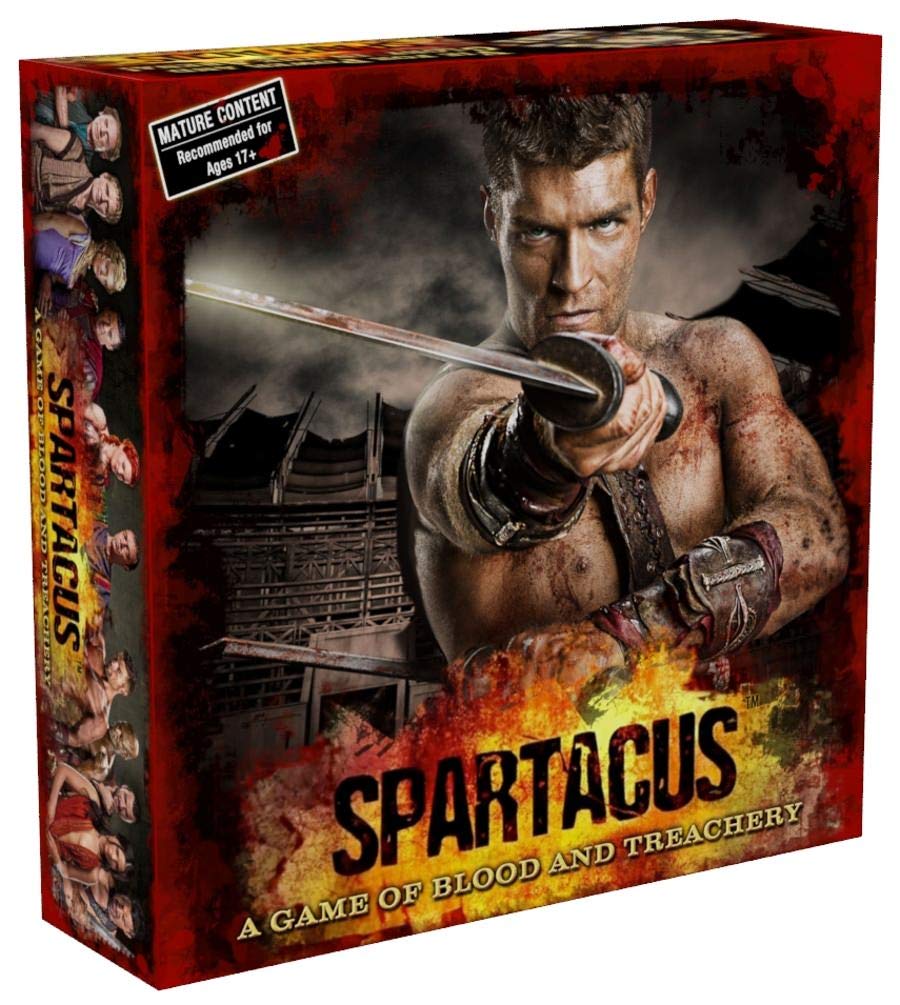
⚔️ Rule Rome’s Shadows: Outsmart, Outbid, Outfight!
Spartacus: A Game of Blood & Treachery is a strategic board game for 3-4 players aged 17+, inspired by the STARZ series. Players compete as Dominus of Roman houses through three dynamic phases—Intrigue, Market, and Arena—combining diplomacy, auction bidding, and dice-based combat. With deep player interaction, fluid trading mechanics, and intense gladiatorial battles, it delivers an immersive, fast-paced experience that’s earned rave reviews and a loyal fanbase.
| ASIN | 0992251613 |
| Best Sellers Rank | #1,175,161 in Toys & Games ( See Top 100 in Toys & Games ) #30,172 in Board Games (Toys & Games) |
| Customer Reviews | 4.9 4.9 out of 5 stars (57) |
| Is Discontinued By Manufacturer | No |
| Item Weight | 3.35 pounds |
| Item model number | GF9 SPAR001 |
| Manufacturer | Battlefront Miniatures USA Ltd |
| Manufacturer recommended age | 15 years and up |
| Product Dimensions | 10.25 x 3 x 10.25 inches |
| Release date | September 1, 2012 |
C**R
Spartacus: A Review
Just wanted to chime in. I'm pretty big into designer board games (active on Board Game Geek, Uber-Fan of Dice Tower, Shut Up and Sit Down etc.). I have never watched the Starz produced television show (although that may change by the time you read this) that this game is based off of, so please take that into consideration. I am usually wary of games (video or otherwise) that are based off of television shows and movies but I have been pleasantly surprised in the past (e.g. "Battlestar Galactica," "Legendary: Encounters"). The company that designed this game, Gale Force Nine have been reasonably successful with their board game versions of popular intellectual properties, the most famous of which is most likely "Firefly." But I digress. It took me a long time to pull the trigger on this game but I'm so glad I did. It's part "take that!" card game, part auction game and part combat (with a fair amount of scheming/dealing/betraying). A game round consists of 3 phases (after some minor bookkeeping): 1. Intrigue Phase (take that! part) This is the phase where each of the players (each playing a Dominus of a great house in Rome) are playing scheme cards from their hands to either gain gold, influence, or to screw with someone else. A player can also sell their scheme cards for gold. Most of the scheme cards require a certain amount of influence to play and if you do not have the influence you can ask one of the other houses for help. Of course, you usually have to make it worth their while with gold, gladiators, slaves, or equipment which can be traded or sold in the next phase..... 2. Market Phase (auction) In this phase, players can offer to trade and sell gladiators, slaves, and equipment. After that is done, four cards are drawn from the market deck and are placed face down. Each card is revealed one at a time and everyone bids the amount of gold they're willing to spend on the card in a closed fist auction. Everyone reveals their bid at the same time and the card goes to the highest bidder. After the market items are bid on, all the players bid to host the next fight in the arena.... 3. Arena (combat) The winner of hosting rights gains influence and also gets to choose two houses (the host may choose his/herself) to duke it out in the arena. A house may refuse, but they lose influence if they do. Each house chooses an individual out of their slaves or (most likely) gladiators and combat is settled with standard six-siders. All houses can then bet their soft-earned gold on which house will be victorious (can't bet against yourself). Also, houses can bet on if there will be a decapitation or injury sustained during the fight. Each character (slave or gladiator) has 3 stats: Attack, Defense, Speed. Attack is the amount of dice a player rolls when attacking, defense is an amount of dice that a player rolls when defending, and speed is the amount a player rolls for initiative (which is rerolled after every round of combat) and also determines how many spaces you can move in the arena. Most of the time, combat ends up with two folks running up to each other as quick as possible and trading blows. Each hit from an attack causes a player to discard a die from their attack, defense, or speed pool. A player loses when he/she is down to one die in each stat. An injury occurs if he/she is down to two dice total (with one stat empty) and decapitation occurs when the player is forced to remove all of his/her dice. Assuming the loser is not decapitated, the host of the game can give a thumbs up/thumbs down which decides the fate of the loser. Of course the host's decision can be "greased" by gold. Meanwhile, the winner gains an influence and that fighter is now favored. If that fighter is brought out again their owner will get 2 gold next time he/she fights in a subsequent arena phase. If the fighter ever gains 3 favored tokens (wins three battles) they become a champion and the owner automatically gains 6 gold when bringing him/her into the arena. The game ends when a house has 12 influence at the end of a round. The starting influence of the houses can also be adjusted to make the game longer or shorter. I pondered heavily about what made me enjoy this game so much and I think that there were two real things about it that stood out for me. The first thing is the fluidity of currency/items. In a lot of games where negotiation occurs there's usually a limit or straight-up prohibition on offering certain items/goods. In this game, literally everything can be traded/sold/bought (with the exception of scheme cards) which enhances the player interaction immensely and manifests the theme very well. The second thing is the memories that this game creates. For me, all of my favorite games have really good stories attached to them. As so many board games do, I guess a lot will depend on the group a player games with, but this has been a hit with every group I've brought it to. People recall winning Spartacus in an auction, only to never use him because they had spent all their money buying him and now never has any money to host. Or everyone bidding on what appeared to be a lock during an arena battle only to have everyone disappointed when the a house's starting gladiator decapitated the fan favorite much to the detriment to everyone's purses. There's also a card or two that make me giggle in a puerile way which I'm convinced are the only reasons this game is suggested for 17 and over players (most of the violence is suggested, not shown). In my experience, the full player count (in the base game) of 4 is the minimum I would play this game with. The scheming/interaction just doesn't work as well with 3 players. If you have a desire to increase the player count, purchase "The Serpent and the Wolf" expansion which ups it to 6 with two extra houses, more cards, and rules for 2 vs. 2 combat in the arena. I have not played the other expansion "The Shadow of Death" as of the date of this review. However, even 6 players flowed really well (with the higher influence boost at the start) in my groups once everyone got a handle on the rules (which even non-gamers can understand within a round or two). Happy gaming!
M**S
My favorite board game ever
So epic. This game is an absolute blast. Even though it says you need at least 3 players minimum, this game works fine just 1 vs 1 and is so much fun either way. The arena phase is exhilarating. My friend/opponent went for the finishing blow and rolled a 6 on his attack dice to take out my gladiator, he was shouting with glee because he thought he won... until I rolled my defense dice and it landed on a 6 to block his attack! Then to his surprise I took him down with the next move. We both went wild with excitement, the thrill is unlike any other board game I've ever played. It multiplies when having more players and things get really crazy in the best way possible. A plus is that the sessions don't drag on and take forever like some board games, in 4 and 1/2 hours we played 3 full 1 vs 1 games, and that included taking breaks. You don't need to like or have watched the TV show to enjoy this, lots of people that didn't like the show love the board game. I like this game so much I'm going to be buying both the expansions for it which allows you to play with up to 7 people. The madness! Overall all the scheming, bribing, betrayal, haggling, table politics, extortion, strategy, and straight up arena brawls make this the coolest and funnest board game I've ever played. 10/10 stars.
A**N
Fun, but not balanced
For me, a truly fun game is balanced. Spartacus is not balanced. Let me make a distinction, there's a difference between "balanced" and "balanced learned curve". I'm not referring to the latter when I say Spartacus is imbalanced. The learning curve is great on Spartacus. Good and less than good players are not equal. Good players do do better, and less than good players do have an obvious enough reward system to help them understand what would make them better. What I mean when I say Spartacus is imbalanced is, however, that when you have a game where each character has unique native advantages and disadvantages, that uniqueness still should be roughly equal to the uniqueness of the characters with their native advantages and disadvantages. Using a simple wizard-game analogy, if I can shoot lightning for tons of damage, and you can shoot ice for less damage, your ice ought to have a secondary effect like chilling your enemies that boosts it. Back to Spartacus, certain characters (houses) are just better than other houses, and not just a little bit, but a lot better. If you're playing a good balanced game, then when a player starts to win, other players will gang up on him/her. The problem with imbalanced characters is that this ganging up starts from the get go and is a necessary strategy in order to win. It makes the games (and the table talk) redundant. However, in many other ways this game excels: you can strategize around your disadvantages, you can table talk your way to victory, etc. I would just suggest three house rules: (1) There's a 12-point victory point (influence) track. Start at four. This avoids that boring part of the game where one player has skyrocketed and losing is obvious and imminent for everyone else. It does this by enabling all characters to do more with the cards they draw so that if someone gets too advantaged too quickly, by making the advantage of the more advantaged characters less sizeable, and by eliminated a stretch of the victory point track. (2) Make it so that players cannot pool their money during the auction phase, including the host auction. This makes the game last a much more reasonable amount of time. And (3) allow players to rent out their weapons, armor, and special items during the arena phase, which allows weaker players to advantage each other through some rental agreement so that the skyrocketing player is not as super advantaged as s/he otherwise would be. With these house rules in mind, I would buy the game. It's fun.
V**I
This board game has lots of great elements - good political maneuvering, engaging gladiator fights, nice balance and a good quality of workmanship. I highly recommend.
G**R
Very enjoyable game that will stay in my collection for a long time. The combat mechanism is unique and adds greatly to the theme of the game.
C**W
Amazing board game. Lots of elements. Twists and turns.
D**N
Awesome game. Great twists and turns.
Trustpilot
5 days ago
1 month ago