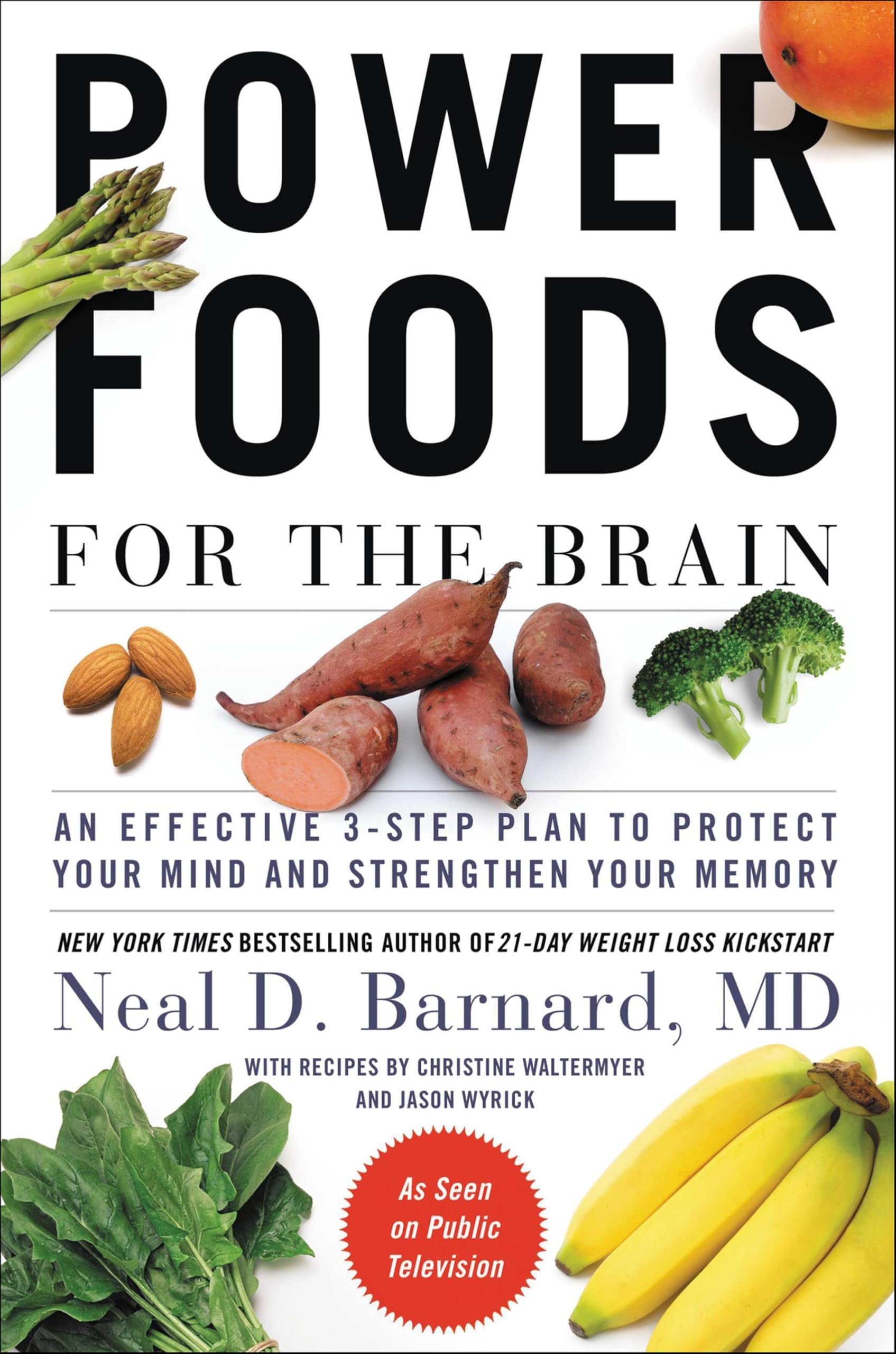
Power Foods for the Brain: An Effective 3-Step Plan to Protect Your Mind and Strengthen Your Memory
Product ID: 99774352
Strengthen your memory with New York Times bestselling author Dr. Neal Barnard's simple 3-step plan to protecting your brain with your diet. Could your breakfast or lunch be harming your memory? Are you missing out on the foods that could prevent Alzheimer's disease? Everyone knows good nutrition supports your overall health, but few realize that certain foods-power foods-can protect your brain and optimize its function, and even dramatically reduce your risk of Alzheimer's Disease. Now, New York Times bestselling author, clinical researcher and health advocate Dr. Neal Barnard has gathered the most up-to-date research and created a groundbreaking program that can strengthen your memory and protect your brain's health. In this effective 3-step plan Dr. Barnard reveals which foods to increase in your diet and which to avoid, and shows you specific exercises and supplements that can make a difference. It will not only help boost brain health, but it can also reduce your risk of Alzheimer's disease, stroke, and other less serious malfunctions such as low energy, poor sleep patterns, irritability, and lack of focus. You'll discover: The best foods to increase cognitive function Dairy products and meats-the dangers they may pose to your memory The surprising roles alcohol and caffeine play in Alzheimer's risk The latest research on toxic metals, like aluminum found in cookware, soda cans, and common antacids. Plus a detailed menu plan, recipes and time-saving kitchen tips Review: Worthy read - This is solid, usable, reasonable advice to achieve some important and specific goals, mainly maintaining your brain health as you age. This book discusses Alzheimer's, but also includes a discussion of how to avoid or reverse general cognitive decline and function so you can boost your memory and recall in just a few weeks. The information in the book is science based, well presented, and a pleasant and easy read. Dr. Barnard has a wonderful sense of humor and is able to explain complex subjects clearly without talking down to his reader. My mother had a stroke a few years ago. When she was recovering, she said her greatest fear was not the possible loss of mobility or discomfort/pain, but the possibility that she might lose her ability to read and work with knitting patterns. Last year I discovered Dr Barnard's other work and my mother and I went on the diet he outlines in his book 21-Day Kickstart Weight Loss 21-Day Weight Loss Kickstart: Boost Metabolism, Lower Cholesterol, and Dramatically Improve Your Health . I wrote a review of that here: http://www.desertcart.com/review/R38EXNJ7X5IP63/ref=cm_srch_res_rtr_alt_1 That diet worked miracles for our health simply by changing our diet. This book will help us extend the benefits of that lifestyle to work miracles for our brain health by showing us what to eat and what to avoid. Dr. Barnard writes in Power Foods about where brain toxins are found in our diet (interestingly, some of the toxins aren't necessarily things to avoid, but things that are a problem if we ingest either too much or too little, or even the wrong form of, for example, some metals). Dr. Barnard writes that just adding an ounce a day of seeds or nuts (for the proper form of vitamin E) will help reduce the risk of Alzheimers by 70%. Add berries, apples, pears, grapes, green leafy vegetables, and beans to your diet. Certainly things we can all do easily! Also, get rid of saturated fats. We all know we need to to this for heart health, and we need to do it for brain health as well. The book also describes brain exercises as well as the benefits of physical exercise and gives some specific things to do. Just a half hour three times a week can make a huge difference. And, very importantly for many of our aging population, what medications can be causing severe damage to our cognition. We found this to be true for my mother. We were able to get her off of her statins from adopting the 21-Day Kickstart diet, and that made a tremendous difference in her ability to think clearly and get rid of the "brain fog" that was following her around like the proverbial dark cloud. We have already made a lot of the changes he suggests in this book, but we are learning some new information to incorporate into our lifestyle, so I would recommend this book even for those who have read other of Dr. Barnard's books. Finding the root cause of cognitive problems can be quite a riddle to solve. I know it has been with my mother. In this book, Dr. Barnard walks you through the variety of things that can be a problem. One of the important things he noted is that not only can medications impact mental function, and the problems can add up as you add more medications. As we discovered in my family, the doctors did not even consider this while medicating my mother, and we had to do the detective work on medications ourselves. Some of the biggest culprits include sleep medications, statins (cholesterol lowering drugs), anti depressants, allergy meds/antihistamines, anxiety medications, pain killers, blood pressure medications, and antacids. Some of these you can just trade out for another kind, but others you really need to see a doctor about and have it managed properly. Dr. Barnard discusses this and tells you how to address the subject with your doctor. We also called our pharmacist and asked him to take a look at what my mother was taking before we saw the doctor so that we arrived to the appointment as informed as possible. In addition to medications, Dr Barnard discusses problems that can arise from other areas, such as food intolerances, depression, menopause (this was a big one for me!), thyroid problems, infections, migraines, cancer treatments, diabetes, and more. There are about 75 recipes in the book. I haven't tried them yet, but they are by the same chef who created the recipes in the Kickstart book, so I expect these to be equally easy to make and quite tasty. Examples of breakfasts include blueberry buckwheat pancakes with veggie sausage and cantaloupe; waffles with maple "bacon;" and breakfast wraps. Examples of lunches include veggie falafel with pita bread and a garden salad; easy colorful pasta salad over mixed greens; English muffin pizza; and a Tuscan wrap. Examples of dinners include red lentil soup with brown rice salad and steamed spinach, tacos with potatoes, swiss chard, and pinto beans with a spinach salad and mashed sweet potato; white bean chili with red rice, steamed spinach, and banana ice cream; and baked ziti with a rainbow salad and strawberry dressing, and warm apple cherry compote. The recipes seem very simple to make without an excessive amount of ingredients or anything excessively costly. I'd like to briefly address the criticism of Dr Barnard's plan that it can be too restrictive or drastic. It may seem that way with an initial look, but to me, loss of brain function and the prospect of losing mobility, cognition, emotions, and the toll that cognitive degeneration can cause on our families are what's really restrictive and drastic. Being bedridden or institutionalized for our later years is restrictive and drastic. Not remembering our children or being able to experience (or even remember) normal emotions is restrictive and drastic. And in light of those very real and unfortunately not uncommon possibilities, Dr Barnard's suggestions are neither restrictive or drastic. Speaking as part of a family that started to make some of these changes about a year ago, they aren't initially easy (it can definitely be hard to give up some of the food we have gotten used to), but if you work at it a little bit at a time and just keep trying, it becomes easier and easier as time goes by (the book has a special section to help deal with food cravings and why we have them). It took way less than a year for our taste buds to change and for this way of life to become not only easy for us, but enjoyable. This book adds to the vast amount of information already out there on the benefits of plant-based diets and is suitable for those who already consider themselves well-read on the subject--there is, of course, some information you will have already heard, but there is more information that is new and important and not available from other mainstream sources. Thank you for reading my review. This is an important topic and I know it's hard for some people to think about some of the changes Dr. Barnard suggests. But it's very do-able. Review: O B V I O U S L Y -- R I G H T - This book is the best I have ever read on the subject of eating right. I got the Kindle version so I also have the X-way function. This gives background information on parts of the book that many readers may not know and page numbers where the subject is in the book for easily review. What a great way to enhance such a great book! I'm a senior citizen, 74, and have been slowly improving my food choices for more than twenty years. With all the fairly recent discoveries of the benefits of certain foods, and the harmfulness of others, I have still made some mistakes. And even while I really was benefiting from my improvements. I had reasoned, for example, that fish high in Omega 3's was something to eat a lot of - along with supplemental fish oil capsules. Result, I have to take a med to control high blood pressure. This is not a complaint. I'm otherwise in good health. I'd be already dead if I hadn't made the diet and exercise corrections that I did make. But,none the less, I should have known better. Long before retirement I worked in the laboratory of a 7th Day Adventist Hospital. They touted the benefits of a vegetarian diet. The Chief of Surgery was in his 80's. I was privileged to attend the weekly physicians meetings that provided a banquet of delicious vegetarian dishes. Many of these meetings involved differences in certain kinds of cancers between vegetarians and non-vegetarians. I also saw a report on television - American groups that lived longest - yes, 7th Day Adventists vegetarians. After reading Dr. Barnard's book, Power Foods . . . I think I'll make another try for perfection. I can't argue with his credentials, the facts he presents, or the clear and stepwise method. His 3-step plan seems simple enough and I think sufficient. The recipe section of the book will help. I've already adjusted my exercise for better safety and for better coverage of my whole exercise needs. One of the great parts of this book discusses mental/chemical causes for obesity and addictions. For the first time I feel comfortable with my own understanding this process. Dr. Barnard writes clearly, simply, and does not confuse the reader with too much information. For me, this part may be the most important part. Now I have a better understanding of the central problem and can better control myself and my appetite. Of course this book isn't just for seniors. I recommend it for everyone - everyone who wants to live long, stay in good health as long as possible, and (as a bonus) always be in control of their lives.
| Best Sellers Rank | #593,457 in Kindle Store ( See Top 100 in Kindle Store ) #136 in Neurology (Kindle Store) #155 in Alzheimer's Disease #174 in Memory Improvement (Kindle Store) |
F**A
Worthy read
This is solid, usable, reasonable advice to achieve some important and specific goals, mainly maintaining your brain health as you age. This book discusses Alzheimer's, but also includes a discussion of how to avoid or reverse general cognitive decline and function so you can boost your memory and recall in just a few weeks. The information in the book is science based, well presented, and a pleasant and easy read. Dr. Barnard has a wonderful sense of humor and is able to explain complex subjects clearly without talking down to his reader. My mother had a stroke a few years ago. When she was recovering, she said her greatest fear was not the possible loss of mobility or discomfort/pain, but the possibility that she might lose her ability to read and work with knitting patterns. Last year I discovered Dr Barnard's other work and my mother and I went on the diet he outlines in his book 21-Day Kickstart Weight Loss 21-Day Weight Loss Kickstart: Boost Metabolism, Lower Cholesterol, and Dramatically Improve Your Health . I wrote a review of that here: http://www.amazon.com/review/R38EXNJ7X5IP63/ref=cm_srch_res_rtr_alt_1 That diet worked miracles for our health simply by changing our diet. This book will help us extend the benefits of that lifestyle to work miracles for our brain health by showing us what to eat and what to avoid. Dr. Barnard writes in Power Foods about where brain toxins are found in our diet (interestingly, some of the toxins aren't necessarily things to avoid, but things that are a problem if we ingest either too much or too little, or even the wrong form of, for example, some metals). Dr. Barnard writes that just adding an ounce a day of seeds or nuts (for the proper form of vitamin E) will help reduce the risk of Alzheimers by 70%. Add berries, apples, pears, grapes, green leafy vegetables, and beans to your diet. Certainly things we can all do easily! Also, get rid of saturated fats. We all know we need to to this for heart health, and we need to do it for brain health as well. The book also describes brain exercises as well as the benefits of physical exercise and gives some specific things to do. Just a half hour three times a week can make a huge difference. And, very importantly for many of our aging population, what medications can be causing severe damage to our cognition. We found this to be true for my mother. We were able to get her off of her statins from adopting the 21-Day Kickstart diet, and that made a tremendous difference in her ability to think clearly and get rid of the "brain fog" that was following her around like the proverbial dark cloud. We have already made a lot of the changes he suggests in this book, but we are learning some new information to incorporate into our lifestyle, so I would recommend this book even for those who have read other of Dr. Barnard's books. Finding the root cause of cognitive problems can be quite a riddle to solve. I know it has been with my mother. In this book, Dr. Barnard walks you through the variety of things that can be a problem. One of the important things he noted is that not only can medications impact mental function, and the problems can add up as you add more medications. As we discovered in my family, the doctors did not even consider this while medicating my mother, and we had to do the detective work on medications ourselves. Some of the biggest culprits include sleep medications, statins (cholesterol lowering drugs), anti depressants, allergy meds/antihistamines, anxiety medications, pain killers, blood pressure medications, and antacids. Some of these you can just trade out for another kind, but others you really need to see a doctor about and have it managed properly. Dr. Barnard discusses this and tells you how to address the subject with your doctor. We also called our pharmacist and asked him to take a look at what my mother was taking before we saw the doctor so that we arrived to the appointment as informed as possible. In addition to medications, Dr Barnard discusses problems that can arise from other areas, such as food intolerances, depression, menopause (this was a big one for me!), thyroid problems, infections, migraines, cancer treatments, diabetes, and more. There are about 75 recipes in the book. I haven't tried them yet, but they are by the same chef who created the recipes in the Kickstart book, so I expect these to be equally easy to make and quite tasty. Examples of breakfasts include blueberry buckwheat pancakes with veggie sausage and cantaloupe; waffles with maple "bacon;" and breakfast wraps. Examples of lunches include veggie falafel with pita bread and a garden salad; easy colorful pasta salad over mixed greens; English muffin pizza; and a Tuscan wrap. Examples of dinners include red lentil soup with brown rice salad and steamed spinach, tacos with potatoes, swiss chard, and pinto beans with a spinach salad and mashed sweet potato; white bean chili with red rice, steamed spinach, and banana ice cream; and baked ziti with a rainbow salad and strawberry dressing, and warm apple cherry compote. The recipes seem very simple to make without an excessive amount of ingredients or anything excessively costly. I'd like to briefly address the criticism of Dr Barnard's plan that it can be too restrictive or drastic. It may seem that way with an initial look, but to me, loss of brain function and the prospect of losing mobility, cognition, emotions, and the toll that cognitive degeneration can cause on our families are what's really restrictive and drastic. Being bedridden or institutionalized for our later years is restrictive and drastic. Not remembering our children or being able to experience (or even remember) normal emotions is restrictive and drastic. And in light of those very real and unfortunately not uncommon possibilities, Dr Barnard's suggestions are neither restrictive or drastic. Speaking as part of a family that started to make some of these changes about a year ago, they aren't initially easy (it can definitely be hard to give up some of the food we have gotten used to), but if you work at it a little bit at a time and just keep trying, it becomes easier and easier as time goes by (the book has a special section to help deal with food cravings and why we have them). It took way less than a year for our taste buds to change and for this way of life to become not only easy for us, but enjoyable. This book adds to the vast amount of information already out there on the benefits of plant-based diets and is suitable for those who already consider themselves well-read on the subject--there is, of course, some information you will have already heard, but there is more information that is new and important and not available from other mainstream sources. Thank you for reading my review. This is an important topic and I know it's hard for some people to think about some of the changes Dr. Barnard suggests. But it's very do-able.
B**N
O B V I O U S L Y -- R I G H T
This book is the best I have ever read on the subject of eating right. I got the Kindle version so I also have the X-way function. This gives background information on parts of the book that many readers may not know and page numbers where the subject is in the book for easily review. What a great way to enhance such a great book! I'm a senior citizen, 74, and have been slowly improving my food choices for more than twenty years. With all the fairly recent discoveries of the benefits of certain foods, and the harmfulness of others, I have still made some mistakes. And even while I really was benefiting from my improvements. I had reasoned, for example, that fish high in Omega 3's was something to eat a lot of - along with supplemental fish oil capsules. Result, I have to take a med to control high blood pressure. This is not a complaint. I'm otherwise in good health. I'd be already dead if I hadn't made the diet and exercise corrections that I did make. But,none the less, I should have known better. Long before retirement I worked in the laboratory of a 7th Day Adventist Hospital. They touted the benefits of a vegetarian diet. The Chief of Surgery was in his 80's. I was privileged to attend the weekly physicians meetings that provided a banquet of delicious vegetarian dishes. Many of these meetings involved differences in certain kinds of cancers between vegetarians and non-vegetarians. I also saw a report on television - American groups that lived longest - yes, 7th Day Adventists vegetarians. After reading Dr. Barnard's book, Power Foods . . . I think I'll make another try for perfection. I can't argue with his credentials, the facts he presents, or the clear and stepwise method. His 3-step plan seems simple enough and I think sufficient. The recipe section of the book will help. I've already adjusted my exercise for better safety and for better coverage of my whole exercise needs. One of the great parts of this book discusses mental/chemical causes for obesity and addictions. For the first time I feel comfortable with my own understanding this process. Dr. Barnard writes clearly, simply, and does not confuse the reader with too much information. For me, this part may be the most important part. Now I have a better understanding of the central problem and can better control myself and my appetite. Of course this book isn't just for seniors. I recommend it for everyone - everyone who wants to live long, stay in good health as long as possible, and (as a bonus) always be in control of their lives.
D**N
This is a wonderful book about how to help your brain
This is a wonderful book about how to help your brain. These are the concrete steps that will help improve the health of your brain, and reduce the risk of certain debilitating diseases. Most notably, Alzheimer's disease is the most dreadful. Dr. Neal Barnard goes through all of the ideas that people have advanced for avoiding Alzheimer's disease. He focuses on the lifestyle approaches that might really help. Some commonly held ideas have no scientific evidence, but do have some anecdotal support. Barnard clearly states which ideas are speculative, and which are backed by hard evidence. For example, dairy products and meats can have deleterious effects on memory, and the effects of saturated fats on the risk of developing dementia. Omega-3 fat supplements have been shown to be no better than a placebo in forestalling memory loss. Fish oil also has no benefit. In the so-called blue zones, even in Okinawa and Sardinia where people commonly live to 100, fish is not a big part of the diet. The Mediterranean diet is better than the Standard American Diet (SAD), but its helpfulness in reducing the risk of Alzheimer's is not conclusive. Some metals, when ingested in excess, can also lead to brain issues. Metals like copper, iron, and zinc are all needed in small quantities. They are absorbed from both plant food and animal food. But when absorbed from plants the absorption is self-regulating, unlike animal sources. Too much absorbed metals are harmful to the brain. People following plant-based diets keep their iron levels in a healthy range. They don't experience anemia, but unlike meat-eaters, they do not accumulate excess iron. The role of aluminum in Alzheimer's is controversial. But, Dr. Barnard maintains that it is best to play it safe. He advances a number of recommendations on how to minimize aluminum intake. Interestingly, donating blood is the fastest way to remove excessive iron from one's body. The book goes into some detail about how exercise can help your brain. Dr. Barnard not only recounts some of the research into the benefits of exercise, but also describes the mechanisms of how exercise works to improve brain function, from a chemical and genetic point of view. I have personally attended many seminars given by Dr. Barnard. He is a true authority on these subjects. He has devoted his professional life to researching the effects of lifestyle changes on health. He never comes off as preachy. He states the facts, and allows people to make up their own minds. I recommend this book to anyone who has a brain, and wishes to protect it.
M**H
bad advice on weight bearing exercise
I liked the book and it had plenty of great information which taught me a lot. What surprised me was how poor his information was about the weight exercise program. With the walking portion he was so careful and thoughtful about how to start and when to progress to various levels. The weight lifting section was, "lift whole body three times a week with the maximum you can lift for eight to ten repetitions times three sets." This will result in you being so sore you won't be able to move from your bed for a week the first time you try. The idea of consulting a trainer was just as poor. Certified trainers are just as bad as certified nutritionists. Following their advice will get you injured, or you'll give up the program within a short time. The lifting should start very light with repetitions in the single set 20 range that you can do very easily. After two days see how sore you are (maximum soreness occurs on the 2nd day) and don't lift again until the soreness passes. Weather you lift three times a week whole body depends on your age, and recovery ability. The older you get the longer it will take to recover. It might make more sense to break the body into three parts and exercise each on one of the three days until the entire body is worked in one week. In fact depending on age and condition start at home with no weight squats using just your body weight and use a chair for help and woman's pushups starting from the knees. You can progress from there to see if you can handle training each body part twice a week or three times. The reason you start with 20 repetitions is that the muscles will grow stronger much faster than the tendons. The tendons have a poor blood supply in comparison to the muscles. In fact if you are the type of person that the doctor describes your supply of blood to the tendon area is even poorer. It will require a good six months of lifting in the 15 to 20 repetition range before you are ready for efforts in the 8 to 10 range. If you push it faster you'll end up with tendonitis in various joints of the body that will take six months or a year to heal.....the first time, if ever. It's even worse for older jocks that haven't lifted in a while. Their muscles will grow faster due to muscle memory and their probability of tendon damage is even higher. Muscles have memory just like fat cells. Fat cells after a hard diet will very quickly regain their prior size when you rebound on the diet, the same occurs with muscles. If you had seventeen inch arms at one time and it took six years of hard lifting to get to that point the first time, it will take six months the 2nd time around because of muscle memory, but your tendons don't work in the same way. Take it from a 64 year old who has lifted on and off for 50 years about my advice. I wish someone would have given it to me 50 years ago. I've damaged my bicep tendon to the point it's painful just to lift a glass of water.
C**J
Great information and easy to understand.
Great book. Well made and binders are strong. Lots of great information. Great information. Recommend highly.
B**Y
Quick and Quality
Quick response and the book was in excellent condition.
M**T
I'm confused
Interesting informatiom but I really don't know how corn an wheat is going to help the brain. For years all you heard was how bad wheat is an that corn is genetically modified or at least 90 percent of it is an dr. Barnard has those ingredients in his recipes. I haven't had wheat in at least six years now an I don't plan on having it now. I feel that every other week there's a dr. Claiming that they have the right diet for the brain. An I got a tell you I think these drs. Confuse people even more. I'm not sure what diet plan to go with to be honest . First it was the medatarian diet then you have the low carb diet now this book is high carb diet what the heck. Which one is it. I did a vegaterian / vegan diet for one year an I had stage four adrenal fatigue an thyroid problems. So for me I'm going to keep my animal protein . I need it for my adrenals. I also want to add if your a women eating this why this is not healthy if your still menstrating. You'll wand up anemic
E**D
Eye Opening
The narrative and data presented in this book are compelling. You do not have to go gently into old age with diminished capacity and feeble health. Neither do you need to starve and eat unappetizing meals. This book presents the data and a plan to change your path to a fuller and happier aging process. I have lived my entire life following the Standard American Diet (SAD) and thought I was getting what I needed to be happy and healthy. Over the years my weight has steadily increased and blood pressure has been an issue. Normal I thought because I was a typical middle ager with an expanding waist line and decreasing energy - you know, getting old. When I retired, one of the hobbies I started was cooking. Being an engineer I wanted to start with the science and data to ensure I was doing it right. This means solid nutrition as well as taste. I saw Dr. Bernard on TV and was impressed enough to get his book and start reading it. I took the three week challenge and felt years younger at the end of the test - weight loss, blood pressure, more energy, and thinking clearer. Since reading this book, I have also read the nutritional books "Super Immunity" and "The End of Dieting" by Dr. Furman. These books have reinforced what "Power Food for the Brain" has taught me and provided more specific food planning tools. All three make a readable reference library for nutrition and health.
J**K
Good true reading
Excellent reports
F**1
Mind-blowing
I read this book in a very short time. It's compelling, simple, and teaches everything that everyone should know about food for our brain's health. Absolutely recommend it.
O**N
Mit der richtigen Ernährung: Ein Leben lang geistig fit!
Vorab: Das Buch ist auch für Nicht-Muttersprachler (Englisch) leicht zu lesen. Der Autor erläutert nicht nur die Zusammenhänge zwischen dem Gehirn und verschiedenen Einflussfaktoren, sondern gibt auch konkrete Praxistipps, was man machen/ändern sollte. Zahlreiche Referenzen am Ende des Buchs bestätigen alle seine wissenschaftlich fundierten Aussagen. Interessant ist auch das Kapitel über Metalle (wie Kupfer, Eisen und Zink), welche man in ausreichender Menge über die Nahrung (Bohnen, grünes Gemüse, Nüsse, Vollkornprodukte usw.) bereits aufnimmt. Es wird jedoch sogleich klar gestellt, das zuviel von diesen Metallen für unser Gehirn toxisch ist. Man denke jetzt nur an die zahlreichen Nahrungsergänzungsmittel, wo z.B. Zink einfach mit Vitamin C (speziell in Erkältungsprodukten) verkauft wird und wie schnell man da toxische Mengen einnehmen kann. Er geht nicht nur auf ernährungsbedingte Probleme und Lösungen in Bezug auf die Gehirnleistung ein, sondern auch auf mentales und körperliches Training fürs Gehirn. Auch hier wieder zig Praxistipps. Am Ende findet man noch nette Rezepte, wenn auch eher nach US-Geschmack. Insgesamt ein super interessantes Buch voll mit massenhaft Informationen und Tipps!
A**R
Five Stars
Wonderful book.
P**E
Very Informative
A very informative book explaining the importance of brain health. It is written in a clear and simple manner, easy for anyone to understand. The doctor basically explains the importance of a high plant-based diet, regular exercise, and brain exercises for good health. All this of course, is easier said than done. Too many people read books like this and don't follow through with the good advice.
Trustpilot
1 month ago
2 weeks ago