Buy anything from 5,000+ international stores. One checkout price. No surprise fees. Join 2M+ shoppers on Desertcart.
Desertcart purchases this item on your behalf and handles shipping, customs, and support to Poland.
๐ก๏ธ Stay ahead of the curve with precision you can trust!
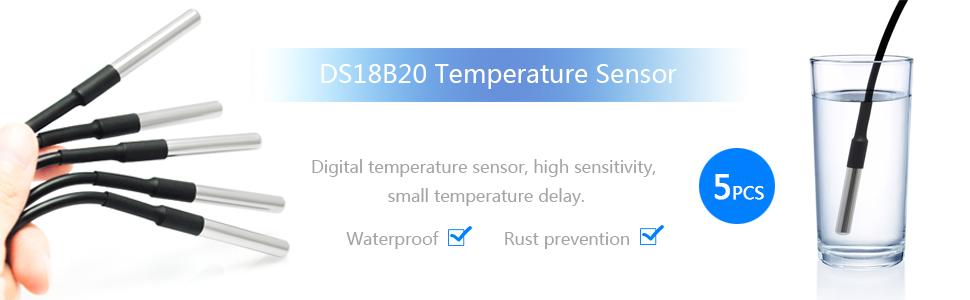
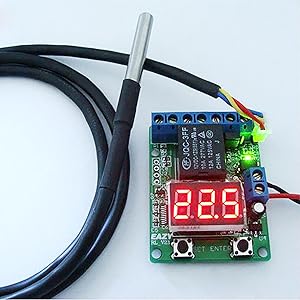
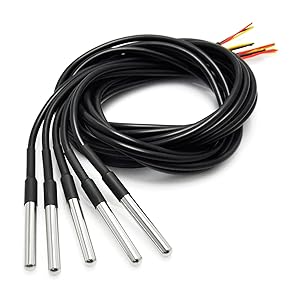
The Gikfun 5PCS DS18B20 Waterproof Digital Thermal Probe Sensors deliver professional-grade temperature monitoring with 1-meter long probes, a wide 3.0-5.5V power range, and robust waterproof construction. Designed for Arduino and similar microcontrollers, these sensors offer reliable, high-resolution digital output ideal for industrial, consumer, and experimental applications. The pack of five enables multi-point sensing, while their durable build and noise-resistant design ensure consistent performance even in challenging environments.


| ASIN | B012C597T0 |
| Additional Features | Waterproof |
| Age Range (Description) | Adult |
| Age Range Description | Adult |
| Best Sellers Rank | #96,101 in Industrial & Scientific ( See Top 100 in Industrial & Scientific ) #141 in Temperature Probes & Sensors |
| Brand | Gikfun |
| Brand Name | Gikfun |
| Color | Black |
| Connectivity Technology | Usb |
| Customer Reviews | 4.5 out of 5 stars 517 Reviews |
| Display Type | Digital |
| Immersion Depth | 100 Centimeters |
| Included Components | 5x DS18B20 Temperature Sensor, Waterproof Digital Thermal Probe, Adapter Module for Arduino |
| Indoor Outdoor Usage | Outdoor |
| Item Length | 100 Centimeters |
| Item Weight | 0.15 Pounds |
| Manufacturer | Esooho |
| Model | LYSB00Q9YBIJI-ELECTRNCS |
| Model Name | Gikfun DS18B20 |
| Outer Material | Plastic |
| Part Number | LYSB00Q9YBIJI-ELECTRNCS |
| Power Source | DC Power Supply |
| Product Care Instructions | Wipe Clean |
| Response Time | 500 Milliseconds |
| Reusability | Rechargeable |
| Special Feature | Waterproof |
| Specification Met | Yes |
| Style Name | Probe |
| UPC | 707948005660 703510988669 |
| Unit Count | 3.0 Count |
| Upper Temperature Range | 125 Degrees Celsius |
S**Y
Easy to use, usually reliable
We have been using these to monitor and control experimental aquaria. Several of these sensors hung in salt water for several months with no problems. There is just one negative - sometimes there are spurious readings of -127C (probably what you get when the value overflows or the bits are all zeros). I don't think this is exactly a malfunction, because it is probably caused by electromagnetic fields or current leakage from other equipment. Still, it would be nice to have a way to prevent this. Other researchers have seen the same thing. [see edit at the end] Still, we are sticking with these sensors. They are reasonably priced, and seem to have no other problems. If there are a lot of bad values we find the problem equipment and remove it. Otherwise we just have the Arduino sketch ignore the -127 C value and use the most recent reasonable one. Update for geeks only: we are up to 12 of these in use now, some for about 8 months. I did a calibration test with all 12 in the same insulated container of water at about 20 degrees C. The standard deviation among the sensors was 0.11 degrees. Three expensive HOBO loggers had a lower standard deviation (0.03) and indicated 0.35 degrees warmer, but I don't have any evidence that the HOBOs are actually more accurate. At 36 C, the standard deviation for the Gikfun sensors was up to 0.17, but I can't quote a temperature difference because the HOBO logger are very slow and the water was cooling enough to make the HOBO values unreliable. Edit, June 2019. I found the source of most of our sensor errors. We are powering our Arduinos with a 12 V power supply which is apparently very noisy. The Arduino itself tolerates this perfectly, we the problem wasn't obvious. Just putting a big capacitor across the 12 V wires before they go into the Arduino made the errors go away. A proper filter with optimal capacitors and an inductor would be even better.
T**.
Professional fit and finish! Perfect 1/4" probe fits into an RO T fitting. Accuate!
These will super glue into any Tee connector with the right glue. Using Starbond Toughened Medium Thick CA. The super glue isn't needed for low pressure, but once over 20psi, I had to glue it in as it is installed in a system at 65psi. Temperature is accurate, though a little slow in responding. The whole metal sleeve needs to get to temp, or more than the 1/8" I have in the water stream, so it lags the water temperature by about 3-5 degrees, but once taken into account, or at temperature for a period of time, the temperature matches other thermometers including a Fluke thermocouple to within 1ยฐF. The downside is conversion takes 1/8 second to 7/8 second depending on resolution. 10 bit is best, as 8 bit microcontrollers aren't so accurate beyond that unless in a critical application. This is due to the Dallas OneWire sensor and not the probe or cable attached to it. They are VERY high quality and professional supple cable with strain relieved weatherproof end at metal probe side. I crimped JST connectors to the wires simply for portability as I glued a few into Tees for RO monitoring, the lack of a connector is a bonus as it allows you to use what is needed. Out of box the wires are tinned and stiff enough to plug directly into a breadboard for a microcontroller. Using with both a PIC32 and Arduino and having zero issues.
S**B
Works great with the Shelly add-on
Am using for temp sensors in home assistant on a Shelly add-on for a Shelly 1 plus. Have one probe outside, one inside, and another on my hot water heater. Easy and works, cheap, stable, accurate enough, and no battery to deal with.
C**S
Recomended for small, non-sensitive projects.
One of the sensors had a very wild readout (off by +-20F), but I imagine it was a fluke. The sensors are accurate to a ~2 degree Fahrenheit, so you probably don't want them for super sensitive data collection but for an ambient room temperature sensor they work great. You will need to use Dallas OneWire protocol for these, but there are libraries available and if you read the docs it should be a non-issue. Docked one star for the bad sensor, but other than that they are good sensors that work well for a budget.
N**K
Easy to use, well constructed
For me they were very easy to set up. I used the milesburton/DallasTemperature libary which requires the paulstoffregen/OneWire. The example from the library worked fine. My problem requires three sensors so it was nice to discover that all three can share the same Aruino/ESP pin. All three red wires to 5V all three black to ground and all three yellow to my data pin - makes wiring nice and easy. Note the data pin requires a pull up resistor 4k7 or 5k. Just one irrespective of how many devices. The in built pull up is not sufficient. Some users have reported issues if the power supply is noisy so if you get odd readings try adding a capacitor across the power input Each device has an 8 byte ID. The sample code from the library scans the devices and reports the IDs so you can hard code them for future use and know which sensor you are reading from. On my desk all five reported the same temperature. Of course they could all be off by the same amount but I took it as a good sign. They responded fairly quickly to being held in my hand so I believe the sensor is in good thermal contact with the case. Holding each unit in turn was how I figured out which address went with which sensor. They appear to be well made. Nice long cable and a nicely finished stainless steel case.
T**M
Works Great + Arduino Setup Help
These is a great product, but functions differently what I was expecting. This isn't some basic analog temperature sensor. This is a digital temperature sensor and supports multiple sensors (with distinct temperature values) on one data pin. For those of you who don't know how to use these, see below. Wiring: VCC 5v to Red VCC VCC 5V to 5K (4.7K) Ohm pull-up resistor to Yellow Data Yellow Data Pin to desired Digital pin (You can put all three of these on a single digital pin.) - I'm an idiot and accidentally grounded the data pin. Don't do that, it won't work. I promise. Ground to Black Ground Code: You need two libraries to use these temperature sensors. 1) OneWire - Since I can't add links, Google for "GitHub PaulStoffregen/OneWire" 2) DallasTemperature - Google for "GitHub milesburton Arduino-Temperature-Control-Library" Once all libraries are installed into your Arduino Lib folder, you can try it out: #include <OneWire.h> #include <DallasTemperature.h> OneWire oneWire(7); // Digital Pin 7 DallasTemperature dTemp(oneWire); void setup() { Serial.begin(9600); } void loop() { dTemp->requestTemperatures(); Serial.println("Temp @ Index 0: " + String(dTemp->getTempFByIndex(0))); // Get the first temperature. }
M**E
7 Working Non-Stop for 2 Years Indoor/Outdoor/Attic
I have had 7 of these running non-stop for 2 years. I am in Dallas, TX. 1 is in the attic, 1 is outside, and the rest are inside. I have had one of the sensors do the same thing as one other reviewer describes - stopped working by reading only 32F. The rest have worked perfectly for the entire 2 years, through hot, cold, wet, and dry. I had spliced some female jumper wire ends to them (with heat shrink tubing to protect the solder joints) and they easily plug into the RPi header pins. Great product with a low enough price and failure rate for me.
W**E
Really easy to use and very accurate
I'm using these to monitor the refrigerator at our food pantry with a nodeMCU, and it's perfect. I don't really need the waterproof quality, but I like knowing it's not going to be bothered by high humidity or occasional wetness. I use the OneWire.h and DallasTemperature.h libraries and it's been great from day one.
B**2
Great temperature sensor
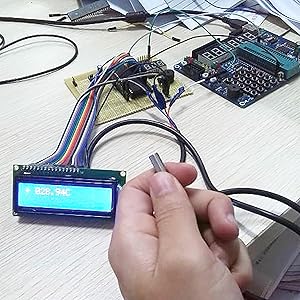
Got 3 of them with a cable about 1m long. I hooked one up to an arduino with LCD pannel and it works great. The other one if hooked up to a Raspberry pi 3 and also works great. All sensors read the same temperature which is good.
D**H
Great price.
Needed a replacement for a damaged sensor. I've only used one so far, but it was perfect. They look to be good quality and the price is good. I'll be using the rest in future projects. The even include the pull up resistors.
A**S
Pico using Temperature sensors with pull-up resistors
Delivered on time as a quantity of 5 as per the photo and not as described โpack of 3โ. Setup using one of the five 4.7kohm pull-up resistors in conjunction with a pi pico 2W microcontroller. Straight forward to implement and readings obtained from the three temperature sensors I setup all work perfectly. I have not checked the accuracy against a typical glass thermometer , however, all readings were within 0.5degC of each other at ambient temperature of 17.5degC.
R**E
good and accurate.
good and accurate. Good for monitoring the soiltemp in the greenhouse and chickenhouse. I used others with heatshrink before but after some time they are rotten.
P**R
They work really well
These work perfect with an ESP32 on Home Assistant using them to keep an eye on my hot water tank and solar water heater
Trustpilot
2 days ago
2 months ago