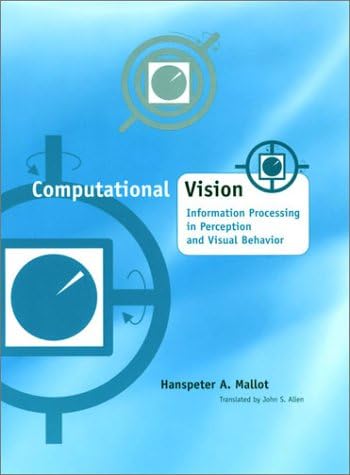
Computational Vision: Information Processing in Perception and Visual Behavior
Product ID: 814328635
Buy anything from 5,000+ international stores. One checkout price. No surprise fees. Join 2M+ shoppers on Desertcart.
Desertcart purchases this item on your behalf and handles shipping, customs, and support to Poland.
Buy Computational Vision: Information Processing in Perception and Visual Behavior by Mallot, Hanspeter A., Allen, John S. online on desertcart.ae at best prices. ✓ Fast and free shipping ✓ free returns ✓ cash on delivery available on eligible purchase. Review: First, even though the title of this book is "neuroscience," it really IS in the newer field of computational vision that includes both human and machine vision. My field is robotics, and I loved this book! The first difference between this book and dozens of others, it that it IS a math book on computational vision, not neuron firing and spiking, and attempting to understand vision with "older biology." By this I mean that "newer" biology includes dynamical systems, differential equations, algorithms and computation, even if not overtly discussing machine vision. The second difference is that it is one of only a few that not only cover the math, but also explain it in English so that those who don't have a year of linear algebra can also "get" it with a little effort. A few of the others include: 1. The CLASSIC by David Marr that started the whole movement of "Can this vision thing (in humans) be the brain using numerical methods to solve Fourier transforms and translate spherical geometry-- Vision: A Computational Investigation into the Human Representation and Processing of Visual Information . This is "old" but still relevant, and you should be able to get a good deal on it used. 2. The MOST RECENT computational vision text by Davies. This is 2012, 900+ pages and NOT cheap. However, given the over 50 titles in this area, Davies is the ONLY ONE that takes the time to painstakingly explain complex engineering at a bright High School level. Not explicitly on the neuro side, but contains a LOT of computational vision topics: Computer and Machine Vision, Fourth Edition: Theory, Algorithms, Practicalities . The next closest text costs over $200 US and isn't nearly as introductory or self study student friendly. Those with a bio background will LOVE this way more than buying 5 separate image and digital signal processsing books, only to find they are way over our heads. Beyond those two are only a few others that take the time to explain the math both with figures/ diagrams and tables as well as the English and the math: STONE: Seeing: The Computational Approach to Biological Vision ; Zeki (one of the best treatments of color vision): Vision of the Brain ; and Palmer: Vision Science: Photons to Phenomenology . There are many others that cover the same material as these fine texts, but they are solid math, assume you can handle differential equations and linear algebra well, and don't give intuitive "co-explanations" for the math. This text, as well as those above, take the time to do that, making it/them ideal for introductions for students coming to math, robotics, machine vision and engineering from other areas (bio, neuro, medicine) as well as auto didacts. Highly recommended. TIP: CHECK both desertcart third parties and Abe books (desertcarts partner) for these titles USED for significant discounts. I DO NOT recommend these titles for e-readers like Kindle because the math formulas get slaughtered, you'll want the figures close, and you'll want to mark in the margins. Library Picks reviews only for the benefit of desertcart shoppers and has nothing to do with desertcart, the authors, manufacturers or publishers of the items we review. We always buy the items we review for the sake of objectivity, and although we search for gems, are not shy about trashing an item if it's a waste of time or money for desertcart shoppers. If the reviewer identifies herself, her job or her field, it is only as a point of reference to help you gauge the background and any biases.
| Customer reviews | 5.0 5.0 out of 5 stars (1) |
| Dimensions | 23.52 x 18.42 x 2.31 cm |
| Edition | 2nd ed. |
| ISBN-10 | 0262133814 |
| ISBN-13 | 978-0262133814 |
| Item weight | 680 g |
| Language | English |
| Print length | 320 pages |
| Publication date | 10 October 2000 |
| Publisher | Bradford Books |
| Reading age | 18 years and up |
P**Z
First, even though the title of this book is "neuroscience," it really IS in the newer field of computational vision that includes both human and machine vision. My field is robotics, and I loved this book! The first difference between this book and dozens of others, it that it IS a math book on computational vision, not neuron firing and spiking, and attempting to understand vision with "older biology." By this I mean that "newer" biology includes dynamical systems, differential equations, algorithms and computation, even if not overtly discussing machine vision. The second difference is that it is one of only a few that not only cover the math, but also explain it in English so that those who don't have a year of linear algebra can also "get" it with a little effort. A few of the others include: 1. The CLASSIC by David Marr that started the whole movement of "Can this vision thing (in humans) be the brain using numerical methods to solve Fourier transforms and translate spherical geometry-- Vision: A Computational Investigation into the Human Representation and Processing of Visual Information . This is "old" but still relevant, and you should be able to get a good deal on it used. 2. The MOST RECENT computational vision text by Davies. This is 2012, 900+ pages and NOT cheap. However, given the over 50 titles in this area, Davies is the ONLY ONE that takes the time to painstakingly explain complex engineering at a bright High School level. Not explicitly on the neuro side, but contains a LOT of computational vision topics: Computer and Machine Vision, Fourth Edition: Theory, Algorithms, Practicalities . The next closest text costs over $200 US and isn't nearly as introductory or self study student friendly. Those with a bio background will LOVE this way more than buying 5 separate image and digital signal processsing books, only to find they are way over our heads. Beyond those two are only a few others that take the time to explain the math both with figures/ diagrams and tables as well as the English and the math: STONE: Seeing: The Computational Approach to Biological Vision ; Zeki (one of the best treatments of color vision): Vision of the Brain ; and Palmer: Vision Science: Photons to Phenomenology . There are many others that cover the same material as these fine texts, but they are solid math, assume you can handle differential equations and linear algebra well, and don't give intuitive "co-explanations" for the math. This text, as well as those above, take the time to do that, making it/them ideal for introductions for students coming to math, robotics, machine vision and engineering from other areas (bio, neuro, medicine) as well as auto didacts. Highly recommended. TIP: CHECK both Amazon third parties and Abe books (amazons partner) for these titles USED for significant discounts. I DO NOT recommend these titles for e-readers like Kindle because the math formulas get slaughtered, you'll want the figures close, and you'll want to mark in the margins. Library Picks reviews only for the benefit of Amazon shoppers and has nothing to do with Amazon, the authors, manufacturers or publishers of the items we review. We always buy the items we review for the sake of objectivity, and although we search for gems, are not shy about trashing an item if it's a waste of time or money for Amazon shoppers. If the reviewer identifies herself, her job or her field, it is only as a point of reference to help you gauge the background and any biases.
Trustpilot
3 days ago
1 month ago