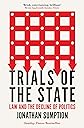
Trials Of The State
Product ID: 540348835
Desertcart purchases this item on your behalf and handles shipping, customs, and support to Poland.
Trials Of The State [Sumption, Jonathan] on desertcart.com. *FREE* shipping on qualifying offers. Trials Of The State Review: Politics vs. Law — Who Should Call the Shots? - Jonathan Sumption’s Trials of the State offers a compelling critique of the increasing entanglement between law and politics in modern democracies. Drawing from his experience as a former UK Supreme Court judge, Sumption argues that courts have increasingly taken on roles traditionally reserved for elected politicians, particularly in areas like human rights and constitutional interpretation. Review: The legitimacy of a democracy to its people is what is essential to its survival - This brief book is a bleakly provocative discussion of politics and law. The author, a distinguished barrister and judge, questions whether judges and written constitutions are a solution to the essentially political problems modern western democracies are facing. The legitimacy of a government is paramount. If the populace do not accord the state legitimacy, it will cease to be a democracy, and no resort to a supreme constitution that preempts a parliament, nor delegating power to judges can save it
| Best Sellers Rank | #2,325,509 in Books ( See Top 100 in Books ) |
| Customer Reviews | 4.6 4.6 out of 5 stars (285) |
| Dimensions | 4.88 x 0.47 x 7.72 inches |
| Edition | Main |
| ISBN-10 | 1788163737 |
| ISBN-13 | 978-1788163736 |
| Item Weight | 2.31 pounds |
| Language | English |
| Print length | 128 pages |
| Publication date | March 5, 2020 |
| Publisher | Profile Books Ltd |
D**G
Politics vs. Law — Who Should Call the Shots?
Jonathan Sumption’s Trials of the State offers a compelling critique of the increasing entanglement between law and politics in modern democracies. Drawing from his experience as a former UK Supreme Court judge, Sumption argues that courts have increasingly taken on roles traditionally reserved for elected politicians, particularly in areas like human rights and constitutional interpretation.
G**J
The legitimacy of a democracy to its people is what is essential to its survival
This brief book is a bleakly provocative discussion of politics and law. The author, a distinguished barrister and judge, questions whether judges and written constitutions are a solution to the essentially political problems modern western democracies are facing. The legitimacy of a government is paramount. If the populace do not accord the state legitimacy, it will cease to be a democracy, and no resort to a supreme constitution that preempts a parliament, nor delegating power to judges can save it
D**N
Jonathan Sumption, who was a Supreme Court Justice until last year, writes cogently about the growing power of judges which is at the expense of the political sphere. He is not in favour of it, even though he was a judge. He deals with some really important constitutional issues in a fluent style, sprinkling humerous examples among the weighty issues he deals with. I particularly liked the reference to the Locomotive Act of 1865, which set a speed limit for all motorised vehicles of 4 mph in the country and 2 mph in towns. Going back to that would cut out almost all road accidents, yet because it would be inconvenient we instead accept several thousand deaths and serious injuries a year as the price of convenience. Sumption starts the book with a reference to the first court being created by the goddess Athena around 900 BC, at least according to Aeschylus. From then until the 19th century the courts did relatively little. Now, they invade almost every aspect of our lives. Sumption thinks this has gone too far. He divides the world into those countries that have a legal model of a constitution, with a set of laws that are more important than the others, unusually a written constitution overseen by a court, and the small number of countries like the UK that have a political model as a constitution where, at least until we joined the EU, the law was what the Queen in Parliament said it was. He goes on to look across the Atlantic, where the USA is the oldest model of a legal framework, and points out that the US Supreme Court has been responsible for some of the most liberal interpretations of the law but also some of the most illiberal. He makes the point that you can remove legislators but not judges, and countries that let judges make laws end up with a more inflexible system than ours. This is quite a short book, at 112 smallish pages, and is in effect the scripts of his five BBC Reith lectures. They are still available to watch on the BBC I-player on the BBC Parliament channel. It is worth a watch to see what you are getting, but what you are getting for a modest price is the well informed view of someone with practical experience of the Supreme Court and the intellectual weight to grapple with what should be one of the major issues of the day, that is, what is the appropriate role of judges in a modern British constituion. This book is highly recommended.
J**N
There is nothing to dislike. These lectures show that Lord Sumtion was the most talented lawyer on the UK Supreme Court during his time there. Unfortunately he is also asimewhat flawed moralist. Nevertheless almost all he writes is worth reading
D**E
An important book. This is Sumption's Reith lectures in which he draws the attention to the law's encroachment on the democratic process. A book every thinking person should read.
J**N
This is a superb collection of lectures in which it quickly becomes apparent that Lord Sumption has not only a fine legal mind but also a profound understanding of political culture. As one would expect from an author who recently retired from the Supreme Court, the argument throughout is balanced and persuasive yet also very provocative, particularly where he questions the conventional wisdom surrounding human rights law and expresses grave concerns about the expansion of judicial power which has led to many controversial policy issues being resolved by judges, not by politicians. These five lectures are highly original and authoritative, and lawyers and politicians would certainly benefit from reading them. Yet they are so well written, so well argued and so interesting that they will also appeal to the lay person for whom they are primarily intended. This is legal writing at its very best.
D**T
Lord Sumption is an extremely intelligent and articulate man with an intimate knowledge of the law and how it works. He covers a lot of ground to explain the boundaries of politics and the law. I learned a lot and enjoyed it but the author's style can seem a little pompous as we're his lectures. I would go as far as to say this is a must watch/read for anyone who wonders what the future of our political system might be.
Trustpilot
2 weeks ago
1 month ago