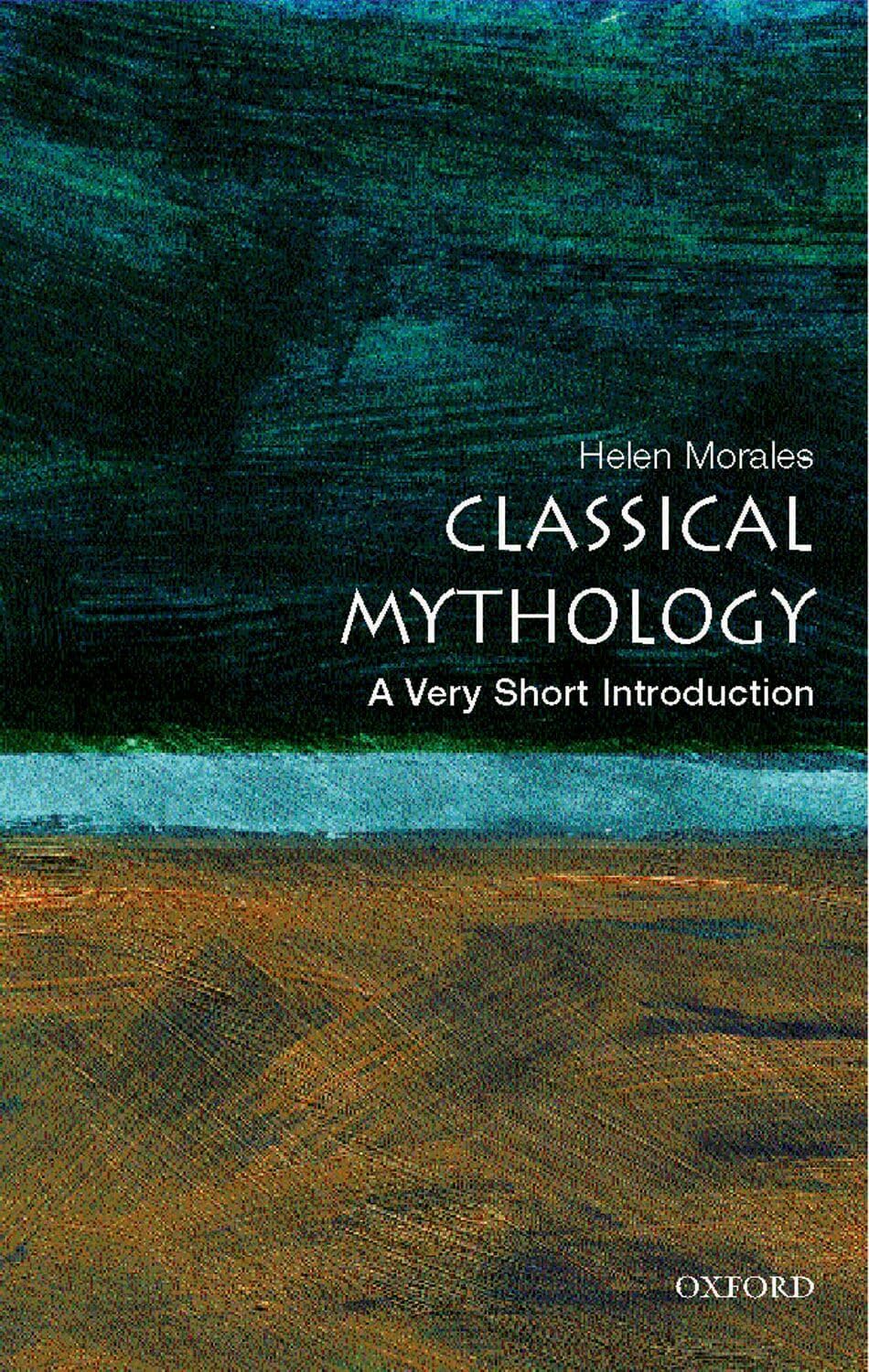
Classical Mythology: A Very Short Introduction
Product ID: 4077299
Desertcart purchases this item on your behalf and handles shipping, customs, and support to Poland.
This imaginative and stimulating Very Short Introduction goes beyond a simple retelling of the stories to explore the rich history and diverse interpretations of classical mythology. It is a wide-ranging account, examining how classical myths are used and understood in both high art and popular culture, taking the reader from the temples of Crete to skyscrapers in New York, and finding classical myths in a variety of unexpected places: from Arabic poetry and Hollywood films, to psychoanalysis, the Bible, and New Age spiritualism. Review: The meaning of myth - Two other entries in this Very Short Introduction series can be seen as companion volumes to the present one. They are Classics, by Mary Beard & John Henderson, and Myth by Robert A. Segal. I would recommend reading those two - in either order - and then this one, although they each stand very well alone. Morales discusses various interpretations of the role of myth in Western culture, its functions and significance. Although she distances herself from works that restrict themselves to narrations and summaries of the myths themselves, she does include a list of Classical deities and their attributes, unapologetically admitting, "I am having my cake and eating it by including this". But the focus throughout is very much on the nature and function of myth rather than its content. The chapter on Freudian psychoanalysis is particularly interesting. She writes very well, often with a light touch and with frequent popular culture references. The book concludes with a useful 5-page Timeline - from 800 BC, "Early Greece" to 2007, the publication of this book - a comprehensive Reference section, and a very useful Further Reading section. If you want an understanding of myth, how it evolves and how it continues to be relevant, you should read this book. [PeterReeve] Review: Changed My Idea of What Mythology Is - I read this book prior to beginning my studies as a Classics major since I did not have any real grounding in classical myth. I originally thought this book would relate what the various myths were and how they were important. Thankfully, this book helped reshape my idea of what "myth" was and is while offering helpful interpretive keys to better appreciate and contextualize Greek mythology. While I do not suggest someone buy this if they want to read a summary of every Greek myth, I would suggest anyone purchase this if they are interested in *what* mythology is and *how* the Greeks used it to help explain their world to themselves.

| Best Sellers Rank | #485,530 in Books ( See Top 100 in Books ) #285 in Ancient & Classical Literary Criticism (Books) #676 in Folklore & Mythology Studies #1,730 in Literature |
| Customer Reviews | 4.2 out of 5 stars 201 Reviews |
P**E
The meaning of myth
Two other entries in this Very Short Introduction series can be seen as companion volumes to the present one. They are Classics, by Mary Beard & John Henderson, and Myth by Robert A. Segal. I would recommend reading those two - in either order - and then this one, although they each stand very well alone. Morales discusses various interpretations of the role of myth in Western culture, its functions and significance. Although she distances herself from works that restrict themselves to narrations and summaries of the myths themselves, she does include a list of Classical deities and their attributes, unapologetically admitting, "I am having my cake and eating it by including this". But the focus throughout is very much on the nature and function of myth rather than its content. The chapter on Freudian psychoanalysis is particularly interesting. She writes very well, often with a light touch and with frequent popular culture references. The book concludes with a useful 5-page Timeline - from 800 BC, "Early Greece" to 2007, the publication of this book - a comprehensive Reference section, and a very useful Further Reading section. If you want an understanding of myth, how it evolves and how it continues to be relevant, you should read this book. [PeterReeve]
S**R
Changed My Idea of What Mythology Is
I read this book prior to beginning my studies as a Classics major since I did not have any real grounding in classical myth. I originally thought this book would relate what the various myths were and how they were important. Thankfully, this book helped reshape my idea of what "myth" was and is while offering helpful interpretive keys to better appreciate and contextualize Greek mythology. While I do not suggest someone buy this if they want to read a summary of every Greek myth, I would suggest anyone purchase this if they are interested in *what* mythology is and *how* the Greeks used it to help explain their world to themselves.
B**E
Morales does an excellent job pointing out the modern contexts of interpretive stances ...
When people think of mythology, especially Greek mythology, they tend to imagine old stories such as the Iliad and Odyssey or the stories of heroes as told in Ovid. Seen as such, the myths become reduced to old stories that hold little to no meaning in our current society beyond an entertaining film or book. In reading Classical Mythology: A Very Short Introduction, I realized how much modern context influences interpretations of mythology and how much meaning modern society can still glean from Greek mythology. Morales does an excellent job pointing out the modern contexts of interpretive stances such as psychoanalysis and the use of Europa in EU propaganda. This books does an excellent job of portraying multiple interpretive stances from which mythology can be viewed. She presents an interesting definition of mythology, where the lore and ideology are interconnected, yet distinct. I enjoyed reading about the ways in which our modern society has adopted mythology into its foundation and famous icons, such as Prometheus at the Rockefeller Center. While Morales does give some good insight and enough background on the myths she discusses, I would have enjoyed a broader discussion of other mythological themes as well. Mythology is riddled with topics such as the effects of war and the virtues of women versus misogyny. It also would have been nice if she had given more examples and counter-examples of the points that she brings up in order to show the diversity of the mythology that exists even with the set of Greek mythology. Overall, this is an exceptional book for someone who is looking for a book on mythology, but wants to know about the interpretations of the myths instead of just the stories.
S**S
Well Done.
This book shows the modern ramifications of ancient myths. Well Done.
F**O
A very modern interpretation of ancient myth
This is a concise and handy guide to approaching Classical Mythology. It assumes the reader is already well-acquainted with the actual legends themselves, and focusses on lines of thought and interpretation. More interestingly perhaps, the author dwells in the present day and describes how ancient myth and its effects are still very alive within our modern culture. She strikes gold for me when she details how famous figures become mythologized. There was Princess Diana, whose death prompted a mass phenomenon of shrines and ritual mourning- as well as any number of rock stars and presidents. Our popular media creates gods and cults out of people in the same way ancient people deified their ancestors- and many traditional cultures still do. However she misses (or ignores?) a crucial insight. Ancient historians, cultural tradition, biblical and other sources reveal that some of the "gods" of antiquity are linked to actual people- namely the first sons and grandsons of Noah, whose longevities, deeds and wisdom would have appeared superhuman to the generations that later fell into ancestor worship: Noah's son Japheth, whose name became corrupted into "Jupiter" and so on. There were also the nephilim- described in various hebraic and non-biblical sources - as superheroes of extraordinary size and strength, and described in genesis as "the heroes of old", the "men of renown". The descendants of noah's grandson Tiras -Thirasians- known as Thracians by the Greeks- who worshiped their ancestor Thuras, as Thor- the god of thunder. The links between ancient myth and biblical reality are well documented for anyone with a genuinely open curiosity.
M**E
Five Stars
Nice Book, great read !!!
T**A
Five Stars
good
A**A
Very Disappointing
I've read many of the "Very Short Introduction" series, and generally found them excellent. However, this book was a real disappointment, and it does not do justice to its title or to the series. From the title, I thought I would get the kind of introduction that I've gotten from other books in the series - a general overview of the subject - but in fact this book tells you very little about classical mythology. Instead, you learn the author's opinions on certain interpretations of mythology, as well as her take on some contemporary topics, including gender issues, with a focus on politically correct themes. The author is clearly more interested in expressing her views on these kinds of issues than with giving you any kind of a substantial introductory understanding of what classical mythology is about. If you are interested in the subject of classical mythology because you simply want to gain an understanding of what it is, this is definitely not the introductory book you are looking for. If you want to learn, for example, who some of the most well-known figures in classical mythology are, what their stories consist of, or what the major themes in classical mythology are, you will be especially disappointed with this book.
J**S
Demystifying the myth
Emphatically not a narrative survey of Classical myths, this guide is firmly analytical. For Morales, 'Myth is a complex game of production and reception'. It is a game which invites reinvention and reinterpretation, selection and manipulation, and is one which is very much alive today. Her approach is radical and invigorating. One modern 'myth' tackled early on is that of Greek 'cultural purity'. Martin Bernal's controversial study, 'Black Athena', is discussed and found wanting, as one of its its central arguments about the value of myth in helping to reconstruct cultural origins is rejected. Morales references her points convincingly. Her argument about the malleability of myths, whose meanings depend on context, is illustated by examining the myth of Marsyas. To the Greeks, the myth can be interpreted as a warning that mortals 'know their place' and do not challenge the authority of the gods. To Romans of the Republic, however, Marsyas is a laudable figure, a freedom-fighter who resists the authority of the patrician class. In the myth's Roman guise, he is not killed by Apollo but rescued by Liber (god of liberation) and taken to Italy. As with Beard and Henderson's 'Classics' in the same series, every effort is made to present the subject in a lively and topical way. Some characters make it onto the A-list of mythological heroes (Theseus), while others, despite their positive qualities, do not (Lycurgus). Trying to find out why A-listers 'make it' (John Lennon) while others remain resolutely B-list (John Major) makes for an absorbing discussion. Morales is succinct and perceptive on the impact of Christianity, philosophy and psychology upon Classical myth (and vice versa), while her style is incisive, even provocative: the grand tradition of Western art, with its 'alibis' and its lascivious depiction of rape, has contributed to a view 'that ancient Greece and Rome were pornotopias.' By such means is a potentially dead(ly) subject brought vividly to life.
M**I
Five Stars
Mind blowing.
M**G
Great and quick guide to mythology
It was recommended to read as a great taster for a OU course i’m doing.
A**T
Interesting but not an introduction
When you hear introduction you would assume that it would start from the basics. However, this book is no introduction to classical mythology. It is clear from the off that the reader needs some existing knowledge of classical mythology as the author herself says she's not going to retell them. The book is more of an analysis of classical mythology. Don't get me wrong the book is interesting and the points made are thought provoking however it is not what you would expect it to be.
M**T
great wee introduction
if your doing the classics, great wee secondary source
Trustpilot
3 days ago
1 month ago