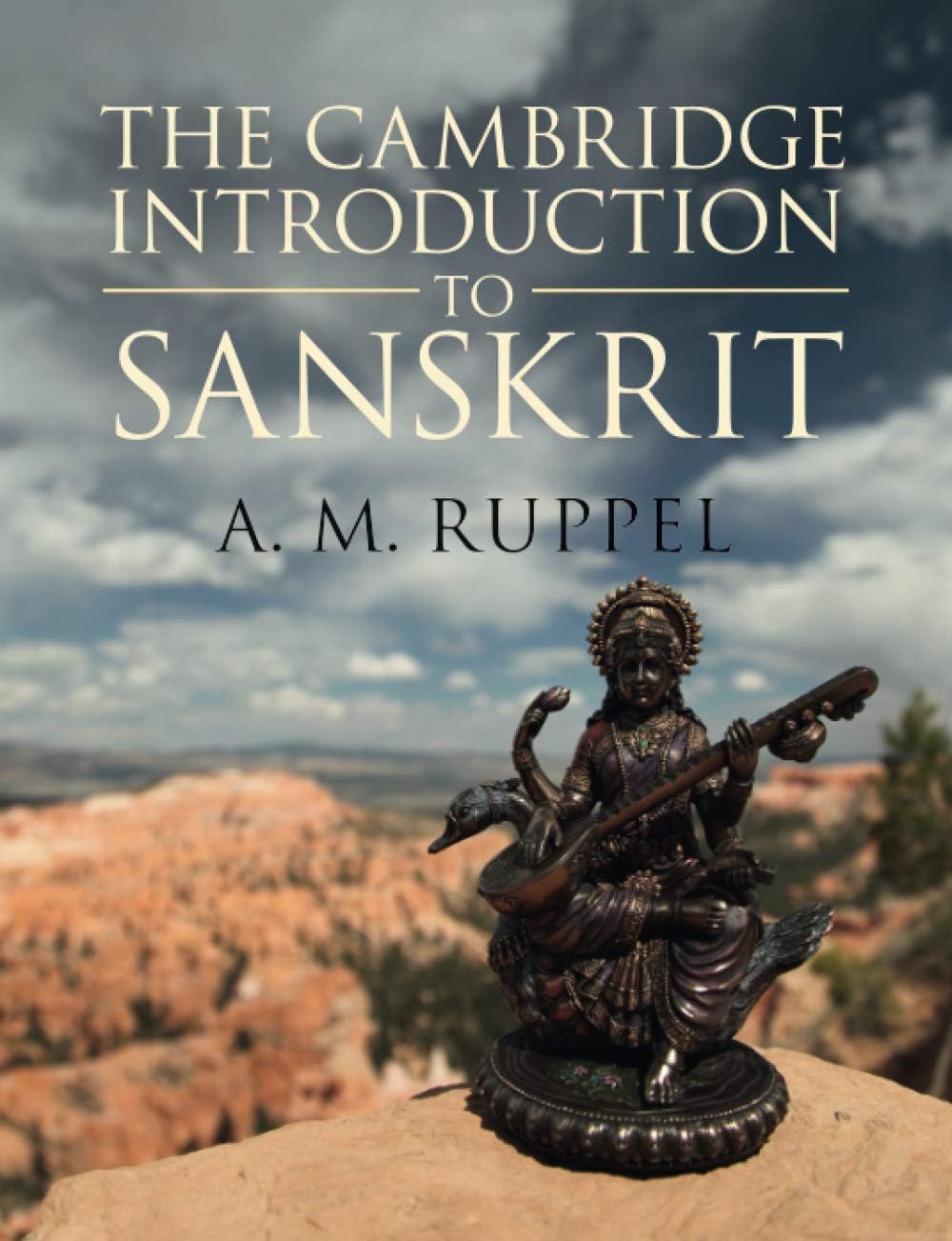
The Cambridge Introduction to Sanskrit
Product ID: 40663266
Desertcart purchases this item on your behalf and handles shipping, customs, and support to Poland.
Ideal for courses in beginning Sanskrit or self-study, this textbook employs modern, tried-and-tested pedagogical methods and tools, but requires no prior knowledge of ancient languages or linguistics. Devanāgarī script is introduced over several chapters and used in parallel with transliteration for several chapters more, allowing students to progress in learning Sanskrit itself while still mastering the script. Students are exposed to annotated original texts in addition to practise sentences very early on, and structures and systems underlying the wealth of forms are clearly explained to facilitate memorisation. All grammar is covered in detail, with chapters dedicated to compounding and nominal derivation, and sections explaining relevant historical phenomena. The introduction also includes a variety of online resources that students may use to reinforce and expand their knowledge: flash cards; video tutorials for all chapters; and up-to-date links to writing, declension and conjugation exercises and online dictionaries, grammars, and textual databases. Review: Amazing Sanskrit Course-book! - हरिः ॐ As an autodidact, I've been studying Sanskrit for about 4.5 years now. I purchased this book because I want to start reviewing previous chapters with new vocabulary (in order to keep advancing), and because whenever I check for a grammar concept online (in order to expand it to fully internalize it), the excerpts that pop up contain very approachable explanations. I can only say that this course-book is the perfect compliment for my Sanskrit für Anfänger Course-book (by Heidelberg's Prof. Thomas Lehmann). As I've continued to study this wonderful language that is मम प्रियं संस्कृतम् through this marvelous book, I can only find its content very accessible and helpful. I've been looking for a book like this for four years now and I never found one. Other courses were simply not appealing: Many of the expensive course-books I checked back then only offered a few lessons per course-book with very limited/lacking explanations. Making money seemed more important than teaching. This course-book offers 40 chapters, which is around 3-4.5 years of study. It has a lot of exercises. If you're interested in India's ancient sacred teachings, and that's mainly why you're learning Sanskrit, you can read excerpts of the Bhagavad Gītā, the Mahābhārata, etc. right from the beginning (Chapter 2, page 23) which is an amazing treat for every Sanskrit student. A final note: You can't "learn Sanskrit fast". I know of Sanskrititians who have been learning Sanskrit for 15 years. Once you start learning Sanskrit, the more you learn, the more you'll realize how little you know. The more reverence and humility you will feel when approaching each lesson. Sanskrit's grammar is as vast as a shore; each grain of sand is a concept, an explanation, a declination. It takes time to pick them all. But the journey is totally worth it. Anyway. May Lord Gaṇeśa bestow one-pointed concentration on you. May Mātā Sarasvatī bless your studying endeavors. May you unite with The Absolute. ॐ नमः शिवाय ॐ Review: I am so glad I purchased this book and without knowing in advance ... - I've already own several Sanskrit books before I spotted this one. However, they are either too simple and lack of further explanation, or they have too much academic air in them and no answer keys. I am so glad I purchased this book and without knowing in advance that it would open a door of learning Sanskrit for me. As a self study student, I wrote to the author for the Key and I got something back more than the Key! Dr Ruppel was organizing an online course at that time and naturally she asked if I would be interested in joining the study group. I was thrilled and signed myself up right away. I have been following the course for six months now and let me tell you, this book is the gem in Sanskrit study and Dr Ruppel is a wonderful teacher with lots of compassion and she is a hard worker. This book is carefully designed/engineered in presenting and mapping out the materials--systematical and well organized as Dr Ruppel is an experienced and successful Sanskrit teacher .The more I study the book, the more I understand why and how the chapters are arranged in such order. In addition to many wonderful attributes people already mentioned in their comments above, I personally love the learning tips and technical comments she shares in the book which have helped me a lot. I also love the way she uses English as a comparative example to help us understand how Sanskrit works--same as English or different. Besides the exercises we get from the book, we also get a weekly email which has detailed instruction on how to approach this week's material and the links to her many online resources, such as videos and flash cards. And we also get a weekly test which I have tons of fun doing it. In a nutshell, from the most basic script learning to be able to read Bhagavad gita, this book will guide you step by step and lead you to reach that ultimate goal. I have no doubt about it.
| Best Sellers Rank | #111,560 in Books ( See Top 100 in Books ) #6 in Buddhism (Books) #272 in Foreign Language Instruction (Books) #336 in Philosophy (Books) |
| Customer Reviews | 4.7 out of 5 stars 421 Reviews |
Q**E
Amazing Sanskrit Course-book!
हरिः ॐ As an autodidact, I've been studying Sanskrit for about 4.5 years now. I purchased this book because I want to start reviewing previous chapters with new vocabulary (in order to keep advancing), and because whenever I check for a grammar concept online (in order to expand it to fully internalize it), the excerpts that pop up contain very approachable explanations. I can only say that this course-book is the perfect compliment for my Sanskrit für Anfänger Course-book (by Heidelberg's Prof. Thomas Lehmann). As I've continued to study this wonderful language that is मम प्रियं संस्कृतम् through this marvelous book, I can only find its content very accessible and helpful. I've been looking for a book like this for four years now and I never found one. Other courses were simply not appealing: Many of the expensive course-books I checked back then only offered a few lessons per course-book with very limited/lacking explanations. Making money seemed more important than teaching. This course-book offers 40 chapters, which is around 3-4.5 years of study. It has a lot of exercises. If you're interested in India's ancient sacred teachings, and that's mainly why you're learning Sanskrit, you can read excerpts of the Bhagavad Gītā, the Mahābhārata, etc. right from the beginning (Chapter 2, page 23) which is an amazing treat for every Sanskrit student. A final note: You can't "learn Sanskrit fast". I know of Sanskrititians who have been learning Sanskrit for 15 years. Once you start learning Sanskrit, the more you learn, the more you'll realize how little you know. The more reverence and humility you will feel when approaching each lesson. Sanskrit's grammar is as vast as a shore; each grain of sand is a concept, an explanation, a declination. It takes time to pick them all. But the journey is totally worth it. Anyway. May Lord Gaṇeśa bestow one-pointed concentration on you. May Mātā Sarasvatī bless your studying endeavors. May you unite with The Absolute. ॐ नमः शिवाय ॐ
S**U
I am so glad I purchased this book and without knowing in advance ...
I've already own several Sanskrit books before I spotted this one. However, they are either too simple and lack of further explanation, or they have too much academic air in them and no answer keys. I am so glad I purchased this book and without knowing in advance that it would open a door of learning Sanskrit for me. As a self study student, I wrote to the author for the Key and I got something back more than the Key! Dr Ruppel was organizing an online course at that time and naturally she asked if I would be interested in joining the study group. I was thrilled and signed myself up right away. I have been following the course for six months now and let me tell you, this book is the gem in Sanskrit study and Dr Ruppel is a wonderful teacher with lots of compassion and she is a hard worker. This book is carefully designed/engineered in presenting and mapping out the materials--systematical and well organized as Dr Ruppel is an experienced and successful Sanskrit teacher .The more I study the book, the more I understand why and how the chapters are arranged in such order. In addition to many wonderful attributes people already mentioned in their comments above, I personally love the learning tips and technical comments she shares in the book which have helped me a lot. I also love the way she uses English as a comparative example to help us understand how Sanskrit works--same as English or different. Besides the exercises we get from the book, we also get a weekly email which has detailed instruction on how to approach this week's material and the links to her many online resources, such as videos and flash cards. And we also get a weekly test which I have tons of fun doing it. In a nutshell, from the most basic script learning to be able to read Bhagavad gita, this book will guide you step by step and lead you to reach that ultimate goal. I have no doubt about it.
F**H
Excellent First Book on Sanskrit
It's a wonderful first book. I've been using it all summer with a mix of teenagers and grownups. The best thing about this book is that it's easy to read. Most Sanskrit manuals written by westerners have a slightly academic/professorial air about them. My previous favorite in this genre, Coulson, is not entirely free of a donnish air. This one's, by and large, pleasantly free of it. So I think this book can also be used by people who learn Sanskrit for non-academic reasons. This book covers more or less the same ground as Coulson except it's newer, friendlier and has some more arrows in its quiver. Besides, it seems the author is experienced in teaching youngsters i.e., school kids, too. Some typical initial obstacles to learning Sanskrit i.e., sandhi (combination of sounds), nominal compounds, the noun and the verb systems are rather well presented. The author is committed to a policy of minimizing rote memorization so the chapters on sandhi appeal to reason and internal logic. But they are written well, going by my experience with some 12 year olds. The treatment of the noun system is exhaustive. As far as nominal compounds are concerned, the discussion includes several quick tips to recognize the type of compound. This is something which even many manuals written in Hindi lack. The verb system is well-written with full cognizance of the type of head scratching verb systems cause in people who know or speak only English or modern Indian languages. It's also written with a view to creating a path of least resistance. Here I think the author's teaching experience is in full view. The strongest parts of this book are the chapters on the verb system. It's systematically presented with a step-wise progression in terms of conjugation type, voice and tense. The review, conjugation and translation exercises at the end of each chapter are quite well selected. Somewhat more advanced topics like aorist, participles of various kinds and handling of numerals are also covered. For me the greatest value of this book is in the illustrations and tables (in grey) peppered throughout the book and occasional remarks on points which cause confusion in the mind of the student or aspects of the language which sound more complicated than they are. There are other useful bits of information like how to use a dictionary too. Readers interested in Sanskrit may be happy to know that this book uses plenty of examples from the first two chapters of Gita to illustrate usage and grammar. In summary, I think the book can be used by a teacher and a committed student alike. Also, the icing on the cake is the supplementary resources available on-line. If I have one regret about my purchase, it's that I didn't go for the hardcover edition.
J**S
Game-changer if you’re truly ready to learn Sanskrit
As a Western student who has studied Sanskrit with both Western and Indian teachers, I cannot recommend this book AND its accompanying Yogic Studies course with the author enough (surprising affordable for university-level education). The book is very methodical and takes you on a steady journey to learning grammar and vocabulary. It’s difficult, but still very accessible if you stay consistent. I have learned more in the past 3 months than I have in the past 20 years—and am now actively reading/translating! The key here for me was committing to the accompanying course and taking this study seriously (i.e., showing up for live classes 2x week and doing the homework). This book + course is a total game-changer for the committed student and it’s also quite fun! NOTE: there is no answer key in the book, but I emailed the author as instructed and received those files within 24-hours. Actually convenient, as I can print as-needed and have them on my desk.
D**Y
Much needed book
I am a Sanskrit teacher who teaches, reads, writes and speaks (yes speak!) Sanskrit on a daily basis. Even though I already knew 99% of the stuff covered in this book, I decided to order it because it looked like a good book. And it is indeed a very good book. The printing and page quality is good. This book is very comprehensive. It covers all the major topics of Sanskrit grammar. I applaud the author for not shying away from technical details. Author has struck a good balance between explaining the concept and technical details without getting too academic. But those very technical details also make this book not a casual read. This book is for serious students only who are willing to put in dedicated effort. This book markets itself as ideal for self-study. I have my doubts about that. Going from getting introduced to Devanagari to being able read and understand Bhagvad Geeta is a tall order for a beginner and though this book provides all the tools necessary to do so, I think a complete novice is going to find it extremely challenging to work through this book. This would be a great book to follow along with a teacher. The author herself provides online classes for that. Anybody who can work through this book is going to be very handsomely rewarded by being able to read and understand classical Sanskrit texts. But I believe that will take couple of years of dedicated effort. This book would be a lot easier to tackle if one has already done Thomas Egenes' book. It is possible to start from this book alone (just be prepared to be challenged). One other important detail about this book is that most of the examples are from proper Sanskrit texts. This is good and bad. Good because ultimately understanding those texts is most people's goal. Bad because when you are learning a new concept, it is best to start with simple examples and those are not very many in this book. That adds a whole another level of challenge for a novice. If your goal is to be able to read and understand classical Sanskrit works then this is a good book. If your goal is to be able to read, write and speak conversational Sanskrit then this not the right book as it is written solely with the goal of making reader understand texts like Bhagvad Geeta which have complex verb forms. I did find a few typos here and there (all in Sanskrit text) - one big one being that some declensions of त्रि (three, masculine) are incorrect. Overall it's an excellent book. A book like this one has been much needed for a while. All other good Sanskrit grammar books (in English) are at least half a century old.
S**S
A great textbook with some caveats
I love this textbook. There is a lot to recommend it. She provides a good overview of verbs and nouns and basic Sanskrit Grammer. Cons - she does not introduce the student to the commonly used Sanskrit terminology which makes an unnecessary learning curve when moving on in Sanskrit. Tables in the back do not have page numbers which makes it hard to reference and discuss with others also taking the class. I would have liked more verb and noun tables. I also would like more answer keys included in the book so that I can check my work or use as a reference when studying. I understand the author may be working on a new version and easier sentences would also be helpful when learning the material.
A**L
Outstanding. Best Sanskrit book for self learners.
I usually recommend the two volumes of Egenes to everyone who wants to learn Sanskrit. They are the easiest and most accessible for the beginner. This recommendation now changes: CIS could very well be your first choice. Compared to Egenes: - CIS is more difficult, but still very much suited for the self-learner - explanations are very thorough, detailed and clear - there is a good number of "old fashioned" grammar drills - there also is an abundance of translation exercises from the Sanskrit literature - answer key to exercises is available from the author if desired CIS is a modern textbook with wonderful support on the internet: There is a dedicated Facebook page, there are study groups moderated by the author (for free!!!) and there are YouTube lessons. You basically get a full Sanskrit university level course here. If ever you thought about learning this difficult but rewarding language, now is the time! One cannot thank Dr. Ruppel enough for putting this together!
N**.
The best textbook for learning Sanskrit
After researching and trying other sources and textbooks for learning Sanskrit, I came across Dr. Ruppel's Cambridge Introduction to Sanskrit and joined her online CIS courses. The teaching methodology of the CIS system is superb, the text is user friendly with clearly defined grammatical topics and categories. The readings and exercises are very helpful and engaging. The textbook is intelligently written and structured - a true delight to anyone with linguistic affinity. If you are serious about learning Sanskrit - you don't need to look elsewhere. The Cambridge Introduction to Sanskrit should be your first choice.
S**Y
素晴らしい構成ですが・・・
Devanagari を読める・学ぶ予定がある方に向けられたものです。 当面 alphabet 表記で済ませようと思っている自分には不向きでした。
N**N
Bra lärobok
Pedagogisk lärobok med bra övningar efter varje kapitel, tillsammans med videos på YouTube väldigt bra.
L**N
Thorough and good quality
Purchased this to accompany a course taught by the author. Reading first few chapters it looks like a great systematic teaching with lots of printable online resources and exercises in the book.
F**Y
A good read for intermediate students.
Great for beginner to intermediate students. I have worked through the book with quite good results. It has many positives, a few negatives. The greatest strength of the text is its insightful presentation of the grammatical structure of sanskrit, and the reasons behind this structure. It fills a gap in presenting grammar in a modern way. Though it gives a good concise understanding of the structure of sanskrit, sanskrit has really really complex grammar, and just reading it over is not enough to master it. For average students like me, Thomas Eugenes I is more digestible in the beginning and gives a better guide to writing devanagari, so this is a better choice for raw beginners. Eugenes II becomes a bit more pressured and unravels towards the end, so at this point Ruppel is probably a better choice. But occasional passages in Ruppel are difficult to digest, and there are a lack of simple examples. Despite claims for self teaching, Coulson, Eugenes, and Ruppel were all designed around university academic years, rather than around simple digestible learning steps. The exercises have two problems. Firstly there is an absence of drills, so there is no solid reinforcement. Secondly there are no answers to the exercises. The readings given are stimulating and fairly advanced, but she likes you to play a guessing game. This is stimulating but difficult and there aren't any translations. I understand that there are answers to the questions if you know where to look or if you seek the right connections online. Beyond this beginner-intermediate level the next step is to start reading original texts. For this there is a Ruppel reader. Again there are guessing games, but fortunately a full vocabulary for the reader can be found online via her websites, and the reader is truly great in helping the extremely difficult transition from text book to understanding texts.
G**H
Excellent introductory text
This is the text we are using in our introductory Sanskrit class, so far it's been very good. It covers everything in a mostly accessible way, and has a lot of very useful tables in the back with various paradigms, summaries of sandhi, and consonant conjuncts which make a convenient reference. The majority of the grammar is explained very clearly even for people who have no background in ancient languages, and there are interesting and useful notes on stylistics which help prepare for translating. The only real criticisms are that in the actual main body of the text, the author sometimes seems a little reluctant to show things in a "visual" way using too many tables or diagrams, and instead tries to focus on explaining it through prose. Unfortunately some of these topics are just easier to see than to write about, and so some of the written explanations end up being quite long and unnecessarily confusing as a result! Additionally while there are a lot of short exercises and drills, but so far as we have been using it maybe not quite so much in the way of longer passages for translation. As a mainly language focused (as opposed to readings) introduction though, this is fine. You just may need to find some collection of readings to practice translations with separately (and I understand the author might be developing a readings book to go along with this one anyway!). Overall, I've liked using this book a lot, especially as a lot of the alternatives are quite old and are beginning to show it! This is a nicely laid out, modern textbook, and the layout and typesetting being clear and modern help keep the focus where it should be, the language and grammar! My only other complaint is that the hardback version costs so much - I use it constantly so my paperback cover is getting a little worn where I'm always holding it while flicking through!
Trustpilot
2 weeks ago
2 months ago