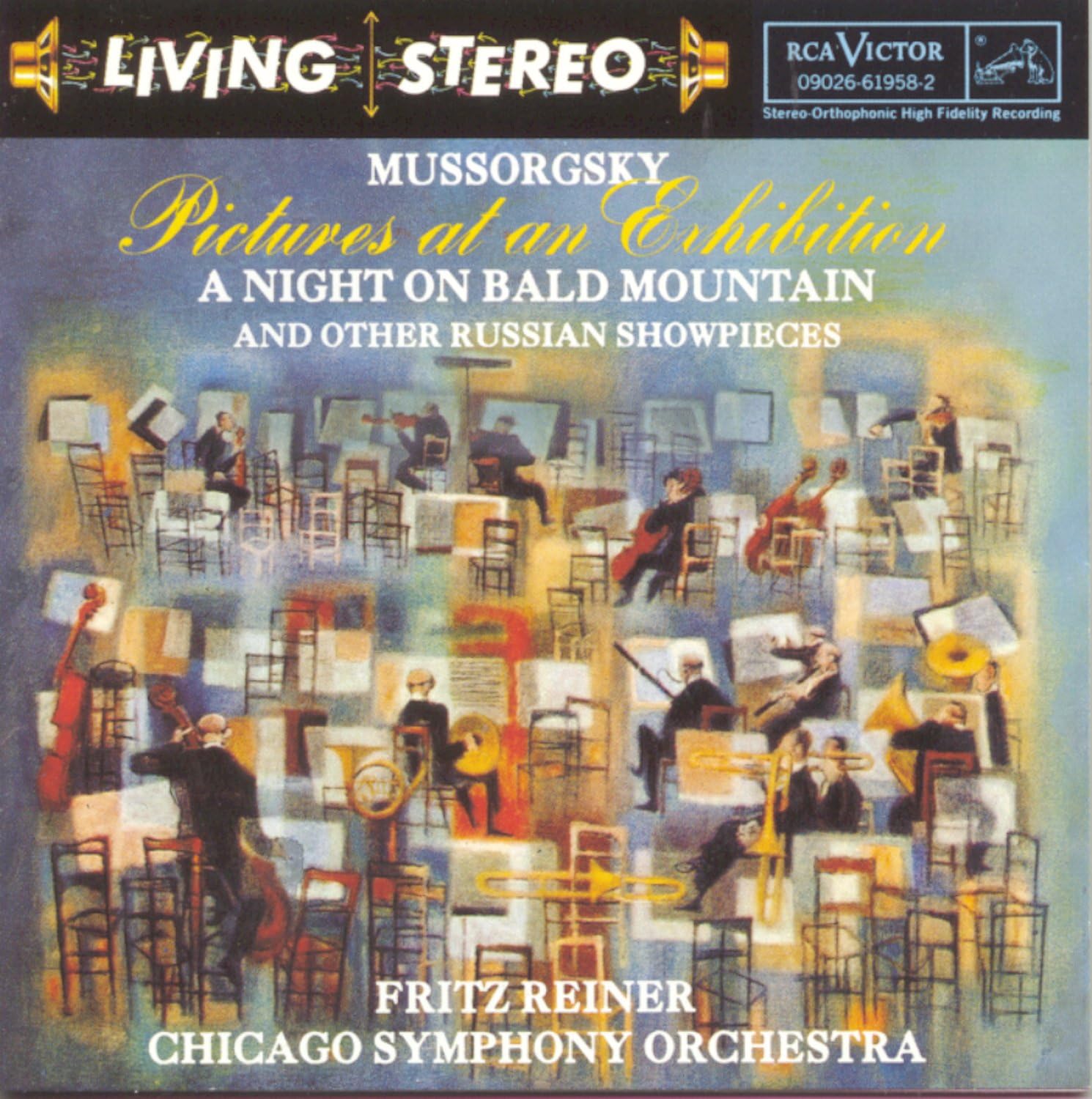

Pictures At An Exhibition
Product ID: 4031926
Desertcart purchases this item on your behalf and handles shipping, customs, and support to Poland.
CD Review: Are You Ready for a Wild Ride? - This recording offers some of the most exciting music you will find on any disc anywhere; if you have any interest in exciting music performed with a maximum of enthusiastic abandon then this is one you should not miss. I want to consider two aspects of this recording, the music and the engineering. First the music One of the biggest features on this disc is a first class recording of "A Night On Bald Mountain" with the original Mussorgsky orchestration. It is more likely you have heard the arrangement of this work by Rimsky-Korsakov as his calmed down version is more frequently performed. This selection alone is worth the price of admission if you enjoy wild, dramatic Russian music; it doesn't get much better than this. I have never heard better sounding recordings of the Chicago Symphony Orchestra than the ones on this disc; the orchestra performs the music with fresh drama that brings it to life. If you have any notion that these performances are just more of the same, put that thought out of your mind; they bring a life and sparkle to the music that is sadly absent on most other recordings I've heard. Although I had heard of Fritz Reiner for almost all of my adult life I had no idea what a gifted interpreter of music he really was and how much he truly deserved his reputation. His conducting of these performances presents the music in a way that opens up new horizons; I felt as if I'd not really heard them before, this was the way they were meant to be played. I already have most of these works by several different conductors and orchestras and had a few reservations about getting yet another rendition; fortunately I overcame those reservations and am delighted that I did. There is a dramatic presence to these recordings that places the listener right on stage with the conductor; I do not know how the microphones were placed but the results makes one feel right on stage there with the orchestra. The sound is sumptuous with sparkling cymbals, resonate bass drums and a smooth string sound that is free of any harshness. Reiner believes in keeping things moving so none of the works drag; the tempi are brisk and bright. Now the engineering My hat is off to the RCA engineers that had the vision to record these so beautifully in three-channel sound; the results in SACD are fantastic. The sound stage is wide and very smooth. It's easy to locate the instruments positions in the orchestra. The dynamic range leaves nothing to be desired. The truth is I cannot find fault with any aspect of this recording concerning music performance, interpretation, or engineering! It is saddening to consider that some of the newest DTS-HD Master Audio recordings don't measure up to the musicality and beauty of this recording. My hat is also off to the engineers and producers who remastered these recordings and transferred them to the SACD format. It is interesting that the full implementation of the early vision had to wait for technology to catch up. I've been ordering a bunch of these "Living Stereo" recordings and the more I hear the more I go back and order the ones I don't have yet. They have become addictive! Review: One of the Great Classical Recordings Ever. - “Pictures at an Exhibition” is Mussorgsky’s most popular concert work and Fritz Reiner’s 1958 RCA Living Stereo LP is the most famous recording of it and is still the standard to which other recordings are almost inevitably compared. It’s one of those monumental recordings that Reiner made with the Chicago Symphony like his “Scheherazade”, “New World Symphony” and “Concerto for Orchestra” that have never been out of print and for good reason. Like all of the Living Stereo CDs this is a combination of two LP’s: Pictures at an Exhibition was released by itself, fully filling both sides of the LP. In 1960 they put out an LP of Reiner and Chicago performing a group of Russian orchestral showpieces titled “Festival”, all of which is included here making up the balance of the disc, though in a slightly different order. Together they make an excellent concert of Russian music played with great spirit and verve. Mussorgsky composed “Pictures at an Exhibition” in June 1874, around the time “The Five” were breaking up mostly due to Balakirev’s desire to totally dominate everything and his not tolerating any different opinions. Rimsky-Korsakov had already taken a teaching position at the St. Petersburg Conservatory (much loathed by Balakirev) and in fact Korsakov and Mussorgsky were sharing an apartment at this time. By now Mussorgsky had completed “Boris Godunov” and it was finally staged in 1874. Because Mussorgsky mostly was inspired to write vocal music, the piano suite version of “Pictures” was forgotten. But in 1922 that indefatigable promoter of Russian music, Serge Koussevitzky, asked his friend Maurice Ravel to orchestrate it as a concert piece. Far more people attended orchestral concerts than piano recitals and it immediately gained an enormous popularity which has never flagged. It’s miniature portraits are so apt that one only wishes Mussorgsky had composed more works in a similar vein. “A Night On Bald Mountain” had a very long history with Mussorgsky, beginning when he was seventeen and intended for a projected but unrealized opera, “St. John’s Eve” (1856). It went through five more transmogrifications including orchestral versions, choral versions and a version for piano and orchestra. Balakirev hated it, which seems odd because he tended to like big, dark, heavy pieces, but then he also called Mussorgsky “little short of an idiot”. In any case Mussorgsky never did complete a final version of it or find a place for it, his last attempt being to make it a dream sequence in “Sorochinsky Fair”. What finally became its concert version was determined by Mussorgsky’s expert biographer Gerald Abraham to be a work by Rimsky-Korsakov based on Mussorgsky’s themes. Rimsky-Korsakov was heavily involved after Mussorgsky’s death in creating performance editions of his works so people would become “familiarized with his enormous talent”. As usual with Rimsky-Korsakov everything was done with great care, “retaining all of the author’s best and most coherent material, adding the fewest interpolations of my own.” Although it was a big hit with the audience at the first of the Russian Symphony Concerts in 1886, the work remained obscure outside Russia until it as featured in Disney’s “Fantasia” in a version orchestrated by Leopold Stokowski, after which its popularity was assured. Borodin’s “Polovtsian March” is no match for the dances but is suitably barbaric. Tchaikovsky’s “Marche Slave,” on the other hand, is a real warhorse, a perennial concert favorite with its big minor key Serbian theme and its major key Russian’s coming to aid the Serbs against the Turks. Pan-Slavism was a major force in its day, which is why the work was commissioned from Tchaikovsky, but one can’t help but feel that he added a bit of humor in the work in the bombast of the big theme and the almost toy-soldier theme of the Russians; even so, it also works if taken totally at face value . Kabalevsky was a model Soviet composer who never caused any trouble and his Colas Breugnon Overture is from his 1938 opera which takes place in a safely distant Renaissance France. It’s full of high spirits and accessible melodies. What would Russian music be without Glinka? The Overture to Ruslan and Ludmilla is as boisterous and full of derring-do as much as anything by Rossini and is a fitting ending to this Russian concert. The sound is as top notch as the rest in the RCA Living Stereo series, and as usual, I find myself amazed that it was recorded in the 1950’s.
| ASIN | B000003FMY |
| Best Sellers Rank | #61,781 in CDs & Vinyl ( See Top 100 in CDs & Vinyl ) #91 in Classical Tone Poems #830 in Special Interest #1,095 in Symphonies (CDs & Vinyl) |
| Customer Reviews | 4.7 4.7 out of 5 stars (268) |
| Date First Available | December 7, 2006 |
| Is Discontinued By Manufacturer | No |
| Item model number | 2303876 |
| Label | Sony Classical |
| Language | English |
| Manufacturer | Sony Classical |
| Number of discs | 1 |
| Original Release Date | 1994 |
| Product Dimensions | 5.62 x 4.92 x 0.33 inches; 3.84 ounces |
| Run time | 1 hour and 10 minutes |
D**R
Are You Ready for a Wild Ride?
This recording offers some of the most exciting music you will find on any disc anywhere; if you have any interest in exciting music performed with a maximum of enthusiastic abandon then this is one you should not miss. I want to consider two aspects of this recording, the music and the engineering. First the music One of the biggest features on this disc is a first class recording of "A Night On Bald Mountain" with the original Mussorgsky orchestration. It is more likely you have heard the arrangement of this work by Rimsky-Korsakov as his calmed down version is more frequently performed. This selection alone is worth the price of admission if you enjoy wild, dramatic Russian music; it doesn't get much better than this. I have never heard better sounding recordings of the Chicago Symphony Orchestra than the ones on this disc; the orchestra performs the music with fresh drama that brings it to life. If you have any notion that these performances are just more of the same, put that thought out of your mind; they bring a life and sparkle to the music that is sadly absent on most other recordings I've heard. Although I had heard of Fritz Reiner for almost all of my adult life I had no idea what a gifted interpreter of music he really was and how much he truly deserved his reputation. His conducting of these performances presents the music in a way that opens up new horizons; I felt as if I'd not really heard them before, this was the way they were meant to be played. I already have most of these works by several different conductors and orchestras and had a few reservations about getting yet another rendition; fortunately I overcame those reservations and am delighted that I did. There is a dramatic presence to these recordings that places the listener right on stage with the conductor; I do not know how the microphones were placed but the results makes one feel right on stage there with the orchestra. The sound is sumptuous with sparkling cymbals, resonate bass drums and a smooth string sound that is free of any harshness. Reiner believes in keeping things moving so none of the works drag; the tempi are brisk and bright. Now the engineering My hat is off to the RCA engineers that had the vision to record these so beautifully in three-channel sound; the results in SACD are fantastic. The sound stage is wide and very smooth. It's easy to locate the instruments positions in the orchestra. The dynamic range leaves nothing to be desired. The truth is I cannot find fault with any aspect of this recording concerning music performance, interpretation, or engineering! It is saddening to consider that some of the newest DTS-HD Master Audio recordings don't measure up to the musicality and beauty of this recording. My hat is also off to the engineers and producers who remastered these recordings and transferred them to the SACD format. It is interesting that the full implementation of the early vision had to wait for technology to catch up. I've been ordering a bunch of these "Living Stereo" recordings and the more I hear the more I go back and order the ones I don't have yet. They have become addictive!
J**F
One of the Great Classical Recordings Ever.
“Pictures at an Exhibition” is Mussorgsky’s most popular concert work and Fritz Reiner’s 1958 RCA Living Stereo LP is the most famous recording of it and is still the standard to which other recordings are almost inevitably compared. It’s one of those monumental recordings that Reiner made with the Chicago Symphony like his “Scheherazade”, “New World Symphony” and “Concerto for Orchestra” that have never been out of print and for good reason. Like all of the Living Stereo CDs this is a combination of two LP’s: Pictures at an Exhibition was released by itself, fully filling both sides of the LP. In 1960 they put out an LP of Reiner and Chicago performing a group of Russian orchestral showpieces titled “Festival”, all of which is included here making up the balance of the disc, though in a slightly different order. Together they make an excellent concert of Russian music played with great spirit and verve. Mussorgsky composed “Pictures at an Exhibition” in June 1874, around the time “The Five” were breaking up mostly due to Balakirev’s desire to totally dominate everything and his not tolerating any different opinions. Rimsky-Korsakov had already taken a teaching position at the St. Petersburg Conservatory (much loathed by Balakirev) and in fact Korsakov and Mussorgsky were sharing an apartment at this time. By now Mussorgsky had completed “Boris Godunov” and it was finally staged in 1874. Because Mussorgsky mostly was inspired to write vocal music, the piano suite version of “Pictures” was forgotten. But in 1922 that indefatigable promoter of Russian music, Serge Koussevitzky, asked his friend Maurice Ravel to orchestrate it as a concert piece. Far more people attended orchestral concerts than piano recitals and it immediately gained an enormous popularity which has never flagged. It’s miniature portraits are so apt that one only wishes Mussorgsky had composed more works in a similar vein. “A Night On Bald Mountain” had a very long history with Mussorgsky, beginning when he was seventeen and intended for a projected but unrealized opera, “St. John’s Eve” (1856). It went through five more transmogrifications including orchestral versions, choral versions and a version for piano and orchestra. Balakirev hated it, which seems odd because he tended to like big, dark, heavy pieces, but then he also called Mussorgsky “little short of an idiot”. In any case Mussorgsky never did complete a final version of it or find a place for it, his last attempt being to make it a dream sequence in “Sorochinsky Fair”. What finally became its concert version was determined by Mussorgsky’s expert biographer Gerald Abraham to be a work by Rimsky-Korsakov based on Mussorgsky’s themes. Rimsky-Korsakov was heavily involved after Mussorgsky’s death in creating performance editions of his works so people would become “familiarized with his enormous talent”. As usual with Rimsky-Korsakov everything was done with great care, “retaining all of the author’s best and most coherent material, adding the fewest interpolations of my own.” Although it was a big hit with the audience at the first of the Russian Symphony Concerts in 1886, the work remained obscure outside Russia until it as featured in Disney’s “Fantasia” in a version orchestrated by Leopold Stokowski, after which its popularity was assured. Borodin’s “Polovtsian March” is no match for the dances but is suitably barbaric. Tchaikovsky’s “Marche Slave,” on the other hand, is a real warhorse, a perennial concert favorite with its big minor key Serbian theme and its major key Russian’s coming to aid the Serbs against the Turks. Pan-Slavism was a major force in its day, which is why the work was commissioned from Tchaikovsky, but one can’t help but feel that he added a bit of humor in the work in the bombast of the big theme and the almost toy-soldier theme of the Russians; even so, it also works if taken totally at face value . Kabalevsky was a model Soviet composer who never caused any trouble and his Colas Breugnon Overture is from his 1938 opera which takes place in a safely distant Renaissance France. It’s full of high spirits and accessible melodies. What would Russian music be without Glinka? The Overture to Ruslan and Ludmilla is as boisterous and full of derring-do as much as anything by Rossini and is a fitting ending to this Russian concert. The sound is as top notch as the rest in the RCA Living Stereo series, and as usual, I find myself amazed that it was recorded in the 1950’s.
M**R
There are many recordings of the orchestral version of "Pictures" currently available. But, the present version by the Chicago Symphony Orchestra under the direction of Reiner, I think, is one of the best in terms of virtuosic playing and the recording quality. Different moods that each picture evokes are marvellously brought out by the Chicago SO in this recording. The twelfth piece ("Catacombae") and the thirteenth ("Con mortuis in lingua mortua" / With the Dead in a Dead Language) appear to me to be the core of the work; the mood they evoke is introspective and melancholic as if the composer communes with the soul of the recently-passed architect friend Hartmann. The last piece ("The Great Gate at Kiev"), using large bells, sounds spectacular as if it is Russian Orthodox church music. My favourite recording has been that by the Berlin Phil and Abbado. But, the present Chicago version is at least as good, if not better. Other pieces on the disc, including Ruslan and Ludmilla Overture, have a tremendous verve. Recorded in 1957/59, the disc certainly belies its age, with a transparent and clear sound. Re-issued as part of the "Living Stereo" series, this hybrid SACD - available at such a low price - is worth acquiring at any price.
P**T
Excellent à tous égards
M**U
Der ungarische Ausnahmedirigent, der aus seiner Spätzeit (1954-63) eine Menge maßstabsetzender Stereo-Aufnahmen mit dem Chicago SO hinterlassen hat, ist hier mir russischen Aufnahmen von 1957-59 zu hören. Mussorgskys 'Bilder' sind mit sehr scharfen Konturen in Ravels Fassung vertreten, seine 'Nacht a. d. kahlen Berge' ist ebenso mitreißend wie prägnant. Dann gibt es von Borodin einen sehr gut gespielten Ausschnitt aus den 'Polowetzer Tänzen', von Tschaikowsky einen Miniatur-Marsch und den äußerst effekt- wie schwungvollen 'Slawischen Marsch'. Vervollständigt wird die CD von auch sehr gut gespielten Kabelewsky- und Glinka-Werken. Russische Standards aus der frühen Stereo-Zeit in einer Qualität, wie sie heutzutage höchstens ausnahmsweise zu hören ist.
D**N
Très bonne version de Pictures at an exhibition
い**人
実は1960年代、小学4年だった私の愛聴盤でした。久々の再会!もともと高音質録音でしたが、CDで初めてその真価を見せましたね。特に、禿山の一夜が素晴らしい。ライナーの指揮は、そのテンポといい音色の重ね方といい凄い!古さなんてどこにもないと思います。それに応えるシカゴ交響楽団、底なしの演奏力でした。
Trustpilot
2 days ago
5 days ago