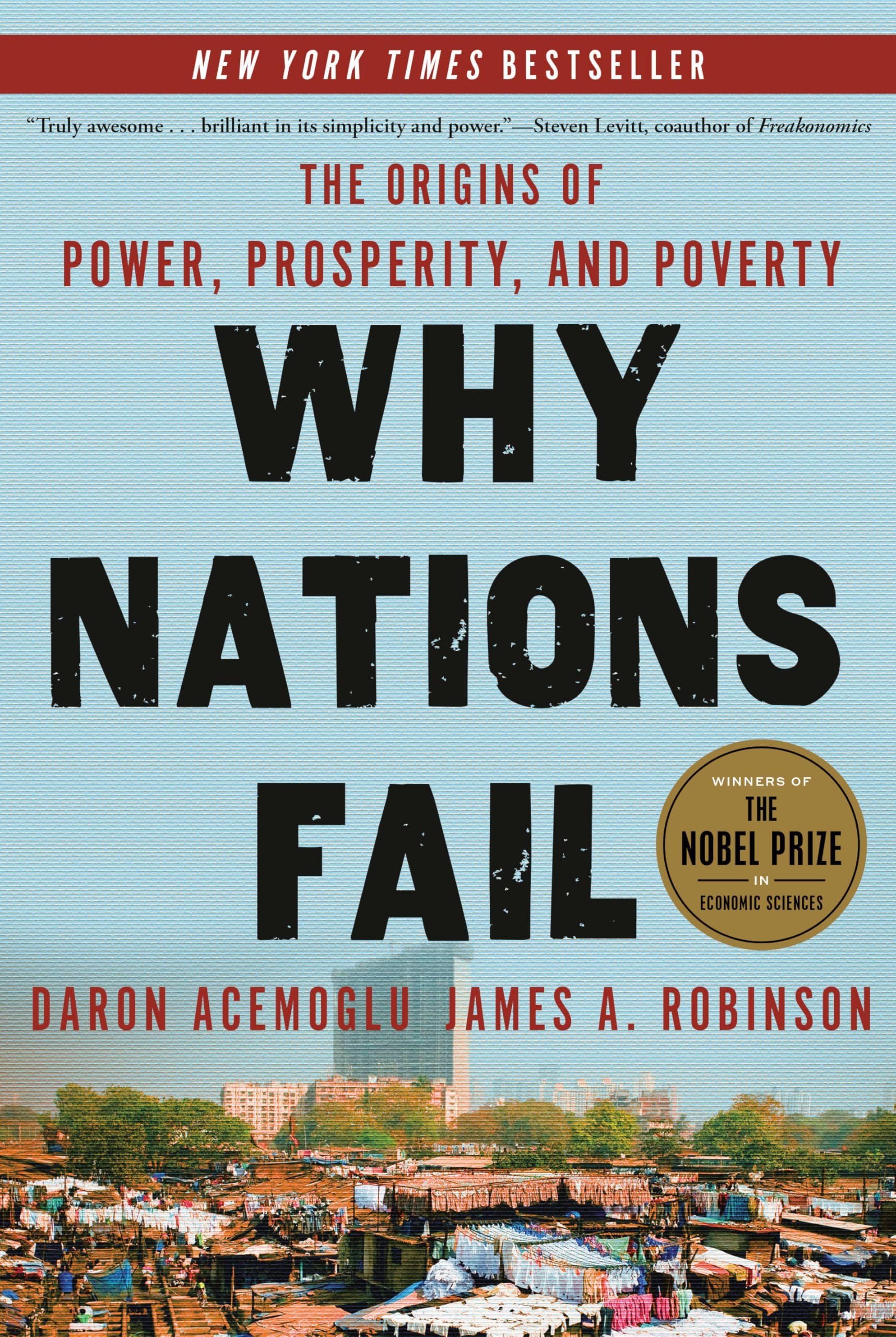
Why Nations Fail: The Origins of Power, Prosperity, and Poverty
Product ID: 286385
🌍Global perspective
💡Innovative insights
📚In-depth analysis
Buy anything from 5,000+ international stores. One checkout price. No surprise fees. Join 2M+ shoppers on Desertcart.
Desertcart purchases this item on your behalf and handles shipping, customs, and support to Poland.
📖 Unlock the Secrets of Success and Failure!
Why Nations Fail offers a groundbreaking exploration of the political and economic factors that shape the success or failure of nations. Through a combination of historical analysis and contemporary case studies, the authors provide a compelling narrative that reveals the underlying causes of prosperity and poverty, making it essential reading for anyone interested in global affairs.


| Best Sellers Rank | #5,475 in Books ( See Top 100 in Books ) #3 in Development & Growth Economics (Books) #6 in Economic History (Books) #6 in Economic Conditions (Books) |
| Customer Reviews | 4.5 out of 5 stars 10,640 Reviews |
T**I
Politics isn't everything, it's the only thing
In his 2000 bestseller “Development as Freedom” Pulitzer Prize-winning economist Amartya Sen made the uplifting argument that the cornerstone of international development ought to be the promotion and growth of human freedom. What his thesis notably lacked was evidence. It seems to me that evidence supporting Sen’s important hypothesis is precisely what Daron Acemoglu and James Robinson present here in “Why Nations Fail: The Origins of Power, Prosperity, and Poverty.” This 2013 bestseller argues that only open and inclusive political institutions – those most likely to provide the freedoms Sen claims are critical – can achieve sustainable economic growth (e.g. “The central thesis of this book is that economic growth and prosperity are associated with inclusive economic and political institutions, while extractive institutions typically lead to stagnation and poverty”). To begin with, Acemoglu and Robinson shred three of the most commonly held theses on global economic inequality, while setting the stage to argue that politics and political institutions along with their associated incentives are what really matters for long term, sustainable economic growth. First, they dismiss the Geography theory, usually associated with Jared Diamond (but also Jeffrey Sachs), which suggests that north/south continents and tropical climates are poorly suited for economic growth. That’s simply not true, the authors say. North America was once far less economically desirable than South America; the Middle East was the cradle of civilization, yet non-oil Middle East countries today are as poor as Peru and Bolivia, which are far poorer than the UK or US. “History thus leaves little doubt that there is no simple connection between a tropical location and economic success.” Second, they reject Culture theory, which started with Max Weber and the Protestant work ethic, and is just as invalid as Geography according to the authors. How can one explain the differences between North and South Korea or the US versus Mexican sides of Nogales, Arizona? Or why is it that the US, Canada, Nigeria and Sierra Leone – all former English colonies and places that have shared cultures and/ or colonial heritage – have vastly different economies today? Finally, they critique Ignorance theory, which is favored by most modern development economists, especially Jeffrey Sachs, the doyen of the poverty-can-be-eradicated school, and essentially maintains that countries are poor because they make wrongheaded policy decisions. If only they had better advisors and made smarter choices to foster economic growth, Ignorance theory proponents argue, everything would work out just fine. Acemoglu and Robinson, on the other hand, claim that leaders rarely make stupid decisions. They make rational choices that may be economically disastrous for their country, but usually align well with economic incentives that are part of the institutions that they’ve created or, more often, inherited. There is no ignorance; it’s just that the system has been set up to encourage harmful policies. In other words, “They get it wrong not by mistake or ignorance but on purpose.” So what then is required for sustainable economic growth? The authors claim that “…to understand world inequality we have to understand why some societies are organized in very inefficient and socially undesirable ways.” They argue that “the ability of economic institutions to harness the potential of inclusive markets, encourage technological innovation, invest in people, and mobilize the talents and skills of a large number of individuals is critical for economic growth…” and that “…explaining why so many economic institutions fail to meet these simple objectives is the central theme of this book.” They lay out a simple and compelling hypothesis to support their position, although it does have some holes. The argument goes like this. First, a country needs to have a foundation of stable political centralization in order to provide basic law and order. This quickly excludes such international basket cases as Afghanistan and Somalia. Thus, from their perspective, without a firm political foundation there is no hope for meaningful growth. Next, the political institutions must be pluralistic, thereby ensuring that the required stability will come from the rule of law and the establishment of a level economic and political playing field for all, and not merely by the use of force flexed by some powerful entrenched elite. Nations that possess these political traits (centralized, pluralistic, rule of law) tend to have inclusive economic institutions, such as free labor markets, secure property rights and free market economies. The combination of these political and economic institutions fosters creative destructive, to use Joseph Schumpeter’s famous phrase, as long established elites cannot thwart the new technologies and processes that threaten the status quo and thus their privileged political and economic position. This focus on the centrality of creative destruction or what is now more commonly referred to as “disruption” from Clay Christensen’s seminal “The Innovator’s Dilemma,” is really the linchpin of the authors’ entire case. I found that it has special merit, although it is far from air tight. The authors view the Korean Peninsula as a powerful example of their theory at work. The two halves of the peninsula share the same geography and culture, so clearly those two explanations do not apply. But what about Ignorance? Although the South was until recently authoritarian like the North, the regime in Seoul allowed for secure private property, unbiased rule of law, proper public services, and an open labor market. Authoritarian regimes of every political stripe tend to have extractive economic institutions, the authors say. The state – and thus the economy, as the two are fundamentally intertwined – is set up for the exclusive benefit of some small elite. More inclusive economic institutions, with the potential for more rapid and broader based economic growth, are often eschewed because such growth would almost certainly come at the expense of the elites. That isn’t to say that extractive regimes cannot produce economic growth. They certainly can, so say the authors, but they are destined to sputter out and collapse eventually according to their theory. Acemoglu and Robinson muster a truly sweeping array of historical examples to make their case, from the Natufian society in the Levant around 9500 BC and the Mayan empire in Central America from 400-800 AD to the Bushong in the Congo in the 1600s and the Soviet Union in the twentieth century. They also boldly predict collapse for the current Communist China economic juggernaut in the years to come (“China…is likely to run out of steam”). Indeed, extractive institutions come in all different shapes and sizes today, according to the authors. Some are Communist, others Socialist, a few are ostensibly free market democracies. But the inevitable common denominator is that the wealth of the nation is expropriated by a narrow and closed elite, whether that be the anti-communist Mugabe in Zimbabwe, the anti-FARC paramilitary in Colombia, the traditional Spanish elite in Argentina, the Sung family in North Korea, crony capitalists in Egypt, or the cotton kings of Uzbekistan. These impressively diverse societies – as measured geographically, culturally, temporally – share many similar traits according to the authors: political centralization, often by force; forced re-allocation of productive resources and mainly for the enrichment of a narrow elite; general economic growth but technological and business process stagnation; and an inherently unstable political system as the incentives to displace the current elites and acquire the narrow stream of great wealth is overpowering. Thus, politically centralized (often absolutist) regimes with extractive economic institutions can deliver economic growth – often spectacular growth – but only for a limited period of time and almost never through technological innovation. The inherent conflicts in the system lead to a “vicious cycle” as “extractive political institutions [support] extractive economic institutions, which in turn [provide] the basis for extractive political institutions and the continuation of the power of the same elite.” The end result is always the same: economic and political collapse. However, the authors say nothing about how long such extractive regimes can continue to grow nor what sends them into collapse. In fact, many of the doomed extractive regimes survived and prospered for quite a long time: Rome (nearly a millennium), the Maya (half a millennium), and many European empires (centuries at least). Will China get its extractive institution comeuppance next year, next decade, next century or next millennium? The authors don’t hazard a guess. A major theme of “Why Nations Fail” is the incredible long range importance of innovation: “The fear of creative destruction is the main reason why there was no sustained increase in living standards between the Neolithic and Industrial revolutions,” the authors boldly claim. They go on to note how William Lee developed a knitting machine for making stockings in England in the 1580s. Queen Elizabeth quickly squelched the idea, fearing the potential disruptions to employment as a threat to political stability. The authors write that this is precisely what all extractive political regimes with non-inclusive political institutions are wont to do: block disruptive technology. It would be the Glorious Revolution of 1688 – an event the authors claim was nothing less than “…the most important political revolution of the past two millennia” – that would change everything. Indeed, they write that “World inequality today exists because during the nineteenth and twentieth centuries some nations were able to take advantage of the Industrial Revolution and the technologies and the methods of organization that it brought while others were unable to do so.” So what made the English Glorious Revolution so important? Well, to start, it promoted political centralization and pluralism, two key ingredients in their recipe for sustained economic growth. Indeed, politics is at the foundation of their case (“…while economics institutions are critical for determining whether a country is poor or prosperous, it is politics and political institutions that determine what economic institutions a country has”). As for the Glorious Revolution, it was a “…momentous event precisely because it was led by an emboldened broad coalition and further empowered this coalition, which managed to forge a constitutional regime with constraints on the power of both the executive and, equally crucially, any one of its members.” It gave England a Parliament that heard and responded to public petitions from a broad spectrum of society, which in turn laid the foundation for the Industrial Revolution. From this radical new system many popular initiatives were developed. Their combination had a profound impact, according to thesis of “Why Nations Fail”: new and improved property rights (i.e. no longer would Englishmen fear arbitrary confiscation by the Crown); improved infrastructure in the form of canals, turnpikes, and later railroads (because investors felt more secure in their investments); a fiscal regime that taxed land rather than hearths, thus shifting the tax burden to land owners rather than manufacturers (which further increased industrial investment); greater access to capital in the form of the Bank of England (a direct outcome of the Glorious Revolution allowing for ready capital to anyone with proper collateral); and aggressive protection of trade and manufacturing from outside competition, but accompanied by the dissolution of internal monopolies. In short, the authors claim that “The Glorious Revolution…was about a fundamental reorganization of economics institutions in favor of innovators and entrepreneurs, based on the emergence of more secure and efficient property rights.” Acemoglu and Robinson note just how dramatic were the waves of innovations that propelled the Industrial Revolution (e.g. the time to produce 100 lbs. of cotton fell from 50,000 hours by hand to 300 hours with a waterframe to 135 hours with a Spinning Jenny) and that these cumulative innovations were almost all developed by new men from humble backgrounds, the antithesis of the traditional ossified, hereditary elite. Moreover, inclusive institutions tend to promote a “virtuous cycle” of “… constraints against the exercise and usurpation of power…[and also] tend to create inclusive economic institutions, which in turn make the continuation of inclusive political institutions more likely.” The exact opposite of “…extractive economic institutions [that] create the platform for extractive political institutions to persist…” The authors use Australia, the French Revolution, and China versus Japan to further their core thesis that inclusive political institutions were fundamental for taking full advantage of the Industrial Revolution, which they claim explains the global economic inequality we have today. States with an entrenched, absolutist political system and extractive economic institutions (Eastern Europe, Ottoman Empire, Africa, China) were dominated by elites that were inherently opposed to change. “The aristocracies would be economic losers from industrialization. More important, they would also be political losers, as the process of industrialization would undoubtedly create instability and political challenges to their monopoly of political power.” “Rich nations [US, UK, Canada, Australia] are rich largely because they managed to develop inclusive institutions at some point during the past three hundred years. These institutions have persisted through a process of virtuous circles. Even if inclusive only in a limited sense to begin with, and sometimes fragile, they generated dynamics that would create a process of positive feedback, gradually increasing their inclusiveness.” Acemoglu and Robinson conclude “Why Nations Fail” with some promising words about an unlikely economic hero: Brazil. “The rise of Brazil since the 1970s was not engineered by economists of international institutions instructing Brazilian policymakers on how to design better policies or avoid market failures. It was not achieved with injections of foreign aid. It was not the natural outcome of modernization. Rather, it was the consequence of diverse groups of people courageously building inclusive institutions.” In closing, “Why Nations Fail” was much better and far more intellectually deep than I had anticipated. It has been one of the most thought-provoking reads I’ve had in a long time. It is an admirable blend of contemporary economic development theory to be read alongside Sachs, Easterly, Collier and Sen and an important contribution to strategic studies and cultural history, easily on par with Diamond’s “Guns, Germs, and Steel” and McNeil’s “Plagues and Peoples” or “The Pursuit of Power: Technology, Armed Force, and Society since A.D. 1000.” Overall, this is a book well worth reading.
M**R
Do Institutions Explain Everything?
Why Nations Fail by Daron Acemoglu and James A. Robinson offers a powerful and accessible explanation for why some countries become wealthy while others remain poor. The authors argue that the key determinant of prosperity is the nature of a nation’s institutions. “Inclusive” political and economic institutions—those that protect property rights, encourage innovation, and distribute power broadly—foster long-term growth. In contrast, “extractive” institutions concentrate power and wealth in the hands of elites, suppressing economic dynamism. The book’s main strength lies in its sweeping historical narrative. Drawing on examples from places such as Nogales, the Industrial Revolution, and colonial Latin America, the authors vividly illustrate how institutional differences shape economic outcomes. The argument is presented clearly and persuasively, making complex political-economy ideas accessible to general readers. However, the book has notable weaknesses. Critics argue that Acemoglu and Robinson place too much explanatory weight on institutions while downplaying other factors such as geography, culture, and global economic structures. At times, the historical examples feel selectively chosen to support the thesis, and alternative interpretations receive limited attention. Overall, Why Nations Fail is an engaging and influential work in development economics. While its institutional framework may oversimplify the complexity of global development, the book remains a compelling starting point for understanding the political roots of prosperity and poverty.
D**E
A very well reasoned theory – with few heroes and many villains
I bought this book because it was the first one found on the particular subject of “Failed Nations” since I had read “The Collapse of complex Societies” by Joseph Tainter. The two books however are entirely different in the way they answer the fundamental question as this is why nations fail. Tainter’s theory is that powerful nations collapse because their institutions have become more and more complex and require more and more effort from their citizens with less and less to show for it, with the result that the fringes of the state start to crumble and the people either die off or move away. He cites many examples but the main ones he concentrates upon are Lowland Classic Maya of Central America, the Western Roman Empire, and the collapse of the Chacoan civilization of northern New Mexico . He argues that States ruling without competition compared with those ruling in polities of equal strength, leads him to the conclusion that collapse can only occur in a power vacuum. The authors of this book take an entirely different approach. Their arguments are primarily ones which are based on economical and political institutions . They firmly reject that there are arguments that the reasons nations fail are due to geographic, cultural or ignorance. But they do recognize that all have one thing in common and that the rule is by a narrow elite whose main focus is on maintaining and/or expanding their own interests at the expense of the rest of the population which they govern. The following is a summary of the contents of this book, which I will comment on later : Chapter 1 SO CLOSE AND YET SO DIFFERENT Nogales, Arizona, and Nogales, Sonora, have the same people, culture, and geography. Why is one rich and one poor? Chapter 2 THEORIES THAT DON'T WORK Poor countries are poor not because of their geographies or cultures, or because their leaders do not know which policies will enrich their citizens. The interests of narrow elites and the long agony of the Congo. Chapter 3 THE MAKING OF PROSPERITY AND POVERTY How prosperity and poverty are determined by the incentives created by institutions, and how politics determines what institutions a nation has. Extractive and inclusive economic and political institutions Chapter 4 SMALL DIFFERENCES AND CRITICAL JUNCTURES: THE WEIGHT OF HISTORY How institutions change through political conflict and how the past shapes the present. The Black Death, the contingent path of history. Chapter 5 "I'VE SEEN THE FUTURE, AND IT WORKS": GROWTH UNDER EXTRACTIVE INSTITUTIONS What Stalin, King Shyaam, the Neolithic Revolution, and the Maya city-states all had in common and how this explains why China's current economic growth cannot last Chapter 6 DRIFTING APART How institutions evolve over time, often slowly drifting apart – Venice, Roman virtues and vices, Roman Britain, Diverging paths. Chapter 7 THE TURNING POINT How a political revolution in 1688 changed institutions in England and led to the Industrial Revolution Chapter 8 NOT ON OUR TURF: BARRIERS TO DEVELOPMENT Why the politically powerful in many nations opposed the Industrial Revolution and enduring backwardness: Ottoman Empire, Spain, Hapsburg and Russian Empires, Ming and Qing dynasties, Somalia, Chapter 9 REVERSING DEVELOPMENT How European colonialism impoverished large parts of the world – Dutch East Indies, African slave trade, South African apartheid. Chapter 10 THE DIFFUSION OF PROSPERITY How some parts of the world took different paths to prosperity from that of Britain – Australia, the French Revolution, Europe, Japan; The roots of world inequality. Chapter 11 THE VIRTUOUS CIRCLE How institutions that encourage prosperity create positive feedback loops that prevent the efforts by elites to undermine them. British Reform acts, Trust busting in the US, Failed attempts to pack Supreme Courts. Chapter 12 THE VICIOUS CIRCLE How institutions that create poverty generate negative feedback loops and endure. Collapse of infrastructure in Sierra Leone, Land grab in Guatemala, Slavery to Jim Crow, Oligarchy in Ethiopia. Chapter 13 WHY NATIONS FAIL TODAY Institutions, institutions, institutions and why nations fail. ; Zimbabwe, Sierra Leone, Colombia, Argentina, North Korea, Uzbekistan, Egypt, Chapter 14 BREAKING THE MOLD How a few countries changed their economic trajectory by changing their institutions. Botswana, US Civil Rights, China’s rebirth Chapter 15 UNDERSTANDING PROSPERITY AND POVERTY How the world could have been different and how understanding this can explain why most attempts to combat poverty have failed – Authoritarian growth (China), Failure of foreign aid (Afghanistan),Empowerment (Brazil) The main thesis that the authors put forward is fairly straightforward. First of all the state must be sufficiently centralized that its rulers and ruling elite can actually govern it. The second is that Economic and Political institutions established in the state are inclusive enough that a significant portion of the population have significant powers to prevent the control by a narrow elite, and that the state is governed by the rule of law in which the rights of all – justice, property, education, economic and political - are adequately protected and are difficult to be removed. The concept of contingent events – like the Black Death in which a major portion of the population died, provided an opportunity for a slow but sure change in the political development of western European countries as the rulers had to start to take into account the needs and demands of those which supported them – leading to the development of large cities, with merchants and guilds. Another was the discovery of the Americas which – particularly in Latin America – was primarily a looting operation that simply replaced the native ruling elites with European ones. The authors use the establishment of the North American colonies (which was a century later than that of Latin America) to describe how those colonists found it extremely difficult to exploit the local population and had to be self sufficient for their own survival. The slow development of a larger more wealthy portion of the English populations led to the English Civil War, and the eventual establishment of a more constitutional monarchy. This is described in some detail in Chapter 7 and showed how Britain and subsequently the US industrialized and slowly established more and more inclusive institutions which are so important for the development of their modern democracies. There are course, many descriptions of the ups and downs of this progress, but the book does an excellent job of explaining the successes and failures of various states in all continents of the world – and why this has resulted in the current world political reality. The difficulty I have with this book is that the authors are unable to offer solutions to dealing with the problems of failed states. I suppose that is probably too much to ask for, and the final chapter makes an effort to address this issue – which is more or less an appeal to influential persons to be informed of the failures of aid programs to alleviate poverty, and to understand why those policies may fail if the funds only end up in the hands of the oligarchic rulers. And they certainly do not address the many powerful international organizations such as FIFA, IOC, (and to some extent the UNO) which are observably corrupt and tend only to serve the “narrow elite ” who run those organizations. I am also dubious about some of the arguments used in favour of “Creative Destruction” which seem to be more effective in more successful democracies than those which are anything but democratic. What is the purpose of creative destruction when it can also destroy the foundations of a developing state?. I do agree that the development of a successful state is a slow one – although it appears that the French experience after the Revolution and the Napoleonic era effectively swept away the institutions of the old regime, such that a new structure had to be created in its place – and today (even if you do not agree with its political philosophies) it is one of the more powerful and successful democracies. And I agree with the proposition that you cannot legislate prosperity. I think, however, that the authors are being somewhat optimistic in arguing that current success stories will actually lead to long term success. What is interesting about the book is the there is little or no discussion on the impact of religion on the development of the state which is probably just as well, because once you can get on that topic then you enter the realm of beliefs and articles of faith, and any possibility of reasoned analysis tends to be glossed over as irrelevant. I found this book to be very readable and the arguments in support of their thesis very easy to follow. But as they say, economics is a dismal science and there are indeed few heroes and many villains in this account. I can understand why this book has been so well received, because it is provides strong justification as to why the western democracies have been so successful. I would certainly recommend it to other readers who have similar interests to my own. I give it 5 stars.
D**R
Great understanding of the world
This is one of the best books I have ever read in my life. It explains the historical roots of the economic development of nations. It explains how history of a nation strongly influences its current economic situation. I am an economist and I strongly recommend it to everyone interested in social sciences.
J**A
This book is maybe an oversimplified answer to the question of why but the best book written on the subject
This book is maybe an oversimplified answer to the question of Why Nations Fail but the best book written on the subject so far. Also these Acemoglu and Robinson clearly state this is an oversimplification: "Our choice was motivated not by a naïve belief that such a theory could explain everything, but by the belief that a theory should enable us to focus on the parallels, sometimes at the expense of abstracting from many interesting details". I think Acemoglu and Robinson are right when claiming inclusive institutions is what explains the success of the Nations and extractive institutions explain the fail. Not 100% ofcourse. I admit some details irritates me a lot. 1. Emphasizing over and over again the importance of centralization as a necessary (even if ofcourse not sufficient) condition for the arise of inclusive institutions they forget totally to tell about the bottom-up spontaneous nature of the institutional change in the Chinese country side which in reality was the first step towards a Chinese market economy. John McMillanin Reinventing the Bazaar: A Natural History of Markets tells: "China's agriculture switched from collective to individual production in the late 1970s. The marketization of agriculture lifted hundreds of millions of Chinese out of dire poverty. It was the biggest antipoverty program the world has ever seen.... Desperation had hit the farmers of Xiaogang village in China's Anhui province by 1978. The commune on which they worked collectively was dysfunctional. Known as the granary of China, Anhui contains some of the nation's most fertile land. But Xiaogang's twenty families were not producing enough rice to feed themselves. They had been reduced to relying on begging in other regions. In years of unfavorable weather they starved. Fearful of being arrested, the villagers met secretly and agreed to parcel out the communal land among themselves. They made a three-part resolution. First, as they were flouting government policy, the contracting of land to individual households was to be kept strictly secret; it was not to be divulged to any outsider. Second, they would continue to deliver the stipulated amount of rice taxes to the state. Third, if any of them were jailed, the others would raise their children until they were eighteen years old. They signed the pact with their thumbprints. A rapid turnaround followed. The farmers of Xiaogang immediately became more productive. "Now is different from the past," one said. "We work for ourselves." Working their own plots of land, they could see a direct link between their effort and their rewards. Any of their output beyond what they owed the state they now retained to use for themselves or to sell. The amount of land planted in rice nearly doubled in one year, and the village began producing a rice surplus. As a farmer said, "You can't be lazy when you work for your family and yourself... Provincial Communist Party officials visited the village and gave their blessings. Then a high-level Beijing official traveled to Xiaogang and neighboring villages to study the effects of individual farming. His report, which concluded that individual farming increased output and improved living standards, became influential when it was circulated among the national leaders. At a Communist Party conference in 1982, four years after the Xiaogang villagers' meeting, China's paramount leader Deng Xiaoping endorsed the reforms. In 1983 the central government formally proclaimed individual farming to be consistent with the socialist economy and therefore permissible. By 1984, just six years after Xiaogang started the movement, there were no communes left....)" 2. A second issue which irritates me is when they tell us about the success story of Botswana they again forget to tell about the other side of the story: The national product of Botswana has - much thanks to the inclusive institutions - reached the level of some East European success countries like Estonia, but the Life Expectancy has collapsed. The Life expectancy is as low as 35 years according to World Bank figures - having been 64 years only in 1990. This double development is nicely explained by the racialist Lynn-Vanhanen theory. Vanhanen and Lynn claim: National IQ explains some 50% of variation in GDP between nations and also variation in many other measures of Quality of Life. But for Life Expectancy National IQ explains even more than 50%: According to " IQ and Global Inequality " by Lynn and Vanhanen National IQ explains 60-70 % of the variation in Life Expectancy between nations. London School of Economics sociologist Satori Kanazawa has shown controlling of IQ makes factors like GDP to explain nothing of the variance in Life Expectancy. Thus even if inclusive institutions make Botswana to prosper, Life Expetancy is low, fully in accordance with Lynn and Vanhanen. The ultimate explanation for low Life-expectancy is the low National IQ. The proximate explanation is AIDS. But what then explains the high rates of AIDS in Africa? According to World Health Organisation it is very much probable HIV will never reach high rates outside Africa. For many years WHO speculated on a risk for AIDS epidemy in India, Russia or what ever country. The risk was never materialised. And now even WHO admits the risk will probably never materialise. How then does WHO explain the lack of AIDS epidemy outside Africa ? The explanation WHO is giving is the high rate of parallel sexual relationships in Africa - high compared to other geographical areas. In other words married African men and women are frequently having unprotected extramarital sex. Low control of sex drive and disability to use condoms by low IQ people is probably the mechanism how low IQ is causing the low Life-Expectancy in case of Botswana.
J**R
Fascinating book, but a little redundant.
Rating - Put it on your list Level - Moderate, you'll need some basic familiarity with economics, politics, and history; Long (462 pages before acknowledgements, notes, etc.) overly repetitious and a bit tedious. Summary As I start to write the review, it dawns on me that perhaps the title is a bit misleading. It isn't so much about why they fail, as to why the never even get off the ground. Some nations seem doomed from the start, however, other become wildly successful. Ultimately, I think, the point of the book is who are the ones that are successful and how does that happen? Acemoglu and Robinson pin it two factors, which taken with their opposites form something like a matrix or quadrant, and you need to overlap with the positive of both. These are whether or not you nation is politically inclusive and, and perhaps more importantly, the whether or not you have extractive institutions. The politic aspect is fairly straight forward, are you in a dictatorship (or other controlling, top down government) or in a democracy (or other form of responsive government)? If you have no say in politics, and government is controlled by a few or just one person, it is fairly easy to see why that wouldn't work. The more complicated and impactful side is the extractive institutions. These can take many forms, such as contract law or heavy taxation, but a good example is property rights. If you know you have solid and secure property rights, you are more likely to invest and build up your business. If you fear that an institution may step in at any moment and take your land or business from you, why bother? The book itself is broken into 15 chapters, with an interesting preface about Mubarak and Egypt. The first chapter compares Nogales, Arizona and Nogales, Sonora; the two cities have similar culture and geography, so why is one rich and the other poor? The chapter serves as the intro to the book and leads into the second chapter where the debunk the reasons for poverty being related to genetics or weather, among others. Chapters 3 through 12 are basically case studies where the authors look a different political situation throughout history through the lenses of responsiveness and extractiveness. In 13 and 14, the authors discuss nations that fail today those that have become successful. The final chapter looks at our attempts to help impoverished nations and how understanding the causes, as the have proposed, will help us to better understand why those attempts have failed and how we can do better going forward. My Thoughts First, about the book itself - the authors are both academics, and the book certainly reads that way to an extent. The book could have been much more concise, dropping at least 100 pages without missing any case studies are points. I think part of the issue may come from the publisher/editor, in that instead of setting up most of the chapters as case studies that then looked at their points each time, it might have been better to make their points, and then touch on case studies as proof. Instead, each chapter could almost be read independently, meaning there is too much repetition of their point. To the content of the book - it was fascinating, anyone with interest in economics, history, or politics, this book is a must read. One of the the more interesting points of history to me, was the impact of the Plague on serfdom in Europe. Eastern Europe reacted one way, England another, which would then impact America (as it was founded with this change as part of history), which ultimately effects me today. Had the reaction in England been the same as the Austria-Hungary reaction, who knows how different the Western World would look, perhaps I wouldn't be writing this review right now. Another point the spend some time on that is worth considering is looking beyond just economics. The point to growth of the economy under Stalin, but that the nation still failed. It is also helpful to see and understand how the impacts of colonialism, which was not inclusive but very extractive, still effects those countries and peoples today. The point was driven home a little more for me because I live in the South, which they actually spend some time on. The impacts of slavery on the economics of white people is still being felt today, though less so than a few decades ago. The discussion centers on the fact that obviously slavery is extractive and was horrible for black people, but it also never would have worked politically because it included so few people in the institutions. Most white people were shut out of the economy and wages and this impact lasted a long time. They point out the that median income in the South was about 40% of the median income through the rest of the nation as recently as 1950. All of this works back to a reminder that part of why life is good for me today is pure luck. From serfdom in England, to the Civil War, on through today. If Lincoln had let the South succeed and be it's own country, it clearly would have failed, based on the theories of the authors. Meaning, I could be living in a failed state right now, instead of America. They call it 'small differences and critical juncture' in history, but it is basically an accident of history; it is somewhat sobering to consider. Overall, and interesting and challenging book. It could certainly be a bit shorter and cleaner, which is why I didn't rate it higher, but a book that is well worth the read and one to put on your list. More reviews - MondayMorningTheologian.com
J**R
Intriguing Theory about Success and Failure of Countries
I just finished reading "Why Nations Fail" (2012) by Daron Acemoglu and James A. Robinson. I'm still processing its theory about why some nations prosper while others remain poor. The book presents a compelling framework that challenges traditional explanations based on geography, culture, or ethnicity. The authors begin with striking examples of global inequality. Consider the two Koreas: before their post-WWII division, they were culturally and economically identical. Similarly, the Mexican city of Nogales tells two different stories on either side of the US border. Same ethnicity. Same geography. Same culture. But the difference is stark. These disparities among nations have emerged relatively recently – most within the last 200-300 years. At the heart of their theory is the distinction between "inclusive" and "extractive" institutions. I realize these are currently politically charged words. But this book was written in 2012, before the current political climate took hold. The book defines inclusive political institutions as frameworks that protect property rights, encourage innovation, and create level playing fields where similar effort, education, and ingenuity will likely result in the same outcomes. Think of them as the foundation for sustainable growth. On the flip hand, extractive institutions are designed to concentrate economic power among elites. Extractive institutions often resist change, even if it means sacrificing long-term progress for short-term gains. What I found particularly fascinating is how political and economic institutions reinforce each other. Inclusive political systems tend to foster inclusive economic practices, creating a virtuous cycle of long-lasting development. Conversely, extractive political systems typically pair with extractive economic practices, trapping nations in cycles of economic stagnation and instability. The authors also introduce the concept of "critical junctures" – historical moments like the Black Death or the Industrial Revolution that can dramatically alter a nation's trajectory. These moments, combined with small institutional differences that accumulate over time, help explain why similar societies can end up with vastly different outcomes. However, the book isn't without its shortcomings. While it excellently explains inclusive political institutions, it's less precise about what makes economic institutions truly inclusive. For instance, how should we evaluate policies like unfunded business mandates? These requirements might seem neutral but could inadvertently create more extractive outcomes by favoring larger, well-connected firms over smaller competitors. Despite this limitation, "Why Nations Fail" offers a powerful lens for understanding global inequality. Its core message is hopeful: economic stagnation isn't destiny, and prosperity isn't predetermined by geography or culture. Instead, it's the result of institutional choices made by societies. The book's insights feel particularly relevant today as nations grapple with questions of economic development and institutional reform. The path to prosperity requires careful attention to both political and economic institutions. They have to work together to promote broad long-term growth.
D**A
Why this book fails; at least sometimes
Here in Brazil, I read this regular book. The main five greatest points of this book: 1- This book is well organized. 2- This book is very easy to understand. 3- This book tells histories about about twenty famous cleptocrats, such as Idi Amin, Ismail Karimov, Kwame Nkrumah, etc. 4- This book is very fun to read. 5- The main idea of this book is that instituitions are decisive, to the destiny of nations. And this idea is mainly correct. Even so, I must give three stars for this book, because: 1- This book has many sophisms. About American development, this book claims that American development happened despite American Indians were behind Mexican and Peruvian Indians. Well, Mexico remains deeply linked to the Aztec past and Peru remains linked to the Inca Empire, but United States hasn't any real link to its Indians. The American Indians were mainly exterminated and their culture became over. The Mexican Indians became one important thing of Mexican culture and politics. As an typical example of sophism in this book, there's nothing about Guyana. And Guyana was colonized by England and its instituitions. Why New Zealand became a rich country and Guyana became a poor one, under the same British instituitions? Well, the nature gave a sentence that in Guyana, European ways of life couldn't be replicated, while in New Zealand, they could. Nature, not instituitions, decided Guyana and New Zealand's fates. 2- About "Israel", I didn't found this word in all of this book. The word "Islam" is on page 61. Even so, this book fails when it doesn't recognizes how important is religion to a people's destiny. Religion is the most important of all instituitions, in all places and times. This book compares Mexico and United States, but hasn't any places to compares The Islamic Morocco and Catholic Spain. And never compares Israel with Egypt, Lebanon, Jordan or Syria. Why Islamic Morocco is so poor and Catholic Spain is so rich? Because of their religions. Why Jewish Israel is so rich and Islamics Egypt, Lebanon, Jordan and Syria are so poor? Because of their religions. 3- About Brazil, this book fails many times. See pages 455 to 460. 4- About former Soviet Union economy, this book remains as correct, the KGB's fake that there was economic prosperity in USSR between 1928 and 1970. Nonsense. There was ever failures, corruption and slavery in Soviet Union in this time. Never there was any great economic growing in USSR. USSR's agriculture was ever a calamity and Russian agricultural production in 1913 was more than the double of any Soviet harvest, in more than 70 years of history. 5- The paper of this book has just regular quality.
J**O
Un viaggio eccezionale.
Avevo sentito parlare in maniera estasiata di Acemoglu da due amici studenti di economia, ma non avevo mai avuto modo di "viverlo" in prima persona. "Why Nations Fail" non è solo un saggio economico, ma un vero e proprio viaggio che, al suo termine, ti fa sentire accresciuto intellettualmente e nella visione del mondo. Acemoglu è stato in grado di far coinciliare in maniera eccellente varie materie: dall'economia alla geografia; dalla storia alla sociologia. Libro che reputo dovrebbe essere fatto leggere in uno degli ultimi due anni di superiori, e che consiglio tantissimo ai miei colleghi di giurisprudenza appassionati di diritto comparato; diritto internazionale ed economia politica. A tratti forse leggermente ripetitivo, ma comunque un "must".
F**U
Fantástico libro, mala impresión.
El libro es fabuloso y queria tenerlo en papel, pero lo he recibod en malas condiciones. Tiene sentido enviar un libro mal impreso y dañado siendo nuevo? Lo cambiaré pero no es razonable hacer el control de calidad de Amazon.
C**N
Excelente lectura.
Excelente libro. Investigación muy detallada. Lectura 100% recomendable para entender el contexto actual en lo político y económico en el mundo.
A**D
Good
Good
D**W
A really, really enjoyable read
I have read recreationally nothing but non-fiction for around thirty years and this is one of the most enjoyable books I ever read. I was happy to note that Harvard Professor Niall Fergusson practically recast this book as part of his first Reith lecture this year and the World Service had the author on Hard Talk. Take note all the negative reviewers out there! Dare I say, shame on you... The author has incredible breadth and dots around history and location to illustrate points. I really liked this because, although the author is developing several core ideas, all the potted histories are absolutely fascinating in their own right. I met a Philipino today and was able to say, "I was reading a bit about your history recently". This was only a small part of the book but my recall was proven to be spot-on and this was purely because the author writes with such clarity. Whereas I have really enjoyed all the histories of places that I'd forgotten existed (e.g. Venice, Mogadishu), reading about the more obvious subject areas was also a joy. For example, I have read three books on the history of France, and in spite of this I thoroughly enjoyed revisiting the topic. The book hit all salient points so well and coined a wonderful summary. To summarise: - The ideas are superb. - The clarity with which tricky ideas are covered is top rate. - Forgetting the above two points, every history that the author calls upon are in themselves fascinating and enjoyable to read. PS: To labour a side issue, if this book has taught me one thing, it is to not trust self reporting reviews, especially those of the type that condescendingly treated this book as though they were an academic professors doing-down an undergraduates best efforts. They even misquote so as to validate their negative reviews (this book does NOT misunderstand about the Armada). I hate the idea of somebody missing out on the chance to enjoy this book and I am guessing that Niall Fergusson, to his credit, was not one of them.
Trustpilot
1 week ago
2 months ago