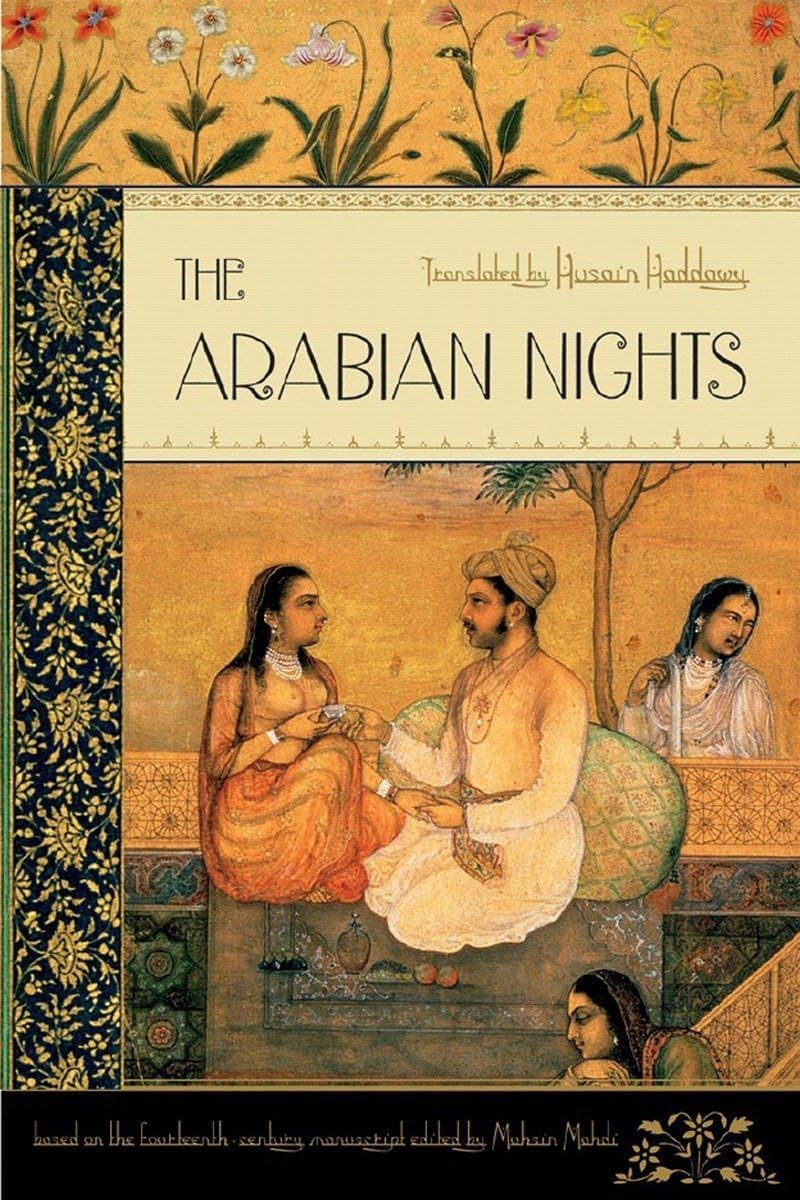

The Arabian Nights [Mahdi, Muhsin, Haddawy, Husain] on desertcart.com. *FREE* shipping on qualifying offers. The Arabian Nights Review: How to Keep Your Husband From Murdering You...skip Powys Mather's translation and read this one! - Translated directly from the original Syrian manuscript, these nine stories (and their associated sub-stories and sub-sub-stories) are a conglomerate of morals, fables, historical or comical anecdotes and Middle Eastern culture rolled into an ingenious framework. The Queen of a fictitious kingdom cheats on her husband, so the king decides to have her killed. No longer can he trust any woman again, ever, so he asks his Grand Vizier to find a new woman every night whom he will marry, sleep with and then have executed the following morning before she has a chance to cheat on him. The kingdom is practically despoiled of virgin brides except for the vizier's daughters who he is reluctant to give up, but has no choice but to obey his master. Not to worry, says the daughter to the vizier, and after she and the king have thoroughly got down to business, she asks him if he wants to hear a story. Alas, the story is unfinished by morning, when Shahrazad discretely falls silent. It was so intriguing the king lets her live until he hears the conclusion. Unfortunately for the king, there is no conclusion, one story grows out of another, which grows out of an other; characters in the stories tell their own stories to the other characters and any time there is a break in a story at all, Shahrazad tells him "oh, but this is nothing compared to the tale of the [INSERT STORY NAME], too bad I'll be dead by then and you won't be able to hear it." 271 Nights are accounted for in the entire work. Apparently, 1001 Nights to medieval Arabs simply meant "a damn long time", so there really never were 1,001 actual nights in the Arabian Nights. Unfortunately for this wonderful classic, the Nights has experienced many adventures in previous releases, especially when 19th Century European "translators" adapted it to Eurocentric perceptions of Arabian culture. Some of the stories we normally associate as having come from the Nights--Aladdin and the Magic Lamp, Ali Baba and the Forty Thieves and Sindbad the sailor--are not in this work because they are actually apocryphal stories from the much later (18th Century) Egyptian canon of Arabic tales, rather than the "pure" Syrian manuscript, edited by Muhsin Mahdi, of the more homogeneous stories which reveal to us the acme of 14th Century (and earlier) Middle Eastern culture of the Abbasid Caliphate. If you *do* want to read a translation of several of the key stories from the Egyptian canon considered more apocryphal to the original (but still worth reading), Haddawy has included them in a second volume entitled "Sindbad and Other Tales from the Arabian Nights", also available on desertcart.com. After all, as one reviewer of the latter volume put it, these stories have been associated with the Nights for over 300 years...should that count for anything? Haddawy thinks so. Incidentally, I have a hardcover, four-volume set of the Mardrus-Mathers translation. Dr J.C. Mardrus translated it from Arabic to French in the late 19th century, and E. Powys Mathers from the French translation into English in the 20th. It was based on this much younger Egyptian manuscript, which is a highly contrived hodgepodge clearly betraying the severe decline in high Arabic literature prevalent during the Ottoman period; whereas Haddawy's Syrian-based work (according to himself) shows a much greater homogeneity (and therefore, accuracy) of Islamic culture of the Mamluk era. And it certainly betrays that fact outright. The Mardus-Mathers translation is full of textual anachronisms and Eurocentricities, such as "they wished each other peace" (instead of just saying "Hi") and such-and-such-Allah (instead of just saying "God"). It's also a little harder to read. P.S.: the four volumes in paperback (yes, paperback!) retail for $110, while the more elegant and authentic (if much shorter) Hussain Haddawy edition retails for $17.95. Hmmm...$17.95 and more accurate, versus $110 and sensationally contrived...gee I dunno, I'm having a hard time deciding this one... Overall, Haddawy's Arabian Nights is a highly recommended, easy to read, and culturally-accurate translation of the Arabic classic. It's lots of fun, even if it does seem like kid's stories to the uninitiated. Trust me, Hussain Haddawy's is not only the much better economic bargain than the European translations, it is also a superb read. Go for the gold and skip the Mathers edition. Haddawy is a genius. Review: imaginitive and rich - As a previous reviewer commented, this collection is "imganitive and rich." I could not say it better. Many of the stories of Sherherazade are familiar to us all - Sinbad, the genie in the bottle ... what I was not expecting, however, was the way in which these stories were woven together. The story begins with a description of the setting: the Sassanid king, after being cuckolded by his wife, decides to marry again - but only for one night, after which she is killed. The vizier's daughter volunteers to become the king's next wife; her father urges her not to, relating a parable - which in turn leads to the daughter's response through another parable. The marriage occurs, and in this manner - one story leading into another and another, the the reader (like the king himself) is helplessly pulled into the stories. A brilliant literary device. The stories themselves are beautiful and varied - some are fantastic (genies, flying horses, talking donkeys), others poignant. It was difficult to put the book down, and each tale had my rapt attention. How much of this is the result of the translator and how much of this is a function of just good story-telling is hard to determine. That, in addition to being entertaining, the stories provide a glimpse into Arabic (and to a lesser extent, Perisan) culture is an added bonus. Recommened reading.
| ASIN | 0393331660 |
| Best Sellers Rank | #47,935 in Books ( See Top 100 in Books ) #580 in Folklore (Books) #1,349 in Classic Literature & Fiction #3,483 in Literary Fiction (Books) |
| Customer Reviews | 4.5 4.5 out of 5 stars (870) |
| Dimensions | 5.7 x 1.2 x 8.3 inches |
| Edition | New Deluxe |
| ISBN-10 | 0140448977 |
| ISBN-13 | 978-0393331660 |
| Item Weight | 2.31 pounds |
| Language | English |
| Print length | 560 pages |
| Publication date | May 17, 2008 |
| Publisher | W. W. Norton & Company |
S**W
How to Keep Your Husband From Murdering You...skip Powys Mather's translation and read this one!
Translated directly from the original Syrian manuscript, these nine stories (and their associated sub-stories and sub-sub-stories) are a conglomerate of morals, fables, historical or comical anecdotes and Middle Eastern culture rolled into an ingenious framework. The Queen of a fictitious kingdom cheats on her husband, so the king decides to have her killed. No longer can he trust any woman again, ever, so he asks his Grand Vizier to find a new woman every night whom he will marry, sleep with and then have executed the following morning before she has a chance to cheat on him. The kingdom is practically despoiled of virgin brides except for the vizier's daughters who he is reluctant to give up, but has no choice but to obey his master. Not to worry, says the daughter to the vizier, and after she and the king have thoroughly got down to business, she asks him if he wants to hear a story. Alas, the story is unfinished by morning, when Shahrazad discretely falls silent. It was so intriguing the king lets her live until he hears the conclusion. Unfortunately for the king, there is no conclusion, one story grows out of another, which grows out of an other; characters in the stories tell their own stories to the other characters and any time there is a break in a story at all, Shahrazad tells him "oh, but this is nothing compared to the tale of the [INSERT STORY NAME], too bad I'll be dead by then and you won't be able to hear it." 271 Nights are accounted for in the entire work. Apparently, 1001 Nights to medieval Arabs simply meant "a damn long time", so there really never were 1,001 actual nights in the Arabian Nights. Unfortunately for this wonderful classic, the Nights has experienced many adventures in previous releases, especially when 19th Century European "translators" adapted it to Eurocentric perceptions of Arabian culture. Some of the stories we normally associate as having come from the Nights--Aladdin and the Magic Lamp, Ali Baba and the Forty Thieves and Sindbad the sailor--are not in this work because they are actually apocryphal stories from the much later (18th Century) Egyptian canon of Arabic tales, rather than the "pure" Syrian manuscript, edited by Muhsin Mahdi, of the more homogeneous stories which reveal to us the acme of 14th Century (and earlier) Middle Eastern culture of the Abbasid Caliphate. If you *do* want to read a translation of several of the key stories from the Egyptian canon considered more apocryphal to the original (but still worth reading), Haddawy has included them in a second volume entitled "Sindbad and Other Tales from the Arabian Nights", also available on amazon.com. After all, as one reviewer of the latter volume put it, these stories have been associated with the Nights for over 300 years...should that count for anything? Haddawy thinks so. Incidentally, I have a hardcover, four-volume set of the Mardrus-Mathers translation. Dr J.C. Mardrus translated it from Arabic to French in the late 19th century, and E. Powys Mathers from the French translation into English in the 20th. It was based on this much younger Egyptian manuscript, which is a highly contrived hodgepodge clearly betraying the severe decline in high Arabic literature prevalent during the Ottoman period; whereas Haddawy's Syrian-based work (according to himself) shows a much greater homogeneity (and therefore, accuracy) of Islamic culture of the Mamluk era. And it certainly betrays that fact outright. The Mardus-Mathers translation is full of textual anachronisms and Eurocentricities, such as "they wished each other peace" (instead of just saying "Hi") and such-and-such-Allah (instead of just saying "God"). It's also a little harder to read. P.S.: the four volumes in paperback (yes, paperback!) retail for $110, while the more elegant and authentic (if much shorter) Hussain Haddawy edition retails for $17.95. Hmmm...$17.95 and more accurate, versus $110 and sensationally contrived...gee I dunno, I'm having a hard time deciding this one... Overall, Haddawy's Arabian Nights is a highly recommended, easy to read, and culturally-accurate translation of the Arabic classic. It's lots of fun, even if it does seem like kid's stories to the uninitiated. Trust me, Hussain Haddawy's is not only the much better economic bargain than the European translations, it is also a superb read. Go for the gold and skip the Mathers edition. Haddawy is a genius.
D**N
imaginitive and rich
As a previous reviewer commented, this collection is "imganitive and rich." I could not say it better. Many of the stories of Sherherazade are familiar to us all - Sinbad, the genie in the bottle ... what I was not expecting, however, was the way in which these stories were woven together. The story begins with a description of the setting: the Sassanid king, after being cuckolded by his wife, decides to marry again - but only for one night, after which she is killed. The vizier's daughter volunteers to become the king's next wife; her father urges her not to, relating a parable - which in turn leads to the daughter's response through another parable. The marriage occurs, and in this manner - one story leading into another and another, the the reader (like the king himself) is helplessly pulled into the stories. A brilliant literary device. The stories themselves are beautiful and varied - some are fantastic (genies, flying horses, talking donkeys), others poignant. It was difficult to put the book down, and each tale had my rapt attention. How much of this is the result of the translator and how much of this is a function of just good story-telling is hard to determine. That, in addition to being entertaining, the stories provide a glimpse into Arabic (and to a lesser extent, Perisan) culture is an added bonus. Recommened reading.
M**S
Good book
This is a solid edition of the tales.
I**E
Forget the Disney versions of these stories...
Forget the Disney versions of these stories. The Arabian Nights tales are much richer, funnier, more risque, and altogether cleverer than that. The framing story of Scheherazade telling tales each night to stay alive is familiar. Most of the stories she tells were new to me, although the elements of the stories - ghouls, genies in pots, a menagerie of strange talking animals, beautiful princesses, thieves, and more - felt familiar. The stories nest inside each other, getting more elaborate and fantastic as the nights' progress. It's great fun. The translation is simple, unadorned, and almost prosaic. The reader is often left to fill in the details. The introduction is wonderful.
D**E
Priceless for the Introduction Alone
I've been collecting versions of the Arabian Nights since childhood, and much of the mass market is Burton, Burton, Burton in various condensed forms. Haddawy's introduction is engaging while also presenting some dissertation-worthy research on translations, prior prominent editions, their pitfalls and wrong turns. If you've ever stumbled over the stilted, flowery prose of Burton or his contemporaries in their versions and wondered why the reading was so awkward, Haddawy has the answer in critical, forensic detail. He also doesn't spare the less-than-stellar translations of other versions, or how societal paradigms in different ages shaped reinterpretations. He likens Mahdi's version to a restoration of a piece of art, and shows the importance of native-speaker level knowledge and context of even modern Arabic dialects when translating historical texts. As for the book itself, it's beautifully bound with soft, lay-flat binding that falls open easily to draw you into random sections of eloquent prose. Definitely a treasure for the home library.
S**.
Love and recommend
Such a fun and clever collection of tales so beautifully woven together. I loved reading Arabian Nights as a child and for a while was looking for a version to read as an adult. This works. The prose of the translation is a bit old fashioned, different from modern English, and it works better to capture the sense of adventure, romance and whimsy of this world. I also love the irregular cut pages as it evokes a sense of holding a book from another time made with hand cut pages. It would be even better if it came with an old leather or parchment cover. I am thinking of making one because this is such a childhood treasure and I hope to pass it on to someone one day.
H**N
The pages are unprofessionally cut...
A**M
Tous les belles histoires ....
D**N
We all read Arabian Nights in high school, but this is the complete “frame story” and completely delightful. It makes me wonder why we in North America don’t fall down in swoons over love. It would be so much more entertaining...
J**E
This is a translation of the oldest manuscript of the Alf Layla wa-Layla, the Thousand and One Nights. It is a lively tale. The 'thousand and one' nights of the title are the nights during which, as the other reviewers have already written, Shaharazad entertains her murderous husband with a tale with cliff-hanger at the end of each to force him to put off her execution for another day. There never were a thousand and one actual nights in the story - that came partly from the title of the book whose translation from Persian into Arabic more than a thousand years ago formed the nucleus of the book we have now, the Hazar Afsan or 'Thousand Tales'. In this volume are to be found the oldest tales of the Alf Layla wa-Layla. You need to buy the companion The Arabian Nights: Sindbad and other stories: Vol 2 published by Norton in paperback or hardback (it's also available as an Everyman hardback The Arabian Nights: Vol 2 ) to get the old favourites like Aladdin, Ali Baba and Sindbad the Sailor. These tales were added to the Arabian Nights by Galland around 1710-1720. He was the first translator of the Arabian Nights (into French) and added tales from other Arabic sources on his publisher's request. These have been part of the Arabian Nights ever since: even modern Arabic editions all include these tales now! Be aware there are two editions of this book, the Norton and the Everyman edition. I like the Everyman hardback, which is not very expensive but nice to read. I haven't tried the Norton, but it's exactly the same text. I think there's a Norton hardback too. [N.B. These aren't childrens' editions... the behaviour can be adult at times.] If you want to read more about the Alf Layla wa-Layla, you could try Robert Irwin's The Arabian Nights: A Companion (his Penguin Anthology of Classical Arabic Literature is a great intro to classical Arabic literature). Both are quite serious; still more academically, Muhsin Mahdi's "Thousand and One Nights" discusses the history of the book (Mahdi was the editor of the Arabic manuscript this book is based on).
T**X
The author who put this together left out all the good stories. These are all stupid ones along the lines of silly man sees a beautiful silly woman and they immediately lose their minds with lust. Boring.
Trustpilot
1 day ago
3 weeks ago