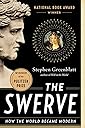
The Swerve: How the World Became Modern
Product ID: 199681
🏆Pulitzer & National Book Award winner
📚356 pages of immersive scholarship
🖼️16 pages of vivid color illustrations
Desertcart purchases this item on your behalf and handles shipping, customs, and support to Poland.
🏛️ Unlock the secret swerve that sparked the modern world!
Stephen Greenblatt’s 'The Swerve: How the World Became Modern' is a 356-page, Pulitzer Prize-winning nonfiction work that chronicles the rediscovery of Lucretius’s ancient poem, a catalyst for the Renaissance and modern thought. Blending rigorous scholarship with compelling storytelling and enriched by 16 pages of color illustrations, this paperback bestseller reveals how a single manuscript changed the course of history and intellectual freedom.

| Best Sellers Rank | #21,610 in Books ( See Top 100 in Books ) #25 in Art History (Books) #65 in European History (Books) #182 in History of Philosophy & Schools of Thought |
| Customer Reviews | 4.4 out of 5 stars 3,522 Reviews |
R**O
An Outstanding Celebration of two Pioneers of the Modern Age: Poggio Bracciolini and Lucretius
"The Swerve" is a magnificent scholarly celebration of Poggio's role in recovering this famous manuscript of Lucretius. There are only two full-scale biographies of Poggio Bracciolini. The only English one is William Shepherd's The Life of Poggio Bracciolini (1837). [See my own Amazon review.] It shows its age. Some of the language can strike us as quaint. Many turns of phrase seem too long in coming to the point and flowery, in the 19th-century rhetorical style. On another hand, some formulations are sharp and strikingly concise. Long quotations in Latin (in the notes at the bottom of pages) are shown without translation. The lack of an initial table of contents and the lack of any kind of index are particularly irksome. In addition there are some errors in the text. For instance, Pope John XXIII is mislabeled XXII, following the renumbering of Gibbon, (as John XXI skipped the XX numbering, there had been no Pope John XX). It is helpful to check details and dates against the superior biography by the German scholar Ernst Walser, Poggius Florentinus, Leben Und Werke (German Edition, Berlin, 1914; Reprints: Georg Olms,1974; Nabu Press, 2011), which remains by far the most complete biography to-date, with more recent, accurate, and detailed information than William Shepherd's, but unfortunately not translated into English. Poggio was marked by the passion of his teachers for books and writing, inspired by the first generation of Italian humanists centered around Francesco Petrarch (1304-1374), who had revived interest in the forgotten masterpieces of Livy and Cicero, Giovanni Boccaccio (1313-1375) and Coluccio Salutati (1331-1406). Poggio joined the second generation of civic humanists forming around Salutati. Resolute in glorifying "studia humanitatis" (the study of "humanities", a phrase popularized by Leonardo Bruni), learning (studium), literacy (eloquentia), and erudition (eruditio) as the chief concern of man, Poggio ridiculed the folly of popes and princes, who spent their time in wars and ecclesiastical disputes instead of reviving the lost learning of antiquity. [See Anthony Grafton, Commerce with the Classics: Ancient Books and Renaissance Readers , (Un. of Michigan Press, 1997).] The literary passions of the learned Italians in the new Humanist Movement, which were to influence the future course of both Renaissance and Reformation, were epitomized in the activities and pursuits of this self-made man, who rose from the lowly position of scribe in the Roman Curia to the privileged role of apostolic secretary. He became devoted to the revival of classical studies amid conflicts of popes and antipopes, cardinals and councils, in all of which he played an official part as first-row witness, chronicler and (often unsolicited) critic and adviser. After John XXIII had been elected pope (later labeled antipope) by the dissident Council of Pisa (May 1410), he was deposed by the Council of Constance in May 1415, while Gregory XII abdicated in July 1415, as agreed with the Council to clear the way to a restoration of a unified papacy. Poggio's duties had called him to the Council of Constance in 1414, following John XXIII. After John XXIII's termination, the papal office in Italy remained vacant for two years, which gave Poggio some forced leisure time in 1416-17. He indulged in some welcome relaxation from the papal court environment. In the spring of 1416 (sometime between March and May), Poggio visited the baths at the German spa of Baden. In a long letter to Nicolli, he reported his discovery of a "Epicurean" lifestyle -- one year before finding Lucretius -- where men and women bathe together, barely separated, in minimum clothing: "I have related enough to give you an idea what a numerous school of Epicureans is established in Baden. I think this must be the place where the first man was created, which the Hebrews call the garden of pleasure. If pleasure can make a man happy, this place is certainly possessed of every requisite for the promotion of felicity." Poggio also persevered in his pursuit of manuscript hunting, exploring the libraries of Swiss and Swabian abbeys. His great manuscript finds date to this period, 1415-1417. The treasures he brought to light at Reichenau, Weingarten, and above all St. Gall, retrieved from the dust and abandon many lost masterpieces of Latin literature, and supplied scholars and students with the texts of authors whose works had hitherto been accessible only in fragmented or mutilated copies. One of Poggio's finds that has become especially famous was, in January 1417, in a German monastery (never named by Poggio, but probably Fulda), the discovery of the only manuscript of Lucretius's "De Rerum Natura" known at the time. Poggio spotted the name, which he remembered as quoted by Cicero. This was a Latin poem of 7,400 lines, divided into six books, giving a full description of the world as viewed by the ancient Greek philosopher Epicurus. It has been translated as "On the Nature of the Universe" (Oxford World's Classics). The manuscript found by Poggio was not even preserved, but he sent the copy he had ordered to Niccolo Niccoli, who made a transcription in his beautiful book hand (the creator of italic script), which became the model for the more than fifty other copies circulating at the time. Poggio complained that Niccoli didn't return his original copy for 14 years! Later two 9th-century manuscripts were discovered, the O ("Oblongus", ca. 825) and Q ("Quadratus") codices, now kept at Leiden University. The book was first printed in 1473. This miraculous discovery is the subject of Greenblatt's magnificent book "The Swerve: How the World Became Modern" (Sept. 2011). The book details the sensational discovery of the old Lucretius manuscript by Poggio. It describes the strange materialistic Epicurean physics based on the atomism of Democritus -- the world is made only of atoms (irreducible, indestructible, non-divisibles), "the seeds of things", forming objects through the random collision due to the clinamen, the "swerve" -- and its ethics. Greenblatt analyzes the poem's subsequent impact on the development of the Renaissance, the Reformation and modern science. The book won the 2011 National Book Award for Non-fiction, and the 2012 Pulitzer Prize for General Non-Fiction. It was well received by the public, although many critics contended that Greenblatt's enthusiasm sounded hyperbolic, and doubted that the Lucretius manuscript had any immediate influence on the development of the European Weltanschauung. [See for instance David Quint's review, "Humanism as Revolution", (The New Republic, Sept. 28, 2011), and Anthony Grafton's "The Most Charming Pagan", (The New York Review of Books, Dec. 8, 2011)] Anthony Grafton remarked: The discovery can be seen as a miracle, since monks, "athletes of holiness" lived the opposite of Epicurus's model life. "The monasteries, in Greenblatt's account--a curious blend of 'Gibbonian irony and Sadean relish' --were not quiet, dignified centers for the performance of the liturgy and the copying of texts but 'theaters of pain.' Their inmates vied to torment themselves more effectively than their rivals, wielding everything from whips and chains to iron crosses fixed with nails into their bodies. In these houses of self-punishment, classical texts naturally aroused relatively little interest, and pleas for the pursuit of pleasure were stigmatized as especially evil. Only a swerve or two--the fact that a copy survived in a library that Poggio happened to explore--saved 'On the Nature of Things' from the extinction suffered by most of Epicurus' own works." However, concludes Grafton, "We never quite learn, in the end, how the world became modern...[But Greenblatt] has brought Lucretius a good many new readers, to judge from the fact that A.E. Stallings's wonderful Penguin translation of the poem is now Amazon's best-selling title under Poetry." This discovery was enhanced by the translation from Greek into Latin of "The Lives and Opinions of Eminent Philosophers by Diogenes Laertius" (ca. 1430), including three full letters by Epicurus. This convergence introduced the philosophy of Epicurus to the mindset of the Italian humanists, and was noted essentially by philosophers and literary circles for its views on ethics and religion (understood in its original sense as the binding down power of beliefs) -- its proclaimed indifference of gods to human affairs, who didn't create the world either; its condemnation of superstitions; its ridiculing of the fear of death since the soul dies with the body; its dispelling the notion of founding morality on an illusory afterlife and its imagined terrors -- and its advocation of the pursuit of beauty and pleasure (happiness) and the avoidance of pain. In fact, the new philosophy was seen as liberating thinking from the Christian worldview of asceticism and preoccupation with angels and demons, and indulging the pleasure of knowledge, the natural curiosity for the workings of the real world and history. [See the fundamental article by David Sedley, "Lucretius", (Stanford Encyclopedia of Philosophy, SEP, Aug. 2008) and Ronald G. Witt, The Two Latin Cultures and the Foundation of Renaissance Humanism in Medieval Italy (Cambridge Un. Press, March 2012)] Additional support came from a dialogue by Lorenzo Valla, "De Voluptate" ("On Pleasure", 1431) revised as "De Vero Bono" ("On the True Good", 1433), where Valla construed Epicurean "pleasure" as a component of Christian charity and beatitude, rejecting the classical association with Stoic virtue. [See the excellent article by Lodi Nauta, "Lorenzo Valla", (Stanford Encyclopedia of Philosophy, SEP, 2009)] The recovery of Lucretius's iconoclastic poem had to face the hostility of the Catholic Church. Jerome had already "reported" that Lucretius had died in madness from a "love philter". "The poet Titus Lucretius was born. Later he was turned mad by a love potion, but in the intervals in between the madness he composed some books, which Cicero afterwards edited. He killed himself when he was 44 years old." In Chronological Tables, (ed. A. Schoene, 171st Olympiad 96-93 BC, 171.3). Epicurus's philosophy was labeled as "atheism" by the Catholic Church, which tried to suppress Lucretius's book. After teaching Epicurean philosophy was banned in Florence in 1513, Machiavelli (1469-1527) made his own copy by hand, and 16th-century scholars used Lucretius covertly, his book fuelling an underground counterculture opposed to the medieval ideas of the "gothic" Dark Age. This was the key period of Italian humanists launching the recovery of reason and liberation from faith and superstition through reconnecting with the Greco-Roman texts, as well described by John Addington Symonds in Renaissance in Italy, Volume 2 (7 vol., 1875-86), Voltaire and David Hume. Thomas More made the pursuit of pleasure the focal point of his Utopia (1516). Lucretius was repeatedly quoted by Montaigne in his Essays (1580). [See Alison Brown, The Return of Lucretius to Renaissance Florence (I Tatti Studies in Italian Renaissance History) . (Harvard Un. Press, 2010) And Frederick Krantz, "Between Bruni and Machiavelli: History, Law, and Historicism in Poggio Bracciolini", in Politics and Culture in Early Modern Europe: Essays in Honour of H. G. Koenigsberger (Cambridge Un. Press, 1987), p. 119-152.] This heralded the dramatic change of world focus that Greenblatt calls "the swerve" in Western civilization. Greenblatt quotes one of Epicurus's disciples: Living with pleasure is impossible "without living prudently and honorably and justly, and also without living courageously and temperately and magnanimously, and without making friends, and without being philanthropic." This basic philosophy of pleasure and the need for friends, (later termed "pursuit of happiness"), was the key to Epicurus. It was grotesquely caricatured by Christian critics as unrestricted sensual indulgence. Giordano Bruno (1548-1600), burnt at the stake as a "heretic" by the Inquisition (1600) had incorporated some of Lucretius's ideas into his own cosmology and pantheism. [See Riccardo Fubini, Humanism and Secularization: From Petrarch to Valla , (transl. Martha King, Duke Un. Press, 2003).] Fuller recognition of Lucretius's physics -- its theory of atoms and the "swerve" -- by modern physicists did not happen until at least the 17th century with the atomism of Pierre Gassendi (1592-1655), while Isaac Newton (1642-1727) also declared his support for atomism. Lucretius's modern-sounding views on evolution (of geology, nature, and primitive human society) were not acknowledged by scientists until the 18th century, when Erasmus Darwin (1731-1802), Charles's grandfather, announced ideas of evolution in his poems "The Loves of the Plants" (1789) and "The Temple of Nature" (1803) . Thomas Jefferson owned eight editions of De Natura Rerum. [See, Gordon Lindsay Campbell, "Lucretius on Creation & Evolution", (Oxford Un. Press, 2003)] Whoever has read Lucretius cannot forget his description of the three methods of primitive man's love-making: woman's own desire, man's brutal force, or seduction with "pira lecta" (choice pears). "Et Venus in silvis jungebat corpora amantum; conciliabat enim vel mutua quamque cupido vel violenta viri atque inpensa libido ver pretium, glandes atque arbita vel pira lecta. (Book V, 962-965) And Venus used to join the bodies of lovers; for either common desire attracted each woman or the violent force of a man and his excessive lust or a bribe, acorns and arbute-berries or choice pears. [See Robert D. Brown, "Lucretius on Love and Sex", (Brill, 1987), in the series "Columbia Un. Studies in the Classical Tradition"]. The whole world of courtship in New York City remains driven by the sophisticated use of "pira lecta". Ancient Greek materialist physics was the subject of Karl Marx's Ph.D. thesis. Karl Marx started working on the materialism and atheism of the Greek atomists under the guidance of Bruno Bauer at Bonn University. Marx presented his thesis, "The Difference Between the Democritean and Epicurean Philosophy of Nature" to the more liberal Un. of Jena, which granted him his Ph.D. in April 1841. When Bauer was expelled, on express order of the Prussian king Friedrich Wilhelm IV, from his position as lecturer in theology in the spring of 1842 for his revolutionary ideas on the New Testament writings, Marx abandoned any hopes for an academic career. Both Harvard philosopher George Santayana and French philosopher Henri Bergson were strongly influenced by Lucretius's ideas of evolution and ethics. Greenblatt has paid an outstanding homage to Lucretius and Poggio Bracciolini, two great figures of the Western World's emancipation from the Middle Ages' obscurantist Christian worldview into a modern vision of humanism -- based on the retrieval of Greco-Roman texts, literacy, education, experimental knowledge, and centered on human aspirations -- bringing our horizon back from the celestial heaven of angels and demons down to earth, and the reality of what the ancient Greeks called polis, nature and our cosmos.
B**L
A can opener to understanding European feudal thinking
I have been visiting castles and historic sites in France and Jersey on weekends for a couple of months, and just spent a week vacationing in Barcelona touring museums, Montserrat, Segrada Familia, and Tarragona. I was particularly impressed on my visit to Museu Nacional d'Art de Catalunya in Barcelona, which is an incredible monument to the totalitarian culture of Catholicism. I don't know if it is an intended selection of representative pieces, but there is only one thought expressed artistically in the Romanesque, Gothic, and Renaissance, and Baroque collections, and that one thought of course is the founding myth of Christianity. I read this book to add some perspective to how the feudal system built on the ruins of Roman culture by the Catholic church could partially replicate the enormous building projects of its predecessors. I am pondering why it is that religious culture can undertake at enormous cost over centuries the planning and building of architectural marvels such as Mont St. Michael, Segrada Familia, Notre Dame, and the thousands of lesser known basilicas and monasteries throughout the world. There are no such artifices to reason and knowledge, only to myths. At least until the Renaissance, these projects were always coupled to an oppressive totalitarian state that coerces the project from a subjugated population. The Swerve does not provide encompassing answers to this dynamic, it is not intended as comprehensive history of the evolution of the modern state from the rotting tree of medieval feudalism. But it does offer very entertaining glimpses into how an idea that was orders of magnitude more insightful and proven to be a much closer approximation to the nature of our existence than Christianity re-emerged after 1000 years of oppression. As illustrated in the recounting of the execution of Jan Hus for articulating an idea, I can correlate the absolute power of the state to suppress non-conformity among the educated to the ability to coerce the illiterate and uninformed to give to the state at levels that surely degraded their lives, increased their hunger, and jeopardized their safety. One can see that sacrifice in the incredible relics built in medieval times for the church, and in pre-400 AD for the Roman Empire. The Swerve provided a lot of interesting sidebars to my tourism and understanding of the sites I have visited, as well as to my background readings on the history of Europe. I agree with other reviewers that the poem by Lucretius is over-emphasized as a sort of holy grail of reason that exploded into the 16th century to create the Renaissance. It is impossible to know how pervasive the ideas articulated by Lucretius were in this time period. Clearly, it was hazardous to one's health to put forward ideas in a totalitarian police state that colored, confronted, or refuted the official mythology.
M**N
Every good turn deserves this sort of treatment
Swerve by Stephen Greenblatt received many honors and acclimations since it was published earlier this year and these accolades are justly deserved. This is one of the best, most erudite books to be published in years. If anyone wants to understand the differences between Blue staters and Red staters, this is the book that does it. Along with making a credible claim that Botticelli, Descartes, Shakespeare, Newton, Galileo, Thomas Jefferson, Montaigne, the philosophes, Greenblatt demonstrates how Lucretius created the secular culture that is behind the development of human liberty that came with the Renaissance and the Enlightenment. The Middle Ages, with its focus on religion and viewing things through a "spiritual lens," probably was about as intellectually stimulating for the average person as life in Mao's China during the cultural revolution only it lasted for 1,000 years.. One viewed nature and the natural world as re-enforcing the rules of Bible and that there were no laws or science that could mitigate man's life on earth. There are a number of factors that lifted western man out of this abyss-Kenneth Clark viewed the advancement of civilization as something that occurred by the skin of its teeth. However the gradual rediscovery of ancient texts certainly played a part by shifting the intellectual focus away from pointless theological squabbles and onto useful knowledge. The discovery of the concept of "zero," something acquired following the fall of Cordova and the rediscovery of Aristotle is example. However there was much more to be rediscovered. The ancient world was one of choices and lacked the stifling unity that an official church or religion usually insists upon. There was more than just Aristotle and Cicero as book hunters would discover over the next 300 years and these would shakeup civilization immensely. Greenblatt makes a strong case that if any book had an impact on Western Civilization, it was "On the Nature of Things" by Lucretius. During ancient times, there were a number of schools that existed in Athens along with those founded by Plato and Aristotle. There were Stoics and Cynics. However the epicureans and their materialist view of life and emphasis on simple pleasure were a group apart. Lucretius was a Roman who lived in the last days of the Roman republic whose work was know for influencing both Virgil and Horace (who appeared about a generation after). The epicureans, with their emphasis on earthly pleasure and denunciation of the creaky metaphysics of Plato, were a group apart from many philosophers. They also tended to regard the world as a collection of atoms and space, which was in a constant state of flux, of creation and destruction, quite at odds with Aristotle's notion of substances being permanent. Lucretius also urged man to give up the fears that lead to his tendency to create gods and religions as means of addressing them. Lucretius believed that this fear could be dismissed if man understood that the world was a series of atoms and natural phenomenon. In a sense it was about expectations. Grandiose expectations fueled great fears fueled great irrationalities. In Aristotle all things may have had their purpose and role in an orderly universe, Lucretius felt matter was capable of all manner of random activity. The gods were too distant to notice or care about the concerns of man. While the ideas of the epicureans were held in disdain by other schools, in those days in which there was not an authority to condemn ideas, this disdain was limited to polemical tracts, many of which were lost. The destruction of classical civilization was part of the cultural agenda of the Middle Ages. If it did not reinforce Christian dogma it was dangerous and so texts were allowed to disintegrate. Hundreds of works are no more and remained unknown by most of Western Europe for almost 1000 years. The rediscovery of Aristotle who was very important in the development of Islamic civilization, served as spur the search for other books. Far from being only a high-minded pursuit, many of these books were supposed to have magical properties. Given the choice between a book on Egyptian magic or Plato's Symposium, a Florentine merchant opted for the former. The rediscovery of Lucretius by Poggio Bracciolini, a papal bureaucrat searching for manuscripts of ancient texts in 1417 allowed for the ideas of materialism to live anew. Over time, as Greenblatt demonstrates, this rediscovery would cause a shift in the intellectual firmament and enrich the civilization of the west. The return of Lucretius would provide the background for Botticelli's "Primavera" (this is a pictorial take on the opening line of "On the Nature of Things"). Many elements of Lucretius found their way into the works of Shakespeare, the materialist view, which stood in opposition to Aristotle's orderly universe, would also promote the scientific enquiries ranging from Copernicus, Newton and Galileo.
M**L
Brilliant, truly pleasurable reading experience with nontrivial caveats
The Swerve is an absolute joy to read. It is written so vividly and with such verve, passion, and breadth of ambition. It is definitely not what I was expecting, though. I thought there would be more, much more, addressing the influence of Lucretius or antiquity in general on world-making and -breaking revolutions in the arts and *especially* the sciences over the centuries, up to the present day. This is, frankly, almost entirely absent. Schrödinger, Heisenberg, and other titans of modern science who revivified traditions in ancient thought in the course of introducing their breakthroughs are absent. The closest this book comes to satisfying any curiosity about Lucretius' influence on the making of the modern world is... honestly it's pretty scant. You'll read the general outlines of the end of Giordano Bruno for the twelfth time. A sprinkle of Galileo too. Greenblatt, rather, seems much more interested in injecting his love of English poetics than exploring any of this - so you'll be reading more excerpted Dryden and Shakespeare than exploring real, material connections between Lucretius and the making of the modern world in any real and significant way. Even Democritus comes up but once or twice. Some puzzling stuff. For the majority of the book, you'll be taking in a gripping narrative of papal intrigue, bibliomania, eccentric monks, and early Christian humanism. This, at least, was to me anyway absolutely new. But yeah, I wish there were more points of contact between the contemporary humanities, particularly intellectual historians and philosophers, and the exact sciences. Cassirer was a one-off, sadly. Even though I was not expecting what was inside, I still rank Swerve among the best books I've read in a while. It was just so rich and fulfilling, even when I feel there are some real shortcomings in its planning. This is a strange review, insofar as I'm coming right out and saying I'm kind of unconvinced by Greenblatt's argument (or the promise of his book's subtitle), but he truly is just that good of a writer that this concern is feels secondary at best - his language is frankly addicting, and I've already ordered another of his books.
B**L
The Swerve
“The Swerve: How the World Became Modern” by Stephen Greenblatt is a book that holds special significance for me. It is a book about a book hunter who lived in the 15th century, Poggio Bracciolini. It resonates with me because I too am book hunter. I know how Poggio Bracciolini must have felt when he came across a dusty scroll hidden away in the library of the Benedictine Abbey of Fulda in Germany. This scroll was one of the few remaining copies extant in the world and the only copy that had surfaced to that point. It consisted of an important poem, “On the Nature of Things,” written by Lucretius in 50 BCE. This book would change the course of human events. “On the Nature of Things” is a poem about the philosophy of Epicurus. Epicurus, a Greek philosopher living in Athens in the third century B.C.E, was a proponent of the theory of atomism. This theory rests on the idea that the basic building blocks of matter are tiny invisible particles called atoms. Epicurus was also a proponent of the pleasure principle. He believed one’s primary aim in life should be enhancing one’s pleasure and avoiding pain. The pursuit of happiness should be the goal of life. Liberated from superstition, you would be free to pursue pleasure. Peace of mind is the key to enduring pleasure. The Church of the 15th century however, thought otherwise. “On the Nature of Things” was considered to be a radical and dangerous document. “The Swerve: How the World Became Modern,” is a book about books. Greenblatt goes into the history of writing books and bookmaking, libraries, and book storage. He discusses the readers of books and the owners of books from antiquity. He describes these readers to be few in number and usually the wealthy elite. They were a cultivated society of men and women whose homes had rooms designated solely for the purpose of reading books. “The Swerve” is also a history of the times in which Poggio lived. He lived in Florence during the 15th century. He became secretary to Pope John XXIII. These were wild times for the Church. There were actually three Popes at the time all claiming legitimacy. Pope John XXIII (Baldassare Cossa) was eventually deposed after being accused of simony, sodomy, rape, incest, torture, and murder. After the Pope was deposed and imprisoned, Poggio unemployed, considered himself to be free. Free to hunt books. Free to read and free from all cares and worries of worldly affairs. He withdrew into the quarters of his private library in his castle. Books delighted him. According to Poggio, time spent with books takes our minds away from our troubles. The most important impact the book had for me was to answer two burning questions: Is the world determined? And, do we have free will? Determinism conflicts with the doctrine of free will. Lucretius suggests that atoms tend to swerve randomly (Clinamen). When atoms fall straight down through space they deflect a bit here and there, at uncertain times and places, slightly changing their motion. This swerving action creates the free will that we all take advantage of in our daily lives and allows us to have purpose. The other important legacy Lucretius leaves us with is the idea that the highest goal of life is the enhancement of pleasure and the reduction of pain. Life should be all about the pursuit of happiness. We find the echoes of these ideas in our own Declaration of Independence, written by Thomas Jefferson in 1776. In it he declared man’s right to life, freedom, and also to “the pursuit of happiness.” Jefferson owned many editions of “On the Nature of Things in various translations. It was one of his favorite books.
R**G
The World may be Modern - but We still Cant Handle the Truth
This book was fun to read, I always love Western classical history, but its thesis is close to nonsense. Stephen Greenblatt (a Professor for 30 years at my alma mater California Berkeley) greatly overstates the case that the discovery of ancient texts on philosophy somehow triggered the Renaissance which led to the World 'becoming Modern'. in particular, he suggests the beginnings of the modern world, built almost entirely of (Western) achievements in Science and technology, and the Economic Industrial revolution that followed them, can be traced to 15th century finding of the Roman Lucretius descrition in the 'The Nature of Things' about the Greek Epicurus' ideals, among them: *There is no Divine design, all religions are superstitious delusions, *The Universe was not created for Humans, *Everything is made up of invisible particles and that *the highest goal of human life is the enjoyment of pleasure and beauty, the minimization of pain, and * the expression of wonder about things we do not understand. Really? We wish the Modern world was so simple. My view of Modernity is that humans, for the most part, are still intrinsically the same as they were 500 years ago but it SCIENCE and Engineering that have transformed the planet, understading disease, minimizing needless death, so that the planet is now filled it with 7 billion people, who can connect with, entertain, educate, argue and yes, occasionally, kill the others. Isaac Newton was not inspired by Renaissance humanism, he was just a very devout Englishman who realized the laws of motion and Gravity. The great scientists of the 19-20th centuries who understood quantum mechanics and the nature of the atom - to create Atomic bombs, computers and iPhones - never needed to know that some Roman 2000 years ago had realized that all things are made up of invisible particles. (many Sanskrit scholars from India will similarly tell you that the concept of the atom was mentioned there first - an equally disingenous claim). Even the claims about the obvious limits of religion 'invariably cruel' and the satisfaction that must be found in Science and wondering about the Nature of things - are not original, and not particularly revealing about the ultimate nature of modern man. In particular, I feel that the great challenge for humans - in the ancient or the modern world 2000 years later - lies in the NOT being able to ACCEPT what they already REALIZE, that the Universe is entirely indifferent to them - this could range from your loved ones not loving you back or a massive Asteroid taking out all life on Earth tomorrow. There is no Good or Evil - only ambiguities in between. Here the certainties of Science do not help, because human beings cannot use it to accept what they may have fully realized about their pathetic, short lives. Paradoxically, the Modern World then has only brought human limitations in to a sharper focus - We know more about ourselves than we ever have, but still unable to accept what typically bothers us most - more or less the same place we probably were when Lucretius wrote 'The Nature of Things' - 2000 years ago.
C**D
Captivating story flawed by an inaccurate representation of Epicruean philosophy
I loved this book. The story of humanists struggling to rediscover the Western world's intellectual heritage right under the nose of the Church was heart-wrenching, thrilling, and astonishing. I can't help but feel sad that in our herd-like stampede toward Christianity, we Europeans and Mediterraneans willingly destroyed all but tatters of the body of understanding that had been accumulated during the ancient, pre-Christian era and I wonder how much farther we might be today if we had been able to preserve it all. Mr. Greenblatt did a wonderful job painting a picture of how these texts were recovered. I felt like I was there at times, nervous about getting caught with some ancient scroll, right alongside Poggio. I do find a couple of points of fault with the book, however. The first is that I feel like the author only glossed over the whole story and could have gone into much more detail. I really would have liked a longer, more thorough work, especially from someone as highly educated as Mr. Greenblatt. The second is that he made no mention whatsoever of the huge role played by the Muslim world in preserving the texts of the Greeks and Romans. The way he tells it makes it seem like we owe all of our modern-day translations to European Christian monks and humanists. Truthfully, though, we owe our Muslim friends an immeasurable debt for their preservation - largely through translations into Arabic - of so many important texts and this was not mentioned at all. Much of our modern day knowledge - mathematics, chemistry, etc - is based on texts retransmitted into Europe via Arab scholars like the great Avicenna, Geber, Alkindus, Rhazes, and many others, who, while we were in the Dark Ages, further developed and perfected many of the ideas contained in those texts, as well as making new intellectual leaps and connections that we are the beneficiaries of today. In my opinion, this is a glaring omission and I was very surprised to see no mention made of this whatsoever in such a widely acclaimed book. The third and final issue that I have with the book is its mischaracterization of Epicurean philosophy, particularly as a philosophy of life. Great fuss is made over the advanced idea of atomism, which absolutely is amazing for the time and the total lack of experimental validation, but no mention whatsoever is made of the fact that the Epicureans were, ultimately, wrong in the notion that atoms are indivisible (we have since divided them), everything is made up of matter and space (everything is actually made up of matter, energy, space, and other things besides), matter cannot be destroyed (actually, we can annihilate both particles and antiparticles), atoms are the fundamental things that make up everything else (not really - atoms are made up of subatomic particles that may be made up of what are essentially vibrating strings of energy), and the list goes on. So, yes, they were on the right track but ultimately, most of their fundamental tenets on physics turned out to be wrong, strictly speaking. Also, the Epicurean lifestyle is misrepresented as one of "eat, drink, and be merry for tomorrow we die". To quote George K. Strodach's introduction to Epicurus' The Art of Happiness: "Though based on the pleasure-pain principle it was not what we would ordinarily call a pleasant life. In Nietzsche's terms, it did not say yea to life but nay. It was largely negative, escapist, self-protective, and therapeutic. By withdrawing from the active concerns and responsibilities of the citizen, it remained socially and politically immature." Epicureans were also against sex, something totally misrepresented in The Swerve, which goes on at length about their supposedly progressive sexual views. It's important not to conflate the words of Lucretius with their interpretation by Poggio or any other reader, and not to conflate either of these with the actual doctrines of Epicurean philosophy. I felt that The Swerve did a poor job of carefully delineating between these three concerns. Overall, it was a wonderful read and I would recommend it to anyone with the caveat that it's not the whole story historically and is in no way a philosophically rigorous or accurate representation of Epicurean philosophy.
B**B
An important book, easy to read
In 1417 Poggio Bracciolini, a papal official, found an old manuscript of a work by a Roman poet and philosopher named Lucretius in a remote German monastery. The manuscript had probably been lying around for hundreds of years, and itself was probably several copies removed from the original. Lucretius lived in the first century BC. His work was influenced by earlier philosophers, particularly the Greek Epicurus, who lived in the third century BC. The work, entitled "On the Nature of Things", had been lost until Poggio rediscovered it. Poggio made of copy of it and it was then re-copied and then printed and eventually disseminated throughout Europe. Lucretius' ideas are astonishingly modern. Here is a summary of what Lucretius thought (I have borrowed Greenblatt's phrases): matter is composed of invisible particles, and these "atoms" endlessly recombine in random ways; the universe has no creator or designer, there is no end or purpose to existence, nature ceaselessly experiments, creatures whose combinations of organs enables them to adapt will succeed in establishing themselves until changing circumstances make it impossible for them to survive, the universe was not created for or about humans, there is no reason to believe that human beings as a species will last forever, there are no souls which survive after death, and no afterlife, all religions are superstitious delusions, there are no angels, demons or ghosts, and the highest goal of human life is the pursuit of happiness (thus the famous phrase in our Declaration of Independence). But this pursuit of happiness is not hedonism, the greatest obstacle to pleasure is not pain, but delusion about what leads to happiness. The poem is an attempt to show how to lead a good life in the face of an indifferent universe. The Latin verse is apparently very beautiful. These ideas were dangerous when Poggio discovered the manuscript and continued to be so all the way through to the Enlightenment. But Greenblatt shows how Lucretius, once reintroduced into European thought, changed it forever, by influencing European humanists. The chain of influence leads through Montaigne, touches Shakespeare, and ultimately permeates the Enlightenment. Jefferson owned five copies of Lucretius in Latin and others in other languages. One of Lucretius' ideas was that sometimes in the random recombination of atoms there is a "swerve", a chance variation which leads to unexpected results. Hence the title of Greenblatt's book. Greenblatt writes lucidly and is endlessly entertaining. My favorite part was the description of how books were copied before the invention of the printing press. As many as fifty monks would sit for hours in a well-lighted room, each at his desk, copying texts. They were not allowed to talk, and were discourged from trying to understand the texts. I especially enjoyed reading about this on my Kindle.
S**N
Following the enormous implications of a single historical moment
Greenblatt's story at first seems simple enough to make you wonder why this non-fictional book received both the Pulitzer and National Book awards: In the early 15th century, an Italian "book hunter" named Poggio rediscovers what at the time seems to be the very last copy of the Roman poet Lucretius' text "On the Nature of Things" in a German monastery. Lucretius' arguments, based on the Ancient Greek philosophy of Epicurus which the Catholic Church had pretty much successfully suppressed, helped kick-start the Renaissance. None other than Thomas Jefferson was later to call himself an Epicurean, which explains how the "pursuit of happiness" - a central Epicurean ideal - ended up in the American Declaration of Independence. However, what makes this book almost impossible to put down - I read it in two long evenings straight through - is what actually boils down to background information, the times and lives of Poggio and others who struggled to resurrect the forgotten Ancient world in a race against time in a world that a best couldn't have cared less and at worst wanted these "pagan" ideas to be completely destroyed. Especially during the first part of the book, it is chilling to realize how close the world came to losing this text forever. Greenblatt also conveys the full tragedy of what humanity has lost through everything from simple decay of scrolls to mindless bookworms to very focused purges of "heretic" thought. The book also serves as an easy to read general introduction to Epicureanism itself - things like atomic theory, the idea that the gods are not interested in our lives, and that pain is to be avoided and pleasure sought after. After reading this book, you'll want to read "On the Nature of Things" yourself, so you might as well consider getting a copy of it right away while you are at it. As with many historical books on the Renaissance, this one makes for uncomfortable reading for Christians given the actions of the Catholic Church at that time, though by its very nature (no pun intended), any book on Epicureanism is going to include attacks on organized religion of any form. Greenblatt makes no bones that he considers the Middle Ages to be dark, ignorant, brutish, and generally quite horrible, very much in contrast to the more modern "hey, it wasn't that bad" school of thought. In the end, "The Swerve" exposed me to whole segments of Ancient and Renaissance history and thought I wasn't fully aware of. The introduction to Epicureanism, however brief, is at least as valuable and has been a starting point to go on and read more on the subject. Add to this that the books is well-written, and there is little more I could want from a history book.
Q**S
A good read
Really interesting. If you like history and the search for knowledge in the Renaissance, this is a good read. Quite well- written
D**I
Bellissimo
Scritto da un americano non me lo sarei aspettato. Un capolavoro: ti emoziona e attravera la storia culturale d’Italia dal ‘400 alla fine del rinascimento
M**N
Even better than expected
There are likely fewer than a dozen books about which I would say "A must for the thinking class" - this is one of them. It opens up an avenue of investigation at every turn, is intriguingly informative and just a sheer delight to read. I am usually a "tough" critic, which is to say, these statements are not meant to please or "be nice". It's a wonderful book.
C**4
Excellent
A wonderful book. The packaging and delivery were good.
Trustpilot
2 weeks ago
3 weeks ago