Different from the Others
Product ID: 15052215
Buy anything from 5,000+ international stores. One checkout price. No surprise fees. Join 2M+ shoppers on Desertcart.
Desertcart purchases this item on your behalf and handles shipping, customs, and support to Poland.
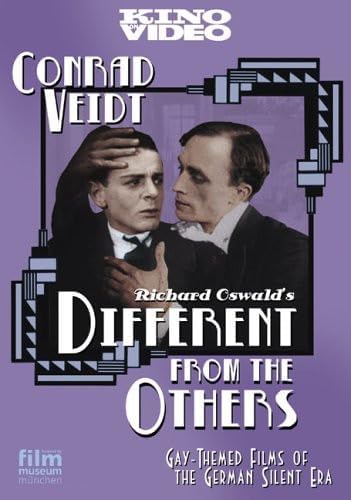
One of the first gay-themed films in the history of cinema, Different from the Others was banned at the time of it's release, later burned by the Nazis and was believed lost for more than forty years. Using recently discovered film segments, still photos and censorship documents from different archives, Filmmuseum Muenchen has resurrected this truly groundbreaking silent film for DVD. Enacted in 1871, the German penal code's Paragraph 175 sentenced thousands of accused German homosexual men to jail terms for "unnatural vice between men." in 1919, director Richard Oswald (Tales of the Uncanny) and psychologist Dr. Magnus Hirschfeld created a film intended to expose the unjust Paragraph 175 and help liberate the "third sex" from legal persecution and public scorn. Different from the Others casts Conrad Veidt (Cabinet of Dr. Caligari) as Paul Korner, a gay concert pianist blackmailed by a closeted low-life named Bollek. When Korner's budding romance with a handsome young music student runs afoul of Bollek's extortion, Korner goes to the German courts for protection. But the draconian Paragraph 175 makes criminals out of both accuser and accused, and the love Korner has found may cost him his career, his freedom or his life. Conrad Veidt's uncompromising performance (the same year as his legendary portrayal of Cesar the somnambulist in Caligari) places a human face on Hirschfeld's reformist fervor and Oswald's tragic melodrama. In it's frank depiction of gay bars, closeted homosexuality, and the suffocating expectations of straight society, Different from the Others is both a fascinating time capsule and a remarkably modern cinematic plea for tolerance and change. Review: A fantastic piece of history - A fantastic film that we are lucky has not completely perished. This film is both of historical importance for the Silent Era as well as one of the very first LGBT subject matter on celluloid. Review: Very good reconstruction of a banned, nearly-lost film - I was very impressed by this 1919 silent film challenging the German law of the time that condemned homosexuals to 5 years imprisonment. Apart from the fine casting of Conrad Veidt in the lead and good picture quality, this film goes out of its way to show how unfair and harsh "paragraph 175" of the law was, leading to many cases of blackmail of homosexuals and suicide by homosexual victims of such blackmail and social outcasting. It pleads with the audience to crush and delete paragraph 175 from the lawcode, and the tragic story of Paul Koerner (Veidt)makes quite an emotional impact. All this, despite the fact that a large portion of the film is missing, but with good summaries in the intertitles of the missing action in between footage of film of various lengths, it doesn't feel like so much is missing. There is enough film to tell the main parts of the story, including the documentary-type lecture of a Sexologist who enlightens his audience, that the overall feeling is merely of a condensed version. And this condensed version really gets its message across impressively, ending with the theme that through knowledge or better understanding of homosexuality, fairer justice for all can be achieved. A great statement film for its time, and it's great to have it restored even in this condensed (50 minutes) version.
| Customer Reviews | 4.1 out of 5 stars 36 Reviews |
I**K
A fantastic piece of history
A fantastic film that we are lucky has not completely perished. This film is both of historical importance for the Silent Era as well as one of the very first LGBT subject matter on celluloid.
B**D
Very good reconstruction of a banned, nearly-lost film
I was very impressed by this 1919 silent film challenging the German law of the time that condemned homosexuals to 5 years imprisonment. Apart from the fine casting of Conrad Veidt in the lead and good picture quality, this film goes out of its way to show how unfair and harsh "paragraph 175" of the law was, leading to many cases of blackmail of homosexuals and suicide by homosexual victims of such blackmail and social outcasting. It pleads with the audience to crush and delete paragraph 175 from the lawcode, and the tragic story of Paul Koerner (Veidt)makes quite an emotional impact. All this, despite the fact that a large portion of the film is missing, but with good summaries in the intertitles of the missing action in between footage of film of various lengths, it doesn't feel like so much is missing. There is enough film to tell the main parts of the story, including the documentary-type lecture of a Sexologist who enlightens his audience, that the overall feeling is merely of a condensed version. And this condensed version really gets its message across impressively, ending with the theme that through knowledge or better understanding of homosexuality, fairer justice for all can be achieved. A great statement film for its time, and it's great to have it restored even in this condensed (50 minutes) version.
N**X
Incredible Document of an important Human Rights Issue
This movie is an incredible document, eventhough it is truncated and reconstructed from stills and with the help of lengthy labels it ends up more as a documentary than a film drama. However, what is left is good enough, largely through the superb acting of Conrad Veidt to make it all worth it. The issue at hand was the blackmailing of a famous violinist and how he was forced to ransom his reputation that way to survive, at a time when he would have been jailed for being homosexual. When he can no longer afford the blackmailer he confronts him, there is a trial and he succeeds in having him punished, but his own punishment for BEING a homosexual, a law that was not fully repealed until 1994 in Germany, condemns him to jail. The scenes are very realistic, and we see the gay violinist as a person and not some comical figure or freak, it is a most enlightening film in its effort to point to the severe injustices of the time. It includes the obligatory visit to the hypnotist, the 'doctor' that can 'make things right' and correct homosexual into herterosexual, which is of course, not possible. At that time, and most unfortunately almost a full century later, in some 'traditional' environments of today, it was assumed that homosexuals were 'made' not born, and that men arrived at their condition by being 'corrupted' by others into a 'vice'. This line of thinking maliciously, because it underlines that there is a choice, assumed that if these men wanted to be 'good' they could stop, prevent or just not indulge in this 'vice' which nevertheless happened to be the natural way that they were born. It is actually unbelievable that people could have at any time believed that they could want to choose voluntarily to either be or act in any way that would automatically reduce them to secondary social status, if not endanger their very lives for any other reason than an imperative from nature. How could anyone possibly 'choose' to be discriminated and downtrodden at best or attacked, humilated, jailed or killed? This idiotic notion of homosexuality as 'sin or vice' has an old pedigree and can be traced through police records to at least the 17th Century, but it probably dates from the time that Christian culture managed to gain control of the European cultural-political landscape after the demise of Paganism. By deciding to divorce all humans from their sexual identity and homosexuals in particular as their sexuality could not have the 'excuse' of procreation, the official view of society identified it as 'sin'. A behavior that was punishable by death from the Middle Ages onwards till lthe dawn of modern society, was certainly a strong motivation to keep it 'in the closet' but of course, like all things in nature that have real existence and therefore constantly renew themselves through new generations, it could neither 'go away' like a plague or disappear like an extinct species . This film is a brave attempt at correcting the brutality of the law. At that time there were other movies made in Germany with gay themes which I would also recommend, "Michael" by C.T. Dreyer which is a great film and "Sex in Chains" by William Dieterle.
G**H
Truth Behind The Masquerade
Timeless material.....A "Beyond The Candelabra" classic of the silent film era. Although the film was a propaganda campaign against law 175 and to shock the masses with a dose of reality and truth. Great character portrayal by up and coming actors Conrad Veidt (Casablanca/Major Strasser ) and Reinhold Shunzel (Hitchcock's 1946 thriller,Notorious/Dr Anderson ) under the direction Richard Oswald. Must see film for the silent film buff and the historic drama seekers. A daring film once silenced is silent no more.
A**N
Important, but...
... huge chunks of this film did not survive, including many of the actors' performances. The "restoration" is basically a few stills and lots of explanatory title cards. Should have been tacked on to one of the other releases in this series.
A**A
Wish more of it survived
It's quite a pity that quite a bit of this film is lost, since the surviving portions presented are incredibly good and give the distinct impression that the entire product was quite compelling and well-made. Since there are so many explanatory intertitles and still pictures to pad out what's missing, it's kinda hard to be fully drawn into the story and the characters. And since most of the surviving footage is in roughly the second half, when the medical pioneer and sexologist Dr. Magnus Hirschfeld (one of my heroes) counsels various of the characters and gives a public lecture on how homosexuality is perfectly normal and natural instead of criminal, insane, or unnatural, it can come off seeming more like a long lecture on the subject instead of a story that's more entertaining (if one can use such a word to describe such a serious subject) than moralistic. Suffice it to say that this isn't going to be an ideal first silent, or even something the average silent connoiseur will easily get into unless s/he's already interested in the subject. Paul Körner (Conrad Veidt) is a talented respected violinist whose life takes a sudden turn when a beautiful younger man, Kurt Sivers (Fritz Schulz), comes to him and begs to become his pupil. The two eventually become romantically involved, and all seems to be going well considering the repressive times, when male homosexuality was deemed a crime punishable by the bestial Paragraph 175, until another man sees them together in the park. He knows their secret, and, as was common in the days of Paragraph 175, uses extortion against Paul, who finally gets fed up and decides to stop paying him off. The blackmailer also hangs out at gay parties, leading one to wonder if he isn't being blackmailed himself for being gay or is just trolling for more victims to blackmail. And after making a pass at a man at the drag ball, Paul finds himself taken to court along with the blackmailer. In between these pivotal events are impassioned pleas from Dr. Hirschfeld to society to become knowledgable, tolerant, understanding, and accepting of homosexuality, to view it as a legitimate third sex instead of a crime or some sort of unnatural moral degeneracy, to work for the repeal of Paragraph 175, and to love the gay community instead of shunning them or trying to convert them. It seems like a surprisingly modern message for 1919, but luckily there was a brief period in German history when the strict censorship was lifted and society was more liberal, progressive, and open. It might not be one of the top essential silents, but given the important message and historical value, it's well worth a look.
L**B
Holy Grail of Queer Cinema
I never thought I would see this wonderful piece of cinema as when I came out in the mid-80's it was thought to have been lost forever to the Nazi maelstrom. I guess the first thing I should point out is that it is a partially complete reconstruction: I have seen fellow reviewers who found this fact deleterious to their enjoyment of the film but for me the film as presented is immmensely satisfying. The film making is very mature: it is not the kind of exploitation flick that Hollywood would indulge in decades later but a legitimate attempt to educate people about the third sex. The script has obviously been pieced together in its entirety and, despite the lost footage, the story still resonates. I found the experience of watching actors, possibly, older than my great grandparents portraying such an enlightened message the most delicious cinematic experience in my life. This dvd is certainly a historic document but it is worth watching as more than an anachronistic curio.
P**R
Today as Ever
In addition to being a beautiful black and white film, that pulls you into the story with haunting intensity, this film holds a historical lesson that is both precious and timeless. It is the amazing documentation of true progressive intelligence in a time of absolute adversity, when homosexuality was a crime punishable by the law known as paragraph 175. An artisitc and beautiful response to intolerance and bigotry, the film contains lessons from 1919 that are still uterlly applicable today. It is unswerving in it's view, amazingly progressive, and revolutionary in thought--before the talkies were even invented!!!!! This film is generally referred to as the first gay film known, and has only recently been restored enough and distributed on dvd. As impressive today as ever, the acceptance of sexual diversity as natural and necessary are expressed point blank: Excellent to say in this era, astounding to shout in 1919. Just under one hour long. Don't miss it.
A**E
Schade und Achtung
Diese DVD ist leider keine PAL Version, was in der Beschreibung nicht erwähnt wird
J**S
Different From the Others (1919) DVD
Good quality and arrived quickly.
T**0
DELIGHTED WITH MY PURCHASE - GR8 VALUE - PROMPT DELIVERY ...
FLAWLESS! DELIGHTED WITH MY PURCHASE - GR8 VALUE - PROMPT DELIVERY - 5 STAR!!
B**S
Amazing film, half destroyed but still enjoyable
Well I really loved this film. For a start, the story is MILES ahead of its time, in fact I don't think you could have a film like this even today. I thought it was a sweet love story and bizarrely enough the homosexual content (the couple, the gay bars, etc.) was not cut- only the scenes involving consulting psychiatrists and their parents are mising, but nice title cards and photos fill that in. However, it is a real shame these scenes couldn't be featured as it makes the film feel more... documentary? like and less like an actual story of two people and their relationship. Of course it isn't just about the relationship, the point of the film is to show that the laws of the German Paragraph 175 (forbidding homosexuality) destroyed good, innocent people's lives and that there is nothing wrong with being gay. So basically I really enjoyed this, Conrad Veidt is spellbinding as ever, very very talented at conveying all the thoughts and emotions of his character, Paul, without any dialogue. I recommend it but probably not if you feel uncomfortable around gay people (though I don't think they kiss and besides, maybe it would actually enlighten you instead) The DVD print is very good for its age and like I said, the title cards and photos are clear and help you understand the story perfectly.
Trustpilot
5 days ago
3 days ago