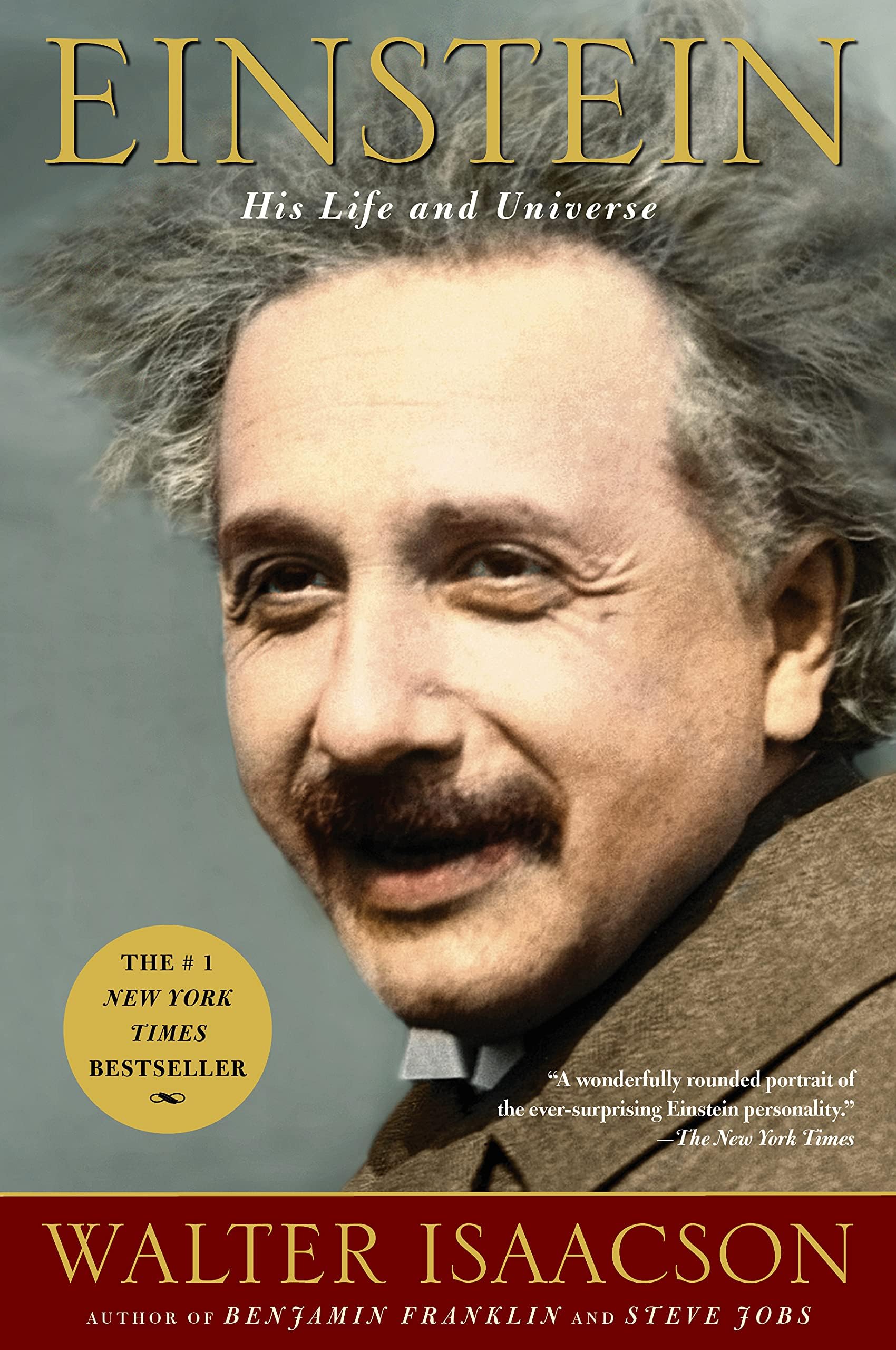
Einstein: His Life and Universe
Product ID: 1313429
Buy anything from 5,000+ international stores. One checkout price. No surprise fees. Join 2M+ shoppers on Desertcart.
Desertcart purchases this item on your behalf and handles shipping, customs, and support to Poland.
By the author of the acclaimed bestsellers Benjamin Franklin and Steve Jobs , this is the definitive biography of Albert Einstein. How did his mind work? What made him a genius? Isaacson’s biography shows how his scientific imagination sprang from the rebellious nature of his personality. His fascinating story is a testament to the connection between creativity and freedom. Based on newly released personal letters of Einstein, this book explores how an imaginative, impertinent patent clerk—a struggling father in a difficult marriage who couldn’t get a teaching job or a doctorate—became the mind reader of the creator of the cosmos, the locksmith of the mysteries of the atom, and the universe. His success came from questioning conventional wisdom and marveling at mysteries that struck others as mundane. This led him to embrace a morality and politics based on respect for free minds, free spirits, and free individuals. These traits are just as vital for this new century of globalization, in which our success will depend on our creativity, as they were for the beginning of the last century, when Einstein helped usher in the modern age. Review: Isaacson's meticulous research and engaging storytelling. - Walter Isaacson takes readers through the extraordinary life of the renowned physicist Albert Einstein. Isaacson's comprehensive biography not only captures the essence of Einstein's scientific contributions but also delves into the fascinating aspects of his personal life. Isaacson's meticulous research and engaging storytelling make this biography a captivating read. He masterfully presents Einstein's complex scientific theories in a way that is accessible to readers of all backgrounds. Whether it's relativity, quantum mechanics, or the photoelectric effect, Isaacson ensures that even the most intricate concepts are explained clearly and without unnecessary jargon. As a result, readers gain a deeper understanding of the revolutionary discoveries that perpetually changed our understanding of the universe. However, what truly sets this biography apart is Isaacson's exploration of Einstein's personal life. Delving into his family dynamics, relationships, and political and social activism, Isaacson provides readers with a well-rounded picture of the man behind the genius. By examining Einstein's struggles and successes, his controversies and ethical dilemmas, Isaacson humanizes the iconic figure, making him relatable and understandable. Furthermore, Isaacson's prose is engaging and fluid, making the biography accessible and enjoyable to read. He skillfully weaves together historical context, scientific explanations, and personal anecdotes, creating a narrative that is both informative and entertaining. Isaacson's admiration for Einstein shines through in his writing, but he remains objective and portrays the scientist honestly, highlighting both his strengths and flaws. One criticism of the book is that it occasionally delves too deeply into scientific explanations, which may not appeal to readers without a strong background in physics. However, Isaacson's ability to seamlessly transition between technical details and personal anecdotes largely compensates for this minor flaw. In conclusion, Einstein His Life And Universe is a compelling biography that provides a thorough understanding of Einstein's life, science, and impact on the world. Walter Isaacson's meticulous research, insightful analysis, and engaging storytelling make this book a must-read for anyone interested in the man behind the theory of relativity. Review: Awesome book about a larger than life scientist... - Einstein: His Life and Universe by Walter Isaacson is an awesome book about a man who was larger than life. Did I understand all of it? Nope. But that didn't keep me from enjoying it immensely. Walter Isaacson is known for his well-researched and well-written biographies of great men, and he was aided by the discovery of many of Einstein's previously unknown private letters in 1986. After going through the basics, the author alternates between Einstein's personal life, his scientific work and his political beliefs. As a physicist, Einstein possessed a brilliant mind. In 1905, he published four new theories that would change science forever. An uninspired student in college, he was unable to get a teaching job upon graduation. Instead, he ended up working for the Swiss Patent Office. This actually proved beneficial as it allowed him extra time to work on his theories. A humble man, Einstein believed that "knowledge is limited" and that curiosity and imagination were responsible for his discoveries. Isaacson tries to explain these in an easy-to-understand manner, but I still found my eyes glazing over in spots. By the end of his career, Einstein was no longer the innovative rebel but instead, the more conservative sage of Princeton. As for Einstein's personal life, the newly discovered letters allow Isaacson to write in more detail about the famous scientist than any other biographer. This new treasure trove sheds new light on his first marriage to Meliva Maric. Einstein had complicated relationships with both wives and his two sons, and he didn't always treat them admirably. Yet, he was a very social man and had dozens of life-long relationships with other scientists and mathematicians. Einstein was described as "kind, good-natured, gentle and unpretentious." This quiet and unassuming man became our first celebrity scientist and hoards of fans flocked to see him. In these respects, Einstein was much like Ben Franklin--another one of Isaacson's subjects. Einstein had strong political beliefs. He was both a socialist and a strong pacifist. But Hitler and Nazi anti-Semitism caused him to not only abandon his native Germany but also, to throw his weight behind the war effort. Einstein also decried racism. When Marian Anderson came to Princeton in 1937 to perform, the Nassau Inn refused her a room. Einstein opened his Princeton home to her. Although Isaacson's biography is exhaustive, he leaves just a few questions unanswered. First, whatever happened to his house in Caputh, Germany after the war? I discovered on the internet that it has a fascinating history that I'm sure Isaacson's readers would enjoy. Also, I wonder how the advent of the computer might have changed Einstein's accomplishments. But these are only small issues in an almost perfect book. I was never very interested in Albert Einstein, but Isaacson has piqued my interest. He succeeds in bringing to life this "locksmith" who "knows that math is the language nature uses to describe her wonders."


| Best Sellers Rank | #20,276 in Books ( See Top 100 in Books ) #9 in Relativity Physics (Books) #12 in Scientist Biographies #42 in History & Philosophy of Science (Books) |
| Customer Reviews | 4.6 out of 5 stars 6,251 Reviews |
C**S
Isaacson's meticulous research and engaging storytelling.
Walter Isaacson takes readers through the extraordinary life of the renowned physicist Albert Einstein. Isaacson's comprehensive biography not only captures the essence of Einstein's scientific contributions but also delves into the fascinating aspects of his personal life. Isaacson's meticulous research and engaging storytelling make this biography a captivating read. He masterfully presents Einstein's complex scientific theories in a way that is accessible to readers of all backgrounds. Whether it's relativity, quantum mechanics, or the photoelectric effect, Isaacson ensures that even the most intricate concepts are explained clearly and without unnecessary jargon. As a result, readers gain a deeper understanding of the revolutionary discoveries that perpetually changed our understanding of the universe. However, what truly sets this biography apart is Isaacson's exploration of Einstein's personal life. Delving into his family dynamics, relationships, and political and social activism, Isaacson provides readers with a well-rounded picture of the man behind the genius. By examining Einstein's struggles and successes, his controversies and ethical dilemmas, Isaacson humanizes the iconic figure, making him relatable and understandable. Furthermore, Isaacson's prose is engaging and fluid, making the biography accessible and enjoyable to read. He skillfully weaves together historical context, scientific explanations, and personal anecdotes, creating a narrative that is both informative and entertaining. Isaacson's admiration for Einstein shines through in his writing, but he remains objective and portrays the scientist honestly, highlighting both his strengths and flaws. One criticism of the book is that it occasionally delves too deeply into scientific explanations, which may not appeal to readers without a strong background in physics. However, Isaacson's ability to seamlessly transition between technical details and personal anecdotes largely compensates for this minor flaw. In conclusion, Einstein His Life And Universe is a compelling biography that provides a thorough understanding of Einstein's life, science, and impact on the world. Walter Isaacson's meticulous research, insightful analysis, and engaging storytelling make this book a must-read for anyone interested in the man behind the theory of relativity.
C**N
Awesome book about a larger than life scientist...
Einstein: His Life and Universe by Walter Isaacson is an awesome book about a man who was larger than life. Did I understand all of it? Nope. But that didn't keep me from enjoying it immensely. Walter Isaacson is known for his well-researched and well-written biographies of great men, and he was aided by the discovery of many of Einstein's previously unknown private letters in 1986. After going through the basics, the author alternates between Einstein's personal life, his scientific work and his political beliefs. As a physicist, Einstein possessed a brilliant mind. In 1905, he published four new theories that would change science forever. An uninspired student in college, he was unable to get a teaching job upon graduation. Instead, he ended up working for the Swiss Patent Office. This actually proved beneficial as it allowed him extra time to work on his theories. A humble man, Einstein believed that "knowledge is limited" and that curiosity and imagination were responsible for his discoveries. Isaacson tries to explain these in an easy-to-understand manner, but I still found my eyes glazing over in spots. By the end of his career, Einstein was no longer the innovative rebel but instead, the more conservative sage of Princeton. As for Einstein's personal life, the newly discovered letters allow Isaacson to write in more detail about the famous scientist than any other biographer. This new treasure trove sheds new light on his first marriage to Meliva Maric. Einstein had complicated relationships with both wives and his two sons, and he didn't always treat them admirably. Yet, he was a very social man and had dozens of life-long relationships with other scientists and mathematicians. Einstein was described as "kind, good-natured, gentle and unpretentious." This quiet and unassuming man became our first celebrity scientist and hoards of fans flocked to see him. In these respects, Einstein was much like Ben Franklin--another one of Isaacson's subjects. Einstein had strong political beliefs. He was both a socialist and a strong pacifist. But Hitler and Nazi anti-Semitism caused him to not only abandon his native Germany but also, to throw his weight behind the war effort. Einstein also decried racism. When Marian Anderson came to Princeton in 1937 to perform, the Nassau Inn refused her a room. Einstein opened his Princeton home to her. Although Isaacson's biography is exhaustive, he leaves just a few questions unanswered. First, whatever happened to his house in Caputh, Germany after the war? I discovered on the internet that it has a fascinating history that I'm sure Isaacson's readers would enjoy. Also, I wonder how the advent of the computer might have changed Einstein's accomplishments. But these are only small issues in an almost perfect book. I was never very interested in Albert Einstein, but Isaacson has piqued my interest. He succeeds in bringing to life this "locksmith" who "knows that math is the language nature uses to describe her wonders."
J**E
Good book; somewhat disappointed with Einstein himself — don't blindly admire people, is the relative lesson
What to say? Not much. A lot. There are probably spoilers herein. My take on him via this biography, is that he was intellectually exceptional for the time and the generally close minded scientific community, but he seems to have been a rather petty and unspectacular man, emotionally. Downright mean. A chauvinist. At one point he states that Marie Curie could not possibly have broken up the marriage of her dead husband's lab assistant because she was not attractive enough. Also, in writing to the daughter of a woman he made romantic or sexual overtures to during his first marriage, he referred to his first wife, Mileva, as "uncommonly ugly." Wow. That shocked me. Mileva made the mistake of being too "dark", "melancholy" — as the book states repeatedly — "depressive", "jealous" and ultimately put a stop the would-be affair by exposing the letters to the other woman's husband. This was the best way to go about it at the time, and it worked. Meanwhile, eventually, Einstein gives her a list of terms, of the things she was to do for him, to keep the marriage going. The list was pretty degrading and hateful. One gets the sense that Mileva was too clever — they bonded over physics at college — and she was rather sad at her own ambitions not being fulfilled because she got pregnant, and it seems he also talked her into giving this child up, and it very likely later died, and basically she did not make things emotionally convenient for him. As for the terms he later gave her to follow if she wanted to remain married to such a prize: whether you're a man or a woman, it'd make you want to spit on a person, if they put it forward into words how much they hated you. I wouldn't say that I no longer admire him, but I suppose he feels more attainable now, and not the impossibly deep and mysterious genius that myth and history has painted him. I admire, more than anything, and always have (and I suppose this book has put the fact into clarity), that he came essentially from nothing and out of nowhere to become a — or THE — star of the scientific community. A real self-made person. Someone who had no connections in the beginning, no wealth, and gained those things, and notoriety, purely via perseverance and his ideas, and for being bold enough to be different for the time. He would probably still be rather different, and if you go a few days, or weeks, without brushing your hair, it's sort of a pass that you can get away with it because Einstein did, as long as it happens your simply too distracted with other things to bother with your hair. I really like the impersonal facts of his life, still, more than any idea itself, no matter how much of an intellectual leap relativity was at the time, or is, for some people, now. I say "for the time", because it doesn't take a genius to acknowledge that a single person's perspective is the only concrete reality there is. By that tack, only one truth of the "time" exists, and yet there are an infinite number of slightly different "truths", since only one thinking being can occupy one place at one time. Einstein's relativity is philosophical, regardless of his denials of the fact. Ultimately, he was as close-minded as anyone, as regarded things like black holes, which his own theory predicted, to be impossible and spent much of the latter half of his life on a crusade to divert quantum physics on the path it was ultimately put on by his own theories. Meanwhile, for someone to put philosophy into equations was and is quite different, but, like Newton, that's really all he did. He was hardly the first person who came to that conclusion. As for the book, it's a pretty breezy read. It's light on abstract stuff and heavy on his life purely as a story and the print is big, so it's fairly unintimidating and accessible.
T**R
This inspiring tome is well worth the considerable time it takes to get through it
I checked this book out of the library and had to renew it several times to finish it, then finally bought it new for a very reasonable price through Amazon.com. I recommend it highly with certain reservations. Firstly, you really need a technical background to have a shot at understanding the physics the way it's presented in the initial chapters. I have to say, on this score, that I was disappointed in Isaacson's rather murky and overly involved explanations of Einstein's various physical concepts and hypotheses, as fascinating as some of his ideas were. He's a good writer, otherwise, but I wouldn't call him an excellent science writer because an excellent science writer can take difficult scientific concepts and make them understandable to a layman without oversimplifying the details. Isaacson does not accomplish that in this book, at least in my opinion, because his discussions of theoretical physics are not truly understandable to a non-physicist, even one with a fair degree of scientific training, at least if it's been quite awhile since you studied physics in school. The book, however, was interesting enough for me to keep plowing ahead, which proved well worth the substantial investment in time and energy. As the book moves beyond the technical phases of Einstein's early career, however, it undergoes a subtle transformation, becoming more interesting, more understandable, and very readable. The reader has seen this remarkable individual grow from an extremely intelligent yet egotistical and rather callous iconoclast to a first-rate human being. In fact, toward the end, it was like reading a spiritual work, very gripping and inspiring, which for me aptly coincided with the recent conjunction of Venus, Jupiter, and the Moon, a moving backdrop while finishing a book about Einstein. When I finally turned the last page, I was further inspired to read the new book on Oppenheimer entitled American Prometheus, which is also quite interesting (if a much sadder book). Since my own father was not only an accomplished nuclear and space physicist but a colleague of some of the leading physicists mentioned in these two books, I've been especially interested in the subject matter. As such, I can highly recommend this title to anyone interested in science, especially in Cosmology, or who is intrigued by a thoughtful and penetrating analysis of genius.
D**U
Never have I read a better biography!
To have read about Einstein as a man, and not merely a scientist, was most riveting. Possibly one of the most popular scientists of our time. Most notable of his traits were his humility, compassion, independent thinking, introversion, pacifism, disdain for bourgeois consumption or ostentatious wealth, and a desire for social equality. While his theories of special and general relativity will continue to elude me, one can still marvel at his thought making process. Pivotal Encounters I found it pivotal that Einstein met Johann Heinrich Pestalozzi and Jost Winteller, at a young age, who believed in encouraging students to visualize images. He also thought it important to nurture the “inner dignity” and individuality of each child. Jost Winteller gave Einstein the wings to take flight on a prosperous career. Another fortunate encounter is with Marcel Grossman who lent Einstein, his maths notes while they were at Zurich Polytechnic and also offered him his first job. He later on provided the necessary Maths that Einstein needed to turn the special theory of relativity into a general theory. Einstein's reading group, the Olympia academy, largely helped in shaping his thoughts towards the theories on relativity. They mostly read books that explored the intersection of science and philosophy. Granted, Einstein's individual brilliance is something you see may be only once or twice in a century, but his story encompasses many more characters than popular account. Particularly, his life with Mileva Maric who mothered two of his children. Due to her first pregnancy, she found herself resigned to giving up her dream of being a scientific scholar. History continues to pay little regard to women who make it possible for men to pursue worthy careers. While Einstein met Hendrik Lorentz quite later in his life, Lorentz influence on him was still very profound. He was the one father figure in Einstein's life. During Lorentz funeral Einstein mentioned with great sadness: "Whatever came from this supreme mind was as lucid and beautiful as a good work of art. He meant more to me personally than anybody else I have met in my lifetime." It is also worth mentioning, the encounter between Niels Bohr and Einstein. To quote the social philosopher C. P. Snow: "No more profound intellectual debate has ever been conducted.” Another important woman in Einstein's life, Helen Dukas, was one who was completely discreet, protective, loyal, and not threatening to Elsa. Helen Dukas came to work as Einstein’s secretary in 1928, when he was confined to bed with an inflamed heart. To quote George Dyson: "Her instincts were as infallible and straightforward as a magnetic compass. Although she could display a pleasant smile and lively directness with those she liked, she was generally austere, hard-boiled, and at times quite prickly." During a later part of his life, Einstein became a closer friend, and a walking partner of the intensely introverted Kurt Gödel, a German-speaking mathematical logician from Brno and Vienna. Gödel wonderfully deliberated on the possibility of time travel basing on Einstein's theory of relativity. Other significant events It is also worth noting Einstein's role in the events that led up to the Manhattan Project and ultimately the construction of the atomic bomb. Einstein had contended that the only way to prevent an arms race of atomic weaponry was to bring about an internationalization of military power. As a Jew who had grown up in Germany, Einstein was acutely sensitive racial discrimination. “The more I feel an American, the more this situation pains me,” he wrote in an essay called “The Negro Question” for Pageant magazine. “I can escape the feeling of complicity in it only by speaking out.” It was interesting to note that Einstein was once offered a position as President of Israel. He was “deeply moved” by the offer, Einstein said in his prepared response, and “at once saddened and ashamed” that he would not accept it. “All my life I have dealt with objective matters, hence I lack both the natural aptitude and the experience to deal properly with people and to exercise official function,” he explained. Conclusion To imagine that Einstein accomplished what he did, in a world before the internet, leaves me in overwhelming awe. I have developed great admiration for the life he lived, and I dare say that it was a FULL life. Notable Quotes “Out yonder there was this huge world, which exists independently of us human beings and which stands before us like a great, eternal riddle.” “A foolish faith in authority is the worst enemy of truth.” “The Jew who abandons his faith,” he once said, “is in a similar position to a snail that abandons his shell. He is still a snail.” “I do not believe that the structure of the human brain is to be blamed for the fact that man cannot grasp infinity”
P**E
One stone in a millenium really turned
Unless I'm mistaken, Albert Einstein's last name freely translates from Geerman to the English words, One (eine) stein (stone). I have read seeveral bios on Einstein, all of them good. But by far, Walter Issacson's is the absolute best. He is one of those biographers who in the parlance of the old time grocer "gives good weeight", i.e.., good value every time. He traverses the very tricky netherland between the temptation to actually try to explain relativity (of course a thankless task) and give the lay reader at least aa sense of the majesty of Einstein's incredible feat of the millenium . At the same time he deals with great insight and wisdom with Einstein's complexpersonal journey, his emotional life, his stubborn clinging to the ever fading possibility of acheiving the discovery of a unified field theory, that keeps you reading. This is really a suberb, engaging work. Issacson's little touches of humor here and ther add immesuarablt to the enjoyment of the read. What is key overall I think is the intelligence and readability of this book. The author's long stint at Time magazine has served him well in learning about the economy of words and the compression of lots of insight into spiffy, keep em reading prose. I strongly recommend this book to anyone interested in what is clearly the man with one of the greatest minds in human history. Take Einstein, add Shakespeare and you have the Damon and Pythius of the modern world. My son has a friend who holds a PHD in Physics from Princeton. He sat me down several times patiently attempting to reduce relativity to terms I might have even the vaguest possibility to grasp. Unfortunely I stand still ignorant. But take heart. One of the funniest quotes in the book is one by founding president of Israel, Dr. Chaim Weitzman, a brilliant biochemist. Upon meeting Einstein he asked him to review relativity for him. They spent two hours in which Einstein patiently laid out the theory. At the end of the session a reporter came up to Weitzman and asked, "Well now Dr. Weitzman, what do you think of the theory of relativity?" Without missing a beat, Weitzman replied, "After three hours I am absolutely convinced, Dr Einstein understands relativity." Great read.
M**R
Why Einstein Failed
Transcending the Speed of Light: Consciousness, Quantum Physics, and the Fifth Dimension Any criticism leveled against Isaacson's book has to be counterbalanced by a recognition of the tremendous effort and importance of the work, such as his ability to recaptured Einstein's life through the many letters by and to him and by an ability to explain many of his most important ideas in a deep and superb way. The missing star in my rating is because of what the book does not do. Occasionally critical of Albert Einstein, ultimately the book is a hagiography. As with the rest of the mainstream, Isaacson is really blind to Einstein's shortcomings. His theory of relativity, on the whole, is a true mish-mash, that, in the last analysis, makes little sense. Several problems with his theory have to do with (1) the arbitrary decision to do away with the ether, and (2) place the subjective view on a pedestal while at the same time eliminate the very consciousness of the viewer as a force in and of itself, or a space (e.g., a 5th dimension of hyperspace for mind). For instance, Isaacson points out that if a lady is on a plane looking down on the Earth, she can't tell if the plane is moving over the Earth or the Earth is moving under a stationary plane. This is a bedrock of Einstein's relativity theory, a highly subjective observation that ignores the elephant in the room, the movement of the Earth around the Sun, the absolute measure Einstein keeps trying to eliminate. The Michelson-Morley experiment didn't do away with the ether. Nor did Einstein. Both simply suggested that the ether could not be detected. So even though Einstein lectures on the ether and states to Lorentz that an ether must exist, he also realized that if indeed it did exist, then his theory of relativity would be wrong. The idea that space can be curved, as Tesla pointed out in the newspapers, is absurd. Since Einstein has ascribed properties to space, it cannot be empty. It is, in fact, the ether, and the reason why light bends around or towards stars is potentially twofold, (a) photons may have mass, and (2) as with all matter, stars are constantly absorbing ether in order to keep their elementary particles spinning. Ether theory explains gravity and its link to acceleration because what we call gravity most likely the absorption of ether by the mass of the planet (or star). According to this theory, we are held to the planet because we are in the way of this constant influx of energy. Had Einstein truly resurrected the ether, (he partly does, as Isaacson notes, once de Broglie's wave theory becomes more prevalent) Einstein may have solved his grand unification theory, but it would have been at the expense of his baby, the theory of relativity. Another problem with his theory is that nothing can travel faster than the speed of light. However, as Gamow points out in Thirty Years That Shook Physics, and I point out in my book Transcending the Speed of Light, electrons spin at speeds in excess of the speed of light! Following in the steps of Minkowski who used the imaginary number the square root of negative one to make the one dimension of time equivalent to 3D space, Paul Dirac essentially did the same thing to account for the spinning electron that violated relativity with his Nobel Prize winning equations that tied relativity to quantum mechanics. Isaacson's book completely miscasts Minkowski, doesn't even mention the idea of imaginary numbers (which can only exist in the mind, yet are used to explain the physical world), and thereby helps relegate Minkowski to virtual non-person status. This is a super book, but flawed because of the rose colored glasses that are always used to portray a great thinker with a flawed theory that will ultimately be upturned.
F**.
Wonderful Personal Story and Technical Issues are Comprehensible for the Layman
I don't usually take the time to do reviews, but I feel compelled to review Einstein: His Life and Universe. I bought it for my son who needed some background for a paper on Einstein's Special Theory of Relativity. I flipped through a few pages, and before I knew it I had read four chapters. I won't have time to read books until I retire, but sometimes you just have to make exceptions. Not only is the book researched incredibly well (see the vast list of persons that the author interviewed and/or asked to review portions of the manuscript - including the top experts in their fields to ensure that the theories/discoveries were accurately represented), it is told as a very personal story of another human being warts and all. I discovered Einstein's sense of humor, especially with the Olympia Society that he and two lifelong friends created to mock the stuffy academic societies. Einstein notes that after later being recruited by several of these societies, he and his friends were right on the mark. Even the Time Magazine Person of the Century is just like you and me, and I admire him all the more because I now know the man. And, I don't want to leave out the fact that Walter Isaacson takes you through Einstein's development of his theories - what triggered them in his head, the thought pictures that he used to work them out, and the events of his life that looked like they would stifle him - settling for being a Swiss Patent Examiner - that actually gave him the time and freedom of thought to work things out. Finally, I enjoyed having the theories of General Relativity and Special Relativity presented in descriptive language I could understand, though certainly not in a condescending manner. I don't do physics and wouldn't have thought about buying this book (or any book for about 10 more years), so I am pleased to have had the good luck to have it fall in my lap. Thank you Mr. Isaacson.
J**S
Einstein
This is an excellent, excellent book. A comprehensive, start to finish biography of the man's life, with extremely complicated, abstract mathematics and physics explained in a simplified manner, in a way only someone who intrinsically understands the subject can do. Despite the subject matter, and by that I I close the First and Second World Wars, anti-Semitism and, intimately, the Holocaust, and also the physics and maths, it was simply a joy to read and never once felt heavy or dull. If there is a better biography of Einstein out there, I won't just eat my hat, I'll grow my hair and moustache and impersonate the man for the rest of my days!
J**A
Muy bueno y profundo
Altamente recomendable. Muy bien escrito.
C**N
Comprehensive biography of Time Magazine Man of the Century
this is a magnificent biography of the Time Magazine Man of the Century. well written and comprehensive. If you have the slightest interest in Einstein and Relativity, buy and read this book
O**R
Another well written book
This was a good read, well written book. Historical books are always a favourite.
J**A
Relativity for everyone
Everyone knows Einstein: genius, german, the most famous scientific in modern history, his tongue and portraits. But, do we know the man? His childhood, dreams, his theories, struggles? How afortunate to know this, but if you're an ignorant like me, you should read this book. Mr. Isaacson delivers yet another brilliant work for the ages, writing a beautiful portrait of the pyshics genius of the modern era. How a shy and late developer kid, grows into a curious and rebel man to become a succesful theorist, As with any book, you will not regret reading it, and you'll get lessons for your lifetime.
Trustpilot
2 weeks ago
1 month ago