
Philoctetes
Product ID: 11931941
Buy anything from 5,000+ international stores. One checkout price. No surprise fees. Join 2M+ shoppers on Desertcart.
Desertcart purchases this item on your behalf and handles shipping, customs, and support to Poland.
Full description not available
M**E
Hopefully, this is not the best translation....
I believe there are better translations out there. This one was rather plodding.I wish amazon would publish the name of the translator as well as the author right up front for its Kindle editions -- one cannot see who the translator is until one has purchased the book -- at least when buying online here. Very frustrating.
L**O
Sophocles on the citizen's responsibility to the state
"Philoctetes" takes place near the climax of the Trojan War. The title character has the great bow of Hercules, given by the demi-god on his pyre to Philoctetes's father. A member of the Achaean expedition that sailed to Troy, Philoctetes was making an altar on an island along the way when he was bitten by a snake. His cries of pain were so great that he was abandoned by his shipments, under the orders of Odysseus, and marooned on the deserted island of Lemnos. Alone and crippled, Philoctetes used the great bow to survive for the ten years the Achaeans have been fighting against Troy. During that time his hatred against the Achaeans in general, and Odysseus in particular, has grown.Meanwhile, back at Troy, Odysseus and the other Achaean chieftains have learned from an oracle that Troy will fall only with the help of Philoctetes and his bow (a juicy tidbit it certainly would have been nice to have known eight or nine years earlier). Odysseus and Neoptolemus, son of Achilles, are sent to bring Philoctetes and his bow back to the war. Of course, Odysseus dare not show himself to Philoctetes and sends Neoptolemus to do the dirty work. Neoptolemus gains the confidences of the crippled man by lying about taking him home. During one of his agonizing spasms of pain, Philoctetes gives his bow to Neoptolemus. Regretting having lied to this helpless cripple, Philoctetes returns the bow and admits all, begging him to come to Troy of his own free will. Philoctetes refuses and when Odysseus shows his face and threatens to use force to achieve their goal, he finds himself facing a very angry archer.In "Philoctetes" Sophocles clearly deals with the balance between the rights of the individual and the needs of society. But this is also a play about citizenship and the need for the idealism of youth to be give way to the responsibilities of adulthood. In fact, this lesson is learned both by Philoctetes, who is taught by the shade of Hercules who appears to resolve the tenses conclusion, and Neoptolemus, who finds his duties at odds with his idealized conception of heroism based upon his father. Although this is a lesser known myth and play, "Philoctetes" does raise some issues worth considering in the classroom by contemporary students."Philoctetes" is similar to other plays by Sophocles, which deal with the conflict between the individual and society, although this is a rare instance where Odysseus appears in good light in one of his plays; usually he is presented as a corrupter of innocence (remember, the Greeks considered the hero of Homer's epic poem to be more of a pirate than a true hero), but here he is but a spokesperson for the interests of the state. Final Note: We know of lost plays about "Philoctetes" written by both Aeschylus and Euripides. Certainly it would have been interesting to have these to compare and contrast with this play by Sophocles, just as we have with the "Electra" tragedies.
R**)
A play of intrigue.
A group of plays, of which this was a member, won first prize in Athens. Philoctetes had been left marooned on an island several years earlier (because of his disease) under orders of Agamemnon and Menelaus. But, the two kings later discover that Troy cannot be conquered without Philoctetes and his bow, a bow given to him by Heracles. Odysseus and Neoptolemus (the son of the late Achilles) arrive at the island to persuade or trick Philoctetes to return with them. Neoptolemus wants to be noble in his actions; yet, his commander, Odysseus, wants to use guile. At the end, a deus-ex-machina device is used to resolve the conflict. The play has excellent characterization, a good plot, and steady movement.
S**D
The proper way to cite literature like this is by line number and not page number
The kindle version does not have clearly marked line numbers. The proper way to cite literature like this is by line number and not page number, so for an edition to not mark the lines is absolutely unforgivable.
S**M
Get a grip, Amazon!
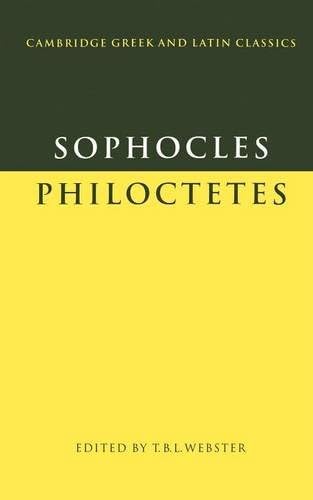
Seth Schein's commentary on the Greek text of the play (the Cambridge "green and yellow" volume illustrated by the side of the heading) is totally different from this much older translation which is what you appear to get when you click on the actual heading. Amazon needs to get a lot more accurate on this kind of thing, because it's extremely misleading to unwary students and others!
R**H
A fascinating Play
Ordering this for my Kindle, I was taking a bit of a chance, as I did not know the translator's name. I was initially ratherdisappointed as he writes in " a worn-outpoetical fashion", all thees and thous,sometimes clunkily. However as I read onthe play held my attention.If you don't like old-fashioned language,look for a more recent translation instead,or be prepared to be patient.
Trustpilot
3 weeks ago
1 week ago