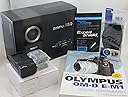
๐ Elevate your vision with Olympus OM-D E-M1 โ where pro power meets unstoppable adventure!
The Olympus OM-D E-M1 is a flagship mirrorless camera featuring a 16.3MP Four Thirds Live MOS sensor, ultra-fast dual phase and contrast autofocus, and a rugged magnesium alloy body thatโs weather-sealed for all conditions. Its groundbreaking 5-axis in-body image stabilization ensures sharp photos and smooth videos, while a high-resolution electronic viewfinder and tiltable touchscreen LCD provide intuitive control. With built-in Wi-Fi and compatibility with over 57 lenses, itโs engineered for professionals and serious enthusiasts seeking versatile, high-quality imaging on the move.
| ASIN | B00EQ07PG2 |
| Aperture modes | F3.5 |
| Are Batteries Included | Yes |
| Aspect Ratio | 3:2 |
| Auto Focus Technology | Center, Continuous, Contrast Detection, Face Detection, Live View, Multi-area, Phase Detection, Selective single-point, Single, Touch, Tracking |
| Autofocus | Yes |
| Autofocus Points | 81 |
| Best Sellers Rank | #82,642 in Electronics ( See Top 100 in Electronics ) #211 in Mirrorless Cameras |
| Bit Depth | 14 Bit |
| Brand | OM SYSTEM |
| Built-In Media | SD Card |
| Camera Flash | Hotshoe |
| Color | Black |
| Compatible Devices | Devices with Wi-Fi and smartphone connectivity |
| Compatible Flash Memory Type | SD, SDHC, SDXC |
| Compatible Mountings | Micro Four Thirds |
| Connectivity Technology | Wi-Fi |
| Continuous Shooting | 10 |
| Crop Mode | 4:3 |
| Customer Reviews | 4.3 out of 5 stars 185 Reviews |
| Digital Scene Transition | False |
| Digital Zoom | 2 |
| Digital-Still | Yes |
| Display Fixture Type | Tilting |
| Display Maximum Resolution | 1037000 |
| Display Resolution Maximum | 1037000 |
| Display Type | LCD |
| Dots Per Screen | 1037000 |
| Effective Still Resolution | 16.3 MP |
| Expanded ISO Minimum | 100 |
| Exposure Control | Aperture Priority, Automatic, Program AE, Shutter Priority |
| File Format | JPEG (DCF/Exif), Raw (ORF), MPO |
| Flash Memory Bus Interface Type | SD |
| Flash Memory Type | SD/SDHC/SDXC |
| Flash Memory UHS Speed Class | U1 |
| Flash Modes | Auto, On, Off, High Speed Sync |
| Flash Sync Speed | 1/320 sec |
| Focus Features | Phase Detection and Contrast Detection |
| Focus Mode | Continuous-Servo AF (AF-C), Single-Servo AF (AF-S) |
| Focus Type | Manual Focus |
| Form Factor | SLR-style mirrorless |
| Generation | 1 |
| Global Trade Identification Number | 00050332186279, 00971498981709 |
| HDMI Type | Type D Micro HDMI |
| Hardware Interface | AV Port |
| Has Color Screen | Yes |
| Image Capture Type | Stills |
| Image Stabilization | Sensor-shift |
| Image stabilization | Sensor-shift |
| Item Weight | 443 Grams |
| JPEG Quality Level | Basic, Fine, Normal |
| Lens Construction | Interchangeable lens |
| Lens Correction Type | Micro Four Thirds |
| Lens Type | Interchangeable |
| Manufacturer | Olympus |
| Manufacturer Part Number | FBA_V207010BU000 |
| Maximum Aperture | 3.5 Millimeters |
| Maximum Shutter Speed | 1/8000 Seconds |
| Memory Slots Available | 1 |
| Metering Methods | Multi, Center-weighted, Spot |
| Minimum Shutter Speed | 60 seconds |
| Model Name | Olympus OM-D E-M1 |
| Model Number | V207010BU000 |
| Model Series | OM-D |
| Movie Mode | Yes |
| Night vision | No |
| Number of Diaphragm Blades | 9 |
| Optical Zoom | 1 x |
| Photo Sensor Resolution | 16.3 MP |
| Photo Sensor Size | Four Thirds (17.3 x 13 mm) |
| Photo Sensor Technology | CMOS |
| Real Angle Of View | 45 Degrees |
| Remote Included | No |
| Screen Size | 3 Inches |
| Self Timer | 10, 15, 2, 20, 5 |
| Sensor Type | CMOS |
| Series Number | 20 |
| Shooting Modes | Automatic |
| Skill Level | Amateur |
| Special Feature | Lightweight |
| Supported File Format | JPEG (DCF/Exif), Raw (ORF), MPO |
| Supported Image Format | JPEG (DCF/Exif), Raw (ORF), MPO |
| Total Still Resolution | 16.3 MP |
| Total USB 2.0 Ports | 1 |
| Total USB Ports | 1 |
| Touch Screen Type | Yes |
| UPC | 050332186279 971498981709 609788730644 |
| Unit Count | 1.0 Count |
| Video Capture Format | H.264, Motion JPEG |
| Video Output | HDMI |
| Video Resolution | FHD 1080p |
| Viewfinder | Electronic |
| Viewfinder Magnification | 1.48x |
| Warranty Description | 1 year coverage for labor, 1 year coverage for parts |
| White Balance Settings | Auto, Flash torch |
| Wireless Technology | 802.11b/g/n with smartphone connectivity, BuiltIn |
| Write Speed | 10 fps |
| Zoom | Optical Zoom |
J**.
Wow...Look how far we've come!
I received this camera just this morning...and I am beyond amazed. My background in photography started in 1983 with a Pentax K1000 (anyone remember those? If the battery was dead, it still took photos, you just lost the exposure meter!). In the late 1980s, I paid my way through college earning money as a used camera and photo gear dealer. Since then, I've been more of an advanced amateur photographer (I received a degree in photography as part of a double major, but have never been paid for my work)...just enjoying it as my hobby. My experience with the MFT system began with a Lumix GF1, followed by a GX1, G3, G5, and then a G6 (for some reason I still have all these). So the E-M1 is my first Olympus MFT body. I've enjoyed the evolution and improvement of the Lumix bodies, and I've accumulated a nice collection of MFT optics. I have been reading about the E-M1 for two months since I placed my pre-order. I had even pre-ordered an extra battery, and had it charged and ready to go so I wouldn't have to wait when the E-M1 arrived! For most of the first day, I've was unable to put the E-M1 down. I went through most of the customizable settings (wow, just wow), and made adjustments and customizations to suit me. This camera has by far the most flexibility of any I've experienced...certainly the most customizable. In my hands, the camera feels like a professional tool. The weight, the speed of the focus and the feel of the shutter...all very subjective, but the focus is fast...faster than any other MFT camera I've owned. And the shutter has a different, quieter and more precise sound and feel. It certainly makes my G6 feel very amateurish. It also has some features I've not seen before, but they are features which I look forward to testing and using. A great example of one of these features is called "Live Time", where you can watch a specifically untimed, long exposure as it develops and then stop the exposure when you are satisfied with the image. Think of this as a "bulb" setting that allows you an unprecedented view of the exposure as it occurs. Another nice feature is the easy way for connecting devices through wi-fi. The E-M1 displays a QR code, which you simply scan with your device (on which you have already loaded the Olympus Image Share app). I have two other wi-fi enabled cameras, and they are not nearly as user friendly setting this up. For me, I use a number of different devices (Galaxy S4, iPad, etc), and I also configured it to work with my wife's phone and iPad (don't want to be locked down to one device). I have already rearranged my function buttons several times, trying to discern the most logical order (logical to me at least). One of my favorites is having Fn2 set to focus peaking, since this button is right behind the shutter button. I've also briefly tested the camera with some of my favorite lenses - the Lumix 20mm f1.7, the Oly 45mm f1.8, and the Oly 75mm f1.8. I also tried a couple of different Lumix zooms, including the 100-300mm. I had recently shelved my beloved Lumix 14-45mm lens in favor of the newer and much more compact 14-42mm II lens. But the 14-45mm is right at home on the E-M1...very nice size and balance combination. I believe this will be my primary lens until the Oly 12-40 f2.8 is available. It seems that the E-M1 breathes new life into my lenses...but I believe it is probably the 5-axis IBIS that is making the real difference. Obviously it is making a difference with my lenses that had no IS...like the Oly 45mm and the Oly 75mm. I was pixel peeping yesterday and realized for the first time that my german shepherd has eye lashes! The photos I've owned many, many cameras through the years...some which I seriously cherished (mostly Leicas). I've owned several DSLRs (mostly Canon and Pentax). But I can say with great confidence that the E-M1 is the most serious and capable photographic tool I've ever owned...and that is after just a couple of days use. The only negative comment I have so far is possibly the location of some of the function buttons...maybe I just need to get used to them. In particular, there are two buttons near the lens base that are a little difficult to reach. I feel like I'm really being a bit nitpicky even mentioning this though as I'm not sure what I would do to improve their location I believe for the price, this camera represents a tremendous value. Of course this is my opinion, but it is an opinion based on years of cameras. I've owned plenty of less expensive cameras and some more expensive cameras...but for me, the E-M1 seems to hit the ball out of the park when considering value. *I commit to come back to this review and update it with my experiences both positive and negative for this camera.* UPDATE Focus Tracking: I shot a cross country running event in which two of my teenage children participated. I'm not used to shooting sporting events, but I was excited about using the E-M1. I shot completely in the focus tracking mode (mostly to satisfy my own curiosity). After reviewing the photos, I can say that the focus tracking was very reliable. It didn't always focus on the runner that I wanted, but at least one of the runners in each shot are in sharp focus. I may not use this again, as I think I can do better getting a specific runner in focus. Improved Images: Regarding my earlier statement that the EM-1 seems to "breathe new life into my lenses", this is even more evident now that I've had more time with the camera and have reviewed more photos. At first I attributed this to the 5-axis IS, but now I attribute the improvements not only to the IS, but also to having no AA filter, having an improved sensor, and the automatic removal of CA (jpeg, of course) ...even on my Panasonic lenses. I plan to do a head to head comparison between the E-M1 and my G5 or G6. I really want to compare the CA under varying conditions. If I'm able to do this comparison, I'll post the results here. Other observations: The small rubber cover on the base of the camera covering the vertical grip contacts is difficult for me to remove. Too, it has already started splitting/tearing. I've removed and replaced this cover a number of times to utilize the vertical grip. I wish that the eyepiece protruded more from the rear of the camera, so that I didn't have to press my nose into the display to see through the viewfinder. The best camera I own in this regard is the G3. The G3 eyepiece protrudes ยผ" further than the eyepiece on the E-M1. Maybe the (soon to be available) EP-13 eyepiece will help with this.
R**R
One of the best camera
Olympus OMD EM1 is an awesome camera. I used to be a Nikon guy with D300. i bought D300 for better quality from my friend but hated the size. I wanted a smaller size camera with DSLR quality. I purchased Nikon 1 series camera but was never satisfied with the image quality. I was waiting for one of the new Nikon 1 series which kept getting delayed so i thought to try out Olympus OMD EM5. it was an expensive camera and i never tried Olympus before, i thought it was some cheap company since you never see in Bestbuy and all Anyway, the reviews were so good for EM5 that i thought, i would try it out from Amazon since Amazon's return policy is awesome and worst case scenario, i can always return it. i also purchased 45mm F1.8 lens since it was cheap and had very good reviews. When i got the EM5,i took 3 pictures of my daughter in the night and I couldn't believe what i saw. The pictures were sharp, bokeh was amazing (45mm f1.8) and the pictures were better than my D300. it just became better when i realized how awesome the stabilization was specially in videos. My videos were smooth, not jerky. So, when OMD EM1 came, i purchased it immediately. EM1 - this is the next generation of OMD EM5. It's even better than EM5 (EM5 looks better). Pros - 1) Image Stabilization on the sensor - If you have never tried Olympus with 5 axis image stabilization, you have no idea how good and important this is. Period. I can never think about taking a picture of my daughter in the room light without some flash ot tripod with D300. With OMD, i hardly ever use flash with EM5 or EM1. There is no lens stabilization by any other company which even comes near and here is the best part, it works on video too. So, your video looks smooth. 2) M43 lens are not only awesome, they are cheap - With Nikon, a good quality lens were atleast $1000 or more. Just buy Olympus 45mm f1.8 for $279 refurbished or buy Olympus 25mm F1.8 for $319 refurbished or Panasonic 25mm F1.4 for $529 new. Not only you can buy these high quality lens, you will be blown away by the image quality they produce + bokeh is awesome. 3) Size - this was also big for me. There were times, i just didn't feel like carrying around my DSLR. t was big bulky and the lenses were bulky too. M43 lens are much smaller and light. in the winter, i can carry a pancake on EM5 in my jacket pocket. Try that with DSLR. 4) image quality - EM1 and even EM5 produces better quality than D300. 5) Olympus colors - This is something you have to try. The colors, skin tones with olympus camera are better. BTW, the auto white balance works way better than Nikon if i remember. Cons - 1) Video - If you want video, you are better off with Panasonic bodies. Specially in high motion in day light when i'm taking video of my kids, the fast action shows pixilation. I wish Olympus provides better video codec. I would say unless you are carry fullframe Canon or Leica, try Olympus. You would be impressed by the quality.
S**D
Unbelievable.
Wow. I came from an E-PL5 which I loved and cannot recommend highly enough, but after a year of usage I was ready for the next level up. I was not disappointed, the photos coming out of this thing are amazing, and I have to say that the image stabilization makes a difference for low light shooting. I have the 45mm f1.8, the 75mm f1.8, the 20mm f/1.7, and the 12mm f/2.0 which all worked amazing with the E-PL5 - but the E-M1's extra grip, WiFi features for your iPhone & iPad, the aforementioned extra axis of image stabilization are huge additions. Other favorite items are not having to dig through software menus for Aperture and Shutter Speed controls, the balance from counterweight when using a large lens like the 75mm, the viewfinder and included flash (and not having to choose between the two for one hotshoe), the several shots per second you can take in rapid fire to capture the moment without blinking or motion blur.This feels like a pro DSLR in every way to me, but with lenses that are considerably more affordable, and a size that fits in my wife's purse or slung over my shoulder easily. 5 Stars. ------------- Updated now that I had some more time to write. 12/2/13 ------------- A year ago I decided to get more serious about taking photos. I've always loved photography and I took classes in college, I used to do bottle shots in the Napa wine industry, and I love portraiture. There was one problem: I hate lugging around a DSLR and lenses, I hate how much DSLR lenses cost, and I always end up shooting everything fun in my life with my iPhone unless go leave the house thinking "today is a day dedicated to shooting photos." I hate using a flash and taking terrible flat photos with a DSLR, I hate having to use a flash because the only lens I could afford had an unacceptably high f-stop floor (anything above f/2.0 is unacceptable to me). This lead to my Canon Rebel XT sitting in the closet for months at a time. After hearing of the advancements and affordability in the Micro 4/3 standard of camera and lenses, I decided to take the plunge. I decided to invest in a new camera so that I could have with me without it being an event in itself, one that people would not be intimidated by when I point it at their faces, one that has an affordable but killer range of lenses available. That camera was the Olympus E-PL5. It's been a great year with the E-PL5, and I've taken the best pictures of my life with it for a fraction of the cost of a DSLR, without sacrificing any tangible quality (to my eyes). In fact, I would say the quality is actually better and more fully realized since I can now afford a wealth of lenses with much greater ease and no guilt! I now have a full range of amazing lenses to use with it from 24mm - 150mm (in micro 4/3 parlance that would be 12mm-75mm, you simply divide by 2). Also notable is that I do not buy any lens with an f-stop floor over f2.0 - this keeps me able to shoot excellent photos in natural light even indoors with no flash required at ISO 800-1600. I never go higher than that because I hate noise in my photos. And this also means that since I require lenses at f/2.0 or below, that I will only shoot prime lenses - no zooms. This means I zoom with my feet, not with the barrel of the lens. It's an adjustment but ultimately worth it for the types of things I like to shoot. I just the sold the E-PL5 and am now rocking an Olympus E-M1, which has many similar components within it but is pretty much improved all around. It has excellent improved 5-axis image stabilization which makes my grip on the camera even steadier, enabling me to work with slightly slower shutter speeds at lower ISOs, reducing noise and the necessity of using a flash in low light. It has dedicated hardware knobs for adjusting shutter speed, aperture and ISO - so no more taking my eyes off the viewfinder to dig through software to adjust. It's got a ridiculously rugged magnesium alloy exterior and is weather proof, freeze proof and dust proof. It can connect to iOS devices through a wifi network it spawns itself, no external network needed. And best of all, my lenses still work with it. Can't recommend the micro 4/3 camera world enough. I wrote this because I have never been happier shooting photos in my life, and if I were me before this photographic evolution, I would want to read this review. The E-M1 is the best experience the Micro 4/3 world has to offer. I'm amazed.
S**R
As a whole, the best mirrorless camera made today (2013)
I have thoroughly used and reviewed this camera over the past several weeks (review sample from Olympus) and have been wowed, shocked and surprised at the results. I originally thought this would be an E-M5 with a better build, feel and faster AF and at the end of the day I found it to be much more. Due to the lack of an AA filter, the IQ has indeed been enhanced. Images are sharper/crisper and the high ISO has also been improved. I have written 5700 words on this camera and shared a ton of images as well as a comparison against a Leica M. At the end of the day this camera is so good, I ordered one from Amazon for myself. Below is my "FInal Conclusion" from the full review I posted on my website on the E-M1: Well here we are in 2013 and the choices for all of us crazy enthusiasts are plentiful and excellent. We finally have a definitive Micro 4/3 camera body that is pro level and can do just about anything one needs it to do and do it in any weather. As always, I review cameras from an enthusiasts point of view in a real world way. There are things I do not even get into like Flash, because I have not used a flash in 14 years. I am anti-flash even though I know it is good to have on some occasions. But as an enthusiast and a passionate photographer who has seen it all and used them all, I can say with confidence that the OM-D E-M1 is one of the best cameras "as a whole" that I have ever reviewed. It is superb. Yes, there are others with better overall IQ and others with better high ISO but as a whole, speaking of the whole package, nothing else has come close. You have seen me rant and rave about a few different camera models over the year. Leica's and Sony's for the most part. Well as of today there is a new camera in town that offers the perfect mix of speed, usability, build, image quality, cost and lenses to place it at the top of the heap in the world of mirrorless cameras. Someone asked me today if I would take a Canon 6D and 85L or an E-M1 and 25 1.4. For me that choice is easy. The E-M1 only because it would go with me everywhere when the 6D would be left behind. It is just too large, too bulky and too heavy and the lenses, while fantastic are just too much weight wise for everyday use. The image quality of the E-M1 is an improvement over the E-M5 due to the new processor and lack of an AA filter. The files pop more and I feel they also have slightly different color that I prefer. Crisp. Beautiful. The exposure metering is fantastic, the AWB is fantastic, the out of camera colors are beautiful. There will always be naysayers no matter what towards this Micro 4/3 system. But those who disregard or trash Micro 4/3 or the E-M1 have no idea what they are doing or saying. There is simply nothing to trash and that is fact. It will not match full frame like the RX1 or M in all out flat out IQ but it will meet head to head ANY APS-C mirrorless and beat them on build, speed, and every other area usability area with ease. What it boils down to for me is..Olympus E-M1 or Full Frame? The answer for me is BOTH. One all out IQ monster and one usability and IQ monster. :) Also, let us not forget the lenses. Micro 4/3 has some of the best lenses made for any system, period. There are many highly recommended jewels in the lineup. At the end of the day this camera gets my highest recommendation. Buy the E-M1 and a couple of nice fast primes and go out and use it and it will be hard to put it down. The Olympus E-M1 has the charm, the soul and the goods to Be my pick for Camera of the Year 2013. Not sure if it will as I hear Sony has something on the way but as it stands now, the E-M1 is at the top of the list. :) As of this writing (October 12th 2013) I can say that for me, the Olympus E-M1 is the best Mirrorless camera on the market today when looking at the "Whole Picture" of cost, size, build, speed, toughness, EVF, performance, features and lenses available. No one else even comes close and I should know, I have used EVERYTHING out there. Well done Olympus, you have indeed created a mirrorless masterpiece! Which would I take? Panasonic GX7 or E-M1: E-M1 no contest. E-M1 or Fuji X Body: E-M1 no contest. E-M1 or new rumored Sony Full Frame: BOTH, one for the Full Frame IQ and look and one for all that I have raved about. E-M1 or NEX-6: E-M1 due to the lenses and speed and build and IQ. E-M1 or Fuji X100s: Close, but for me, E-M1 E-M1 or Pentax K3? The new Pentax looks amazing on Paper, but is still a DSLR. I can not say until I test the K3 :) E-M1 or Leica M: Two different cameras for different audiences. End of story, so BOTH :)
K**D
Pro: Phenomenal MFT Camera, Con: MFT Camera
Let me start my saying that I am in no way qualified for a scientific review. What I can tell you is that this is one excellent piece of photographic engineering. The camera has everything you could ever want and more. There are reams of reviews all over the internet singing the praises of the E-M1 and they are generally spot on. But let me cut to the chase for those considering this camera. For me, I am completely sold on the merits of mirrorless cameras, and I have sold essentially all of my DSLR gear. I have been a devotee of the new releases from Fuji; the X100, the x100s, the X-Pro1 and the X-E2. These are amazing cameras with what now is becoming a stellar lens line up. They have and continue to meet my needs with one glaring exception, sports and action photography. In purchasing the E-M1, with it being considered the fastest AF in the mirrorless world, I had hoped to fill the aforementioned gap. Unfortunately the glass just isn't quite there yet for true action/sports photography. The legacy 4/3 glass is outstanding but very expensive and not suitably matched enough to the E-M1 for my needs. They require an adapter and there is a falloff in the focus tracking. The native MFT Lenses are so far, below grade with variable and slow apertures. If Olympus would release an MFT 70-200 (ff equivalent) f/2.8 or better lens, then we would have something to talk about. And finally, my last and final concern. Olympus and Panasonic have staked their mirroless success on the micro 4/3 sensor. While most will be satisfied with that sensor, I am not. The amazing build and technology of the Olympus E-M1 doesn't outweigh the beautiful results photographers are getting with APS-C sized sensors in the Fuji, NEX, Samsung, and other lines (and possibly Nikon and Canon too if they ever get their acts together). Contrary to what anyone tells you, there is a difference, otherwise why would would all of these manufacturers be continually pushing towards Full Frame. Sony is already there with the RX1/RX1r and A7/A7r and while these are first generations, it stands to reason, we are headed there. Full Frame or even APS-C sensors in similarly capable bodies are on the way, and when they get here, why would you want to shoot a MFT sensor? I don't know?
D**C
Fantastic camera just waiting on a couple more lenses
This is first camera that you can use for more serious work. Starting with the grip and going to the phase detection auto focus on the sensor (first m43 camera to use PDAF), this is a camera that you can use as a dSLR replacement. The m43 cameras have always had fantastic contrast detection auto focus, which is faster and more reliable than phase detection auto focus, but contrast detection AF doesn't work well for sports or wildlife. Having PDAF on the sensor allows the E-M1 to be used in these situations. The only word of caution here is that, at the moment, neither Olympus nor Panasonic have released a great lens for longer focal lengths above 100mm, so at the moment, and until Olympus releases the new 40-150 (80-300 equivalent) and the promised long telephoto, this camera will have to justify itself at shorter focal lengths. Comparing it to other m43 cameras, it's a little bigger but not much heavier. Most of the heft is from the grip, which makes actually using the camera easier but also adds a bit of bulk. Image quality is not much improved over the E-M5 but image quality was not an issue with the camera. If I'm trying to be inconspicuous or doing something like hiking, where I know that taking snaps is not a priority, I'll take the E-M5. But if I know that I'm going somewhere where I'll be spending time on the photography I'll take the E-M1. The whole m43 system is reaching maturity. Right now the only hole in the lineup is at the higher end. Note the E-M1 allows you use lenses made for the original 43 mount with an adapter, and those lenses are some of the finest lenses ever made, with great image and build quality. Unfortunately, those lenses were relatively large and heavy, and while those lenses using the SWD motor drive seem to work well on the E-M1, early reports are that the older non-SWD lenses are a bit slow to AF. You also have to use an adapter for these lenses. That's not a big deal but it does add some bulk and weight and it costs a hundred bucks or so (not a significant cost given the cost and quality of these lenses). That's a system issue, which should be resolved during the next year. If Olympus releases the lenses it has promised to release during this period, the m43 system will handle every situation, with the probable exception of sports and birds-in-flight, at least as well as than the Canon or Nikon dSLRs. And it will do so with cameras and equipment that weigh less than half as much and take up less than half the space. No mean achievement. The only other potential drawback of the E-M1 is video. That's funny because the E-M1 has the best in-body-image-stabilization system (IBIS) on the market, and IBIS makes doing handheld video much easier. However, the E-M1 doesn't have high frame rates. Probably not an issue for consumer video but a drawback for more serious users. If you're a heavy video user you probably want to look at the Panasonic GX7. Same m43 system but Panasonic has concentrated more on video and Olympus has focused more on still photography. No doubt they'll both become equally adept at each but right now that's not the case.
K**K
Good camera, bad firmware(?)
I got this from Amazon two weeks ago. I love it for its size and the amazing control/power it offers. Fantastic build quality. I am coming from point and shoots and after much research, decided to go the MFT route and this was my pick after an extensive research with image quality and good lens portfolio being the priority. I've coupled this with the new 12-40mm PRO lens and cannot believe the picture quality. However, after about 300 shots, today, the camera froze with the EVF stuck on the last image and not responding to power off, removing the lens, etc. I finally had to remove the battery and re-insert it back to being it back to life. A few in flickr apparently have had the same issue. As these have been out for only a couple of months, I am thinking it's probably a firmware issue, but unacceptable for a ~$1500 package body only. I have the M.Zuiko 75mm f1.8 on order as well and all together has now dented me about three grand - now I am not sure if I made the right decision picking this one. Wanting to take advantage of the return period and to rule out a lemon, I've initiated a replacement with Amazon (They've been great BTW helping me out on this one) hoping the next one won't fail me as I am now too attached to this camera to let it go. Hopefully this is just a firmware issue and they will do something to fix it. Planning to call Olympus to make them aware of this issue as well. I'll update back when I get the new one and get to send time with it. *****Update - 01/08/2015***** Apologies for lying quiet after my earlier thoughts a year ago. Amazon customer service was amazing in that a brand new replacement was already on its way before even I shipped out the faulty one. No issues since then and what a delight this camera has been! I've tried to improve my photographic skills just so I can learn to use this camera better and extract everything that it could offer. My Flickr can be found here.(Most pictures are SOOC except some of the seagull ones) - https://www.flickr.com/photos/23818914@N03/ Like: 1. Menu system. Once used to, very handy and don't have to take the eyes off of the view finder for most changes. 2. Tonal curve adjustment- Highlights can be darkened and shadows could be lightened or vice versa to get better Dynamic Range/Contrast respectively. Fn2 button could be used to do this or any other button could be reprogrammed to do the same.(Unsure if this is a common feature for this level of cameras, but just the fact that you could do this for JPEGs w/o any PP is good enough for me to list it here as I am using RAW only selectively) 3. Color creater could be accessed by pressing the Fn2 and OK button together. Very handy if you want to play with the mood of the picture. 4. Image quality. This is purely from a novice-amateur perspective. I've not used any of its competitors or DSLRs. So I am not comparing the image quality to anything- Just a very satisfying feeling looking at the picture and analyzing it. 5. Good build quality. 6. The 12-40mm build and image quality is great. Pictures are very sharp. (So is 75mm f1.8). 7. Can control the camera through WiFi over smartphone-handy for long exposures. No Like: 1. Battery indicator not accurate. Have a spare one handy. 2. WiFi App doesn't allow to mass select pictures for importing. 3. Not good for Birds in Flight. Remember this is not coming from an expert, so don't take my word for it. But tracking moving objects seemed a challenge to me. I don't think my words above are my final thoughts (in a good way) as I am still honing my skills and learning about Photography. I've hardly realized this camera's power, I think. So far so good. If you are like me, coming from a point and shoot and starting to be an amateur or a serious amateur, worth considering this camera.
J**H
A very, very capable camera (and system!)
Before I start, let me say I'm pretty much a brand-agnostic shooter. I've owned multiple Nikon, Canon, Pentax, Olympus, Panasonic, and Sony systems and like them all for their own strengths and weaknesses. So, I write this review not as a fan-boy of any type, but just a person that loves camera gear :) That said, what is nice about the E-M1? Surely if you're a prospective buyer, you've read countless reviews and accolades of the camera. Though I'm not intending to repeat everything on the internet, I will just go over what stands out to me after a day of shooting with the camera (I received from Amazon yesterday). If we could rate half stars, I would rate this camera 4.5 stars. 1) The ergonomics - They're pretty darn nice, actually. The camera has a real grip, unlike a naked EM5. I stand 6 feet tall with moderately large hands, and my pinky starts to slip off the bottom of the camera (half-on-half-off) but it's still a great feeling - very secure and no sense that I would drop it. As of yet have not used the camera strap at all, just the bare camera and 20mm/1.7 That said, the new grip does "bulk up" the camera slightly, compared to say my former EM5 or the GX1 I also have, but it's still certainly much smaller than my 6D. Control wheels feel very nice indeed, sure clicks. The mode dial has a lock button that frankly I find nice but unneeded - that mode wheel is VERY firm and basically "protected" by the profile of the camera, and I'd be highly surprise if I ever, every accidentally change a mode -- I leave it unlocked! Buttons - I wish they were a bit clicky-er and less mushy. They're not nearly as annoying as the EM5 buttons, but they are still a little too mushy for me. Same with the shutter button - it's almost a hair trigger and very sensitive, but I got used to it pretty rapidly. 2) Operation - So far, so good. Yes, you have to get used to the byzantine Olympus menu system - get ready to study if you've never used Olympus before. That said, I have pretty much warmed up to the things one can do with the Olympus menu and button customization. The "2x2" operation mode is AWESOME. I love love love it, and while it takes some practice to get used to (to prevent changing one parameter, when you thought you were on another), overall it's so very useful. My rear dial is aperture control, my front is EV comp - a flick of the switch on the back with my thumb, and the front becomes ISO, the rear WB (for me) -- just great. I also really love the flash sync speed and 1/8000s shutter - I've already put both to use just playing around and find them very nice. Olympus quirks still exist - Press screen to get anywhere-AF box and you lose the histogram, etc, meaning you have to revert to normal "joystick" AF selection to get your histogram back. That said, the quirks are easily overtaken by the level of customizability. I mean, one can save a Myset now and map it to a MODE DIAL setting! Freaking awesome -- If you're like me and you NEVER use "P" mode, save yourself a Myset and map it there -- beautiful. AF seems fairly snappy, about as snappy as one can get with the 20/1.7 mounted. My 12-40 arrives in a few days, so hopefully I can do a proper test to include some C-AF with tracking, etc. 3) Image quality - So far it's about the same as the EM5. Don't expect a massive upgrade in image quality. That said, it's still a very, very capable camera and unless one is doing some extreme shooting, it should be able to handle almost anything the owner could throw at it. JPEGs out of the camera look good. The EVF is very nice, but I'm not too picky when it comes to EVFs, so as long as I can use it, I'm happy. I'm just as happy with my VF2 on my GX1 or even my former XE1's VF - again, I'm not too picky! The negatives - There are very few. I really wish the body had the flash built-in, somehow. I just hate the incredibly "fiddly" Olympus (included) flash setup because it consists of 4 different pieces one must juggle if you wish to mount the flash. I would leave the included flash on, but it adds considerably to the top of the body, so typically I just keep it in my pocket, if I bring it at all. Panoramic mode is useless. I mean, seriously, almost any other modern camera out today will be better if you want a quick pano stitch. Finally, peaking is very substandard. You're given the choice of two colors to peak with, black and white, and they're typically very hard to see. Also, peaking is a special "mode" that slows down the EVF frame rate, as if it's processing it like a complex Art filter or something. That said, the negatives are fairly minor for me, and the positives of the camera really outweigh the negatives.
D**7
OOOlympus em1 great camera!
amazing camera lives up to all the hype, best camera i have had in 10 years . takes wonderful pics can't recommend it higher. love the size for travel. build quality is amazing. five axis stabilization works so good you dont need a tripod with 100 to 300 zoom . love this camera, more features than you will ever use unless you are a pro. suprizing how easy it is to use.
M**R
A very fine camera. I like the 4/3 format
A very fine camera. I like the 4/3 format, a full featured camera with smaller lenses. A million modes. Takes great fast action nature shots.
A**R
Love this camera, my goto body, Nikon went to my son.
Packed well and shipped on time. Very happy with this camera, quality and design and compactness cannot be beat at this size and price point. Well below retail, warranty is with Olympus so not an issue. Sharp with even entry level zoom, but really shines with pro lenses.
J**Z
Great Build, Great Camera
Excellent camera. UI is intuitive and you can start shooting amazing photographs right out of the box. Highly Recommended camera for anyone.
M**D
A very good camera with lots of user control
A very good camera with lots of user control. Takes some practice to get used to it. I had a little difficulty in update its firmware which was a couple of years old.
Trustpilot
3 weeks ago
1 week ago