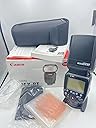
⚡ Illuminate Like a Pro, Anywhere, Anytime!
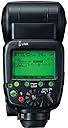
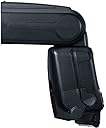
The Canon Speedlite 600EX-RT is a professional-grade flash unit featuring advanced 2.4 GHz radio wireless control for up to five groups of flashes, a powerful zoom range from 20 to 200mm with a maximum guide number of 197 ft at ISO 100, and rugged dust and weather resistance. Designed for seamless integration with Canon DSLRs, it offers a dot matrix LCD for easy operation, full swivel flash head for versatile bounce lighting, and customizable functions including color filter compatibility, making it the ultimate tool for creative and reliable flash photography.
| ASIN | B007FH1KX2 |
| Audio Recording | No |
| Battery Average Life | 30 Hours |
| Battery Life | 30 Hours |
| Best Sellers Rank | #439 in Shoe-Mount Flashes |
| Brand | Canon |
| Built-In Media | Color filter holder |
| Camera Flash | Slave |
| Color | Black |
| Compatible Devices | Canon Cameras |
| Compatible Mountings | Canon |
| Connectivity Technology | Radio Frequency |
| Customer Reviews | 4.4 out of 5 stars 422 Reviews |
| Exposure Control Type | TTL, Manual |
| Flash Sync Speed | 1/200 |
| Global Trade Identification Number | 00013803136692 |
| Guide Number | 197 ft./60m |
| Hardware Interface | Radio Frequency |
| Has Self-Timer | No |
| Included Components | Color filter holder |
| Item Weight | 14.99 Ounces |
| Light Sensitivity | ISO 100 |
| Manufacturer | Canon |
| Manufacturer Part Number | 5296B002 |
| Maximum Shutter Speed | 1/200 |
| Media Type | EnhancedContent |
| Minimum Shutter Speed | 0.004 |
| Model Name | 5296B002 |
| Model Number | 5296B002 |
| Mount Type | Hot Shoe Mount |
| Number of Batteries | 4 AA batteries required. |
| Screen Size | 3 Inches |
| UPC | 617215768597 013803136692 |
| Unit Count | 1.0 Count |
| Warranty Description | Limited 1 year |
| Water Resistance Level | Water Resistant |
| Wireless Technology | RF |
C**R
Great Built In Wireless - Fantastic Flash!
I purchased 3 of these flashes from Amazon and plan on adding a fourth soon. I also have a pre-order placed for the Canon ST-E3-RT Speedlite Transmitter which I hope to receive sooner rather than later. The radio's on these flashes are awesome and the menu system is also greatly improved. One of my favorite features is the ability to use a master flash or the ST-E3-RT to control each of my flashes. The group mode is great, but can only be used with 2012 or newer Canon Cameras such as the Canon 5D MKIII which I also own. I tested the group mode on my Canon 5D MKII and it definetly does not work with that camera. With the group mode you can have up to 5 groups total and set the power levels using either ETTL or Manual mode. I use a label maker and mark my flashes as A B C (and future will be D for the fourth flash). I still have one group left if I want to go to five flashes. If you have more than 5 flashes you can assign multiple flashes to the same group and their power settings will be the same. Using the Master you can easily switch the slaves remotely from either ETTL or Manual mode and set their power settings. When you turn on the flashes they come up quickly and link up before you are ready to shoot - mere seconds. I was really impressed with how the radios worked and it's so nice to have just one set of batteries and not have to hook up a bunch of external gear. These are a huge time saver. One thing I will mention to those who may want to mix these with Studio Flashes. You can fire these from remote triggers just like the older Canon models as they have a PC input port. Even when using the external triggers to fire in conjunction with my studio lights it's still nice to be able to set up the power levels using manual levels and group mode through the master. The one thing that I discovered and is very important to note is that if you change power settings on the master for the slaves they will not receive the changed information unless you first press the TEST button on the master and I'm sure the same will be true for the ST-E3-RT. Firing the master from the synch port or even using a hot shoe adapter does not transmit the new settings. You must press the TEST button first to get the new settings over the the slaves. This is pretty minor and easy enough to do. Keep in mind if using external triggers you will need one on each flash. I could not figure out a way to get them to fire just by triggering the master in radio mode, although I am still experimenting. It would be really nice to only have to put an external trigger on the master but from what I could find you need one on each flash. I still need to read the manuals all the way through and experiment some more so I will try to remember to update my review if I find out something new. It would be nice to see these work in group mode with older cameras such as the 5D II and 7D and that is probably my only real disappointment with the flashes. I can't see why that can't work at least in manual mode, but it doesn't unless there is a workaround I haven't found yet. Overall I am really pleased with these flashes and look forward to giving them more of a workout as well as testing them with an external battery pack. For photographers that are on the go and want a powerful system that is more convenient in terms of space, set up time, batteries and reliability, this is the way to go. EDIT (04/27/2012): After some more time with these flashes I still love them. I have 5 of them now and am still waiting on the wireless controller. I did come up with a much better solution for combining these with studio lights. Not sure why I didn't think of it before as it's simple and works great. I just put my 600EX-RT on top of my camera in the hot shoe so I have full control - no need for third party radios on the 600EX-RT's. I then use the synch port on the camera to fire the studio flashes. A cable runs from the synch port to the trigger port of the transmitter for my studio lights. I now have a mixed radio system with wireless control over all my lights. Awesome!
P**N
Superb tool that rewrites Speedlight/Speedlite functionality
These new strobes are a bargain, particularly now Amazon is selling them for the same price the 580EX MkII's ended up going for before the 600EX-RT came out. Manufacturer supported wireless is the future and these just work, also, despite the warnings from Canon they function very well with pre 2012 bodies, in my case 1Ds MkIII's, maintaining full power at max sync and HSS works at all shutter speeds. You don't get Group Mode but I have never had it so won't miss it until I get a newer body! Great new features to the wireless system are remote control from a strobe, I find it invaluable for accent lights in layered interiors, and the ability to use multiple masters for common slaves, if you are shooting with two bodies or a second shooter this feature alone is worth the price of admission. Very well built, weather sealed etc, I can pick up my heavy camera with the flash and with full integration with the earlier optical system Canon didn't leave legacy users out in the cold, having said that all my earlier gear is up for sale, I never found the optical protocol very reliable and now I can use all my softboxes and modifiers without consideration to getting line of sight. Once you go wireless you don't go back. Oh my third party radio triggers are up for sale too, whilst some systems do offer similar, and in some instances better, functionality, principally the Phottix Odins, the all in one fully integrated manufacturer supported solution won my decision making process over. So what could they improve? Well why oh why are all catchlight cards on the back of the head? Everybody that uses them needs them on one side of the head, this makes landscape to portrait orientation a one angle flip, not a two stage twist and flip. Also change the stupid mount thread from some obscure Japanese size to the universal lighting thread size so we could use it . Other than those small niggles, the only thing I would like is a body firmware upgrade to their current high megaixel pro body (the 1Ds MkIII) to enable Group mode and the newer flash menu via the camera, I am not buying 5D MkIII's and the 1Dx is not my logical next body either.
M**N
Completely Satisfied!!
I use three of these flashes, primarily because after reading about some of the shortcomings of the controller, I decided it would be worthwhile to just by an additional flash to use on camera. To date, they have worked flawlessly and can be controlled easily through the menu on the on-camera flash or in my 5dmkiii. I love, love, love the ability to manually control the off-camera flashes and change setting on the fly. Battery performance is great. I'm have been in the habit of changing to fresh batteries for each event, but have found, after using a battery tester, that I have at least half the battery power left and can stretch the batteries to two events. I'll eventually get power packs for these, but until then, they absolutely perform! Unlike my previous Pocket Wizards, the ETLL works well, and these allow for customizing each flash individually. I have yet to experience any issues with the RF system and they have fired reliably for several events. Although I am usually using these at a range of anywhere from 20 - 50 feet, these things have fired from as far away as 200 feet. I haven't tested them or used them much beyond that distance, but for my purposes, this is more than enough. The on flash menu's can be a little confusing and convoluted. I highly recommend sitting down with these prior to your first use to really get a feel for the flashes and the menus. Like anything else, once you spend enough time working with them, adjustments will become second nature. Another great aspect of these flashes is allowing for different groups to be set-up. A second photographer can set up their preferences for each flash, which will allow you both to trigger the flashes, with different settings. Pretty Neat. Again, I am completely satisfied with these flashes and they are a vast improvement over my previous 580ex's. If you plan to use these for wedding receptions or any other two strobe set-ups, I would recommend spending a little more money and purchase a third to act as the controller. Not only do you have the ability to have that third flash, it also provides you with the IR assist beam in low light situations!
L**T
Great Flash, hard to figure out...
It has been a long time since I have used a dedicated flash and apparently the technology has moved forward a bit. Either that, or there are just too many bells and whistles on this flash for its own good. I like the product, don't get me wrong. But, I have had it for several weeks now and I am still trying to figure out how to use it. The instruction book is small, has many pages and reads like...well, a tech manual. I have used this flash on camera and off, using the built-in flash on my Canon 60D to trigger the 600EX-RT as a "slave" unit. It took me a while to figure out how to slave the 600EX-RT and I still can't do it without thinking about it. And, when the flash is too strong, overexposing my shots, I haven't figured out how to back it down yet. SO -- bottom line, I like this flash and may even buy a second one for more complicated lighting set-ups. But, (for me, at least), it was not intuitive to use and I expect others may have the same problem. I'll figure it out, eventually -- because I have to. Maybe there's a YouTube video that will explain it. Otherwise, I'll have to take a trudge through a small, many paged, dryly written instruction manual. I have taken some nice pictures bouncing the flash off or walls and ceilings or shooting through a Fotodiox 48" octagonal softbox. The difficulty of use was why I dinged this speedlite one star... 11/3/2012 Update: I ordered two more 600EX-RT flashes so I can do three-point lighting set-ups. I have also ordered a book on using the 600EX-RT. Having played with the first light some more, I am gradually becoming familiar with it. By no means a master, yet. But, I have found out the symbols on the LCD display that show when the Speedlite is using radio communication and when it is using optical communication. Until I get the other two 600EX-RTs, the radio transmission is useless. So, I have to make sure that the 600EX-RT is set for optical communication with the camera's pop-up flash to fire the 600EX-RT remotely. I have also figured out, sort of, how to do some simple exposure compensation for when my shots are a little too bright or a little too dark. Still far from intuitive or second nature, but I'm plodding along. For all the trouble, I would still recommend it. I must sense the potential...
M**A
bad experience
I tried to buy this twice. The first time my item was "returned" and the money was refunded before I even received it. Strange. So then I tried to order again and it arrived the second time. When I opened it the flash was in terrible shape - lots of wear and tear more than indicated in listing. Lots of dust in the sensor and elsewhere. When I added the batteries it wouldn't even turn on. This is a brick. Extremely disappointed. Total waste of my time.
T**5
Only Good, but Bad option for Canon photogs.
This is a must have flash if you're a professional canon photographer. I give this flash only two stars because it overheats when their older models did not. Once it overheats then the flash will not fire until it cools. Sucks if your bouncing light during an awards ceremony and it just stops working (bounce light when I can because I'm not into the "crime scene photography" look). I looked at buying a Nissin (not the car maker) flash that is on youtube flashing without overheating next to a canon that overheats after a few dozen shots. The problem with the Nissin is it cannot swivel 360 degrees. So there is a 90 degree area to your left or right back that it will not want to go. Buy if needed, wait if you can for canon to come out with new model and prey.
S**S
Amazing for Strobists, Event Photographers
I sold all of my previous flashes and bought these. Previous flashes include Canon's 580exII, 580ex, and 430exII. The Good: First off, if you're a Strobist or an off-camera speedlighter, sell everything you own and get these. The RF signaling system and fully independent group controls right from your master device will change everything for you. Already using RadioPoppers or a PocketWizard FlexTT system? Welcome to a new world of reliability, simple setup, and battery life. Going into "Gr" mode on the master flash, I can independently tell up to five different groups to operate in full eTTL mode (plus adjust each group's FEC) OR shift one, some, or all groups into M mode with full power controls on each group. I do this right from the flash itself, or from the screen on my 5d mark III. Shooting a party with dancing? Want to have eTTL on-camera to bounce, and an off-camera light in the background on M for a little dramatic rim-lighting? No problem. All easily configured right from your camera. Working outdoors at night with nothing to bounce off of? No problem. Tell the master unit on your camera not to flash, and it will simply operate as a master controller for the off-camera units. (If you often need a master controller with no flash, a Canon ST-E3-RT Speedlite Transmitter might save you a bit of money. ) If you get lost in the menus, use the configuration screen on your camera instead. I find this much easier to navigate, set modes, etc. This is too expensive, you say? Consider that here on Amazon (as of this writing) a 580exII costs $530 + a PocketWizard Flex TT5 transceiver costs $230 for a grand total of $760, and you still haven't invested in the transmitter to go on your camera. PLUS you have to do on-site assembly, AND you have to deal with the finicky unreliability of that system. Canon claims a range of 100'. I've used these in huge reception venues, and never run out of range. I guess the lawyers were setting a target they could defend? Read around the blogosphere, and you'll find people testing them to over 1000' out in the countryside. Other changes that I love over the previous units I owned: -They now clearly indicate when they are overheating. Both the backlight on the screen changes from green to orange, and two little "heat wave" wiggly lines appear above the speedlight's icon. (This may not affect many users, but event photogs doing bounce-flash in high-ceiling venues will appreciate this. Keep another cooling in your bag, and cycle them out.) -When controlling off-camera flashes, the units are now aware of each other's power states. The "ready" light on the master will not come on until ALL flashes have finished cycling. Yup, they really talk to each other that much. Pretty cool. Yes, these work with your existing CP-E4 battery packs. The Neutral: If you do not do off-camera flash, then yes, this is probably a bit steep. You have to ask yourself how much the additional zoom range is worth (up to 200mm on this unit vs 105 on the 580 series.) You may not feel it's worth that much. Be cautioned that if you do not own a 2012 generation camera or newer, you will not be able to use mixed-mode with these flashes. As of this writing this means you need a 1D-X or a 5d3. If you don't have one of these cameras, you're limited to setting all groups to M, or all groups to eTTL. I believe you can still control each group's power/FEC, but double check if this is important to you. If you do a lot of studio work and are hoping to mix speedlights and studio strobes, be cautioned that this is a brand-new RF signaling system developed by Canon. It will not integrate with your existing PocketWizard (classic, flex, or otherwise,) RadioPopper, CyberSync, Profoto Air, etc etc system. I really hope that Canon will chose to release an inexpensive, "dumb" receiver with a generic miniphone plug that can be used to trigger studio strobes, but this is just my own pipe dream. That said, you may be able to use your studio strobes in optical slave mode and get basic integration that way. The Bad: If you're a gel-er, you'll hate the included gel holder. Initially I was excited. It's obviously designed to allow you to cut and use your own gels, which is a nice thought. Unfortunately, the way it holds the gel produces harsh, mixed light. The holder does not hold the gel flush against the speedlight head. Instead, it allows it to arch out in front of it. The frosted clear plastic of the holder along the edges not only allows, but encourages ungeled light out around the sides. What you end up with is a bit of an Omni-Bounce ( Stofen Gold Color Omni Bounce Diffuser for Canon Speedlite 580EX Flash ) look, but with CTO out the face, and daylight out the sides. It's a color correcting disaster. The provided gel holders now sit at home, and I'm back to my previous favorite combo: LumiQuest UltraStrap LQ-126 and HonlPhoto Color Correction Filter Kit In Conclusion: I love these for the kind of work that I do, and cannot recommend them highly enough. I'm on the fence as to whether I'll get two more, or one more and an ST-E3-RT. (I'm disappointed that Canon dropped the focus assist beam from the new ST-E3-RT. The previous ST-E2 had one, and is my only hesitation.)
J**Y
Exactly the pro upgrade I was praying for - but not for amateurs.
This flash is everything that I have been hoping for. As a professional photographer who shoots a ton of low-light weddings and events and works nearly exclusively with bounced flash, this is the perfect flash for me, and every bit worth the price. That said, if you are an amateur, or prefer to work with direct flash or flash fill, you would be just fine with an older, less expensive model. Because of the way I use the flash, it takes way more power than simple direct flash. Don't get me wrong, I LOVED my 580 exII's, but this flash blows them out of the water. I used to overheat the 580 CONSTANTLY, and was always having to switch back and forth between two or three flashes to give them time to cool off. Worse, there was no indicator to tell me whether the flashes were out of batteries, or if they had simply overheated and needed a cooling off period. The 600 solves all of that. It has indicators to tell you if the unit is overheating or if the batteries are low, and takes SO much longer to overheat. I shot a 5-hour party with lot of dancing on Saturday night, and only had to swap out my flash twice the entire night. With the old models, I would be changing flashes every 20 minutes to half an hour by the end of the evening. They cycle time is amazing as well, and the menus allow for so much customization, plus are a lot easier to adjust. The RT capabilities are great we well, though I haven't had a chance to test them yet, and I love the fact that I can zoom this one in to 200mm to throw a tighter spot of light, where the 580 stopped at 105mm. The built in CTO gel is an awesome addition as well, and looks so much more professional than a janky piece of plastic velcro'd to the end of the flash. All in all, I love this flash, and think it is totally worth the price. I'll be trading in my last two 580 exII's for another one of these, and can't wait for the start of wedding season now.
A**I
Excelente flash para canon
He tenido excelentes resultados con el flash, sencillo de usar en el modo automático y tiene muchas opciones de personalización. Es una excelente opción si lo quiere utilizar un aficionado a la fotografía y he lo he visto utilizado por los profesionales.
D**Y
Five Stars
Best Flash i ever had. Little Expensive but money worth it.
M**N
Five Stars
Good one. Two years over. Tq u Amazon for original product.
A**I
Five Stars
Nice product
R**L
Five Stars
I am very satisfied with all the features.
Trustpilot
3 weeks ago
2 days ago