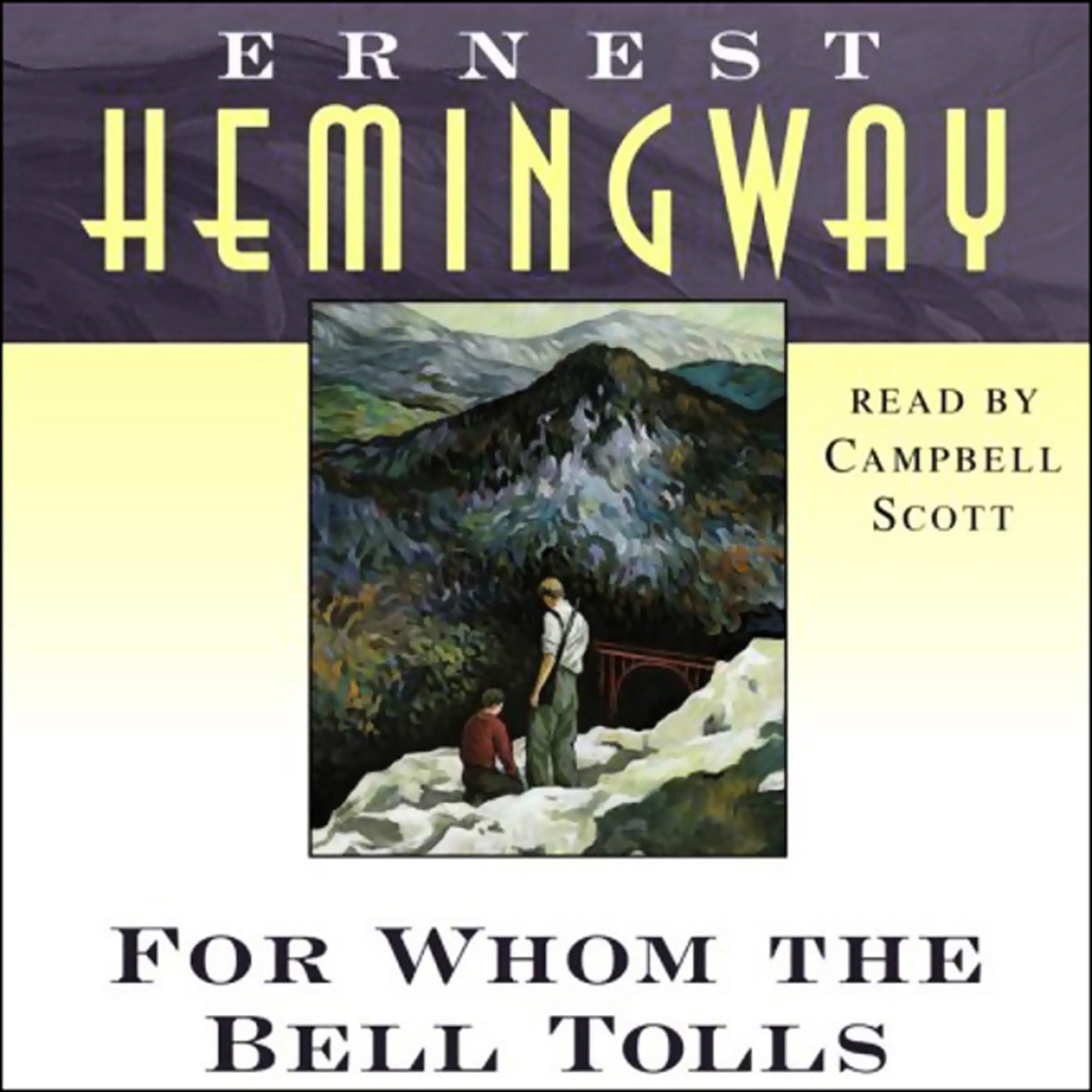

For Whom the Bell Tolls
Desertcart purchases this item on your behalf and handles shipping, customs, and support to Poland.
Description
Ernest Hemingway's masterpiece on war, love, loyalty, and honor tells the story of Robert Jordan, an antifascist American fighting in the Spanish Civil War. In 1937 Ernest Hemingway traveled to Spain to cover the civil war there for the North American Newspaper Alliance. Three years later he completed the greatest novel to emerge from “the good fight” and one of the foremost classics of war literature. For Whom the Bell Tolls tells of loyalty and courage, love and defeat, and the tragic death of an ideal. Robert Jordan, a young American in the International Brigades, is attached to an antifascist guerilla unit in the mountains of Spain. In his portrayal of Jordan’s love for the beautiful Maria and his superb account of a guerilla leader’s last stand, Hemingway creates a work at once rare and beautiful, strong and brutal, compassionate, moving, and wise. Greater in power, broader in scope, and more intensely emotional than any of the author’s previous works, For Whom the Bell Tolls stands as one of the best war novels ever written.
Reviews
User
An American Masterpiece About A Pivotal Point In World History
"For Whom The Bell Tolls" has long been my favorite Ernest Hemingway novel. A compelling action adventure, this is a tale filled with mystery and suspense, peopled by a cast of extraordinarily vivid characters. It is also the author's finest, and most emotional love story. Although his use of language seems simple, it is deceptively so. Hemingway deals effectively with broad themes here - love, loyalty, trust, courage and honor are some. And of course, "For Whom The Bell Tolls," set against the brutal violence of the Spanish Civil War, is probably the definitive work of fiction about this pivotal period in European, and world history.Generalissimo Francisco Franco's fascist troops invaded Spain in July 1936 in order to overthrow the newly established Republic headed by the Popular Front, (composed of liberal democrats, socialists, anarchists, trade unionists, communists and secularists. (If I have left anyone out, I am sorry - this was a truly complex and unique political situation.)The country was basically divided into Red Spain - the Republicans, and Black Spain, represented by the landed elite, committed to a feudal system and Franco's cause, Fascists, the urban bourgeoisie, the Roman Catholic Church, and other conservative sectors. The number of casualties is only an estimate, but suggests that between 500,000 and 1,000,000 people were killed. Many of these deaths, however, were not the results of military battles, but the outcome of brutal mass executions perpetrated by both sides.During the war in Spain, 2,800 American volunteers took up arms to defend the Republican cause against Franco, who was aided by Hitler and Mussolini. Those who fought with the Abraham Lincoln Brigade, from 1937 through 1938, believed the defense of the Republic represented the last hope of stopping the spread of international fascism. These Americans fought alongside approximately 35,000 anti-fascists from fifty-two countries. Most of the volunteers were not political, but idealists who were determined to "make Madrid the tomb of fascism." Hemingway's protagonist Robert Jordan, an American professor of Spanish from Missoula, Montana, was one such volunteer.Robert Jordan, an explosives expert, has been ordered to make contact with a small band of partisan fighters in the Guadarrama Mountains of fascist controlled southern Spain. His mission, of critical importance, is to blow up a bridge, at a specific time, to facilitate a simultaneous Republican attack on the city of Segovia. Most of the novel deals with Jordan's relationships with members of the guerilla fighters, including the girl Maria with whom he falls in love. Jordan is described as, "a young American of slight political development, but a great way with the Spaniards and a fine 'partizan' record." Neither a Communist nor a Marxist, he is anti-fascist. As is the case with most foreign fighters, he is under Communist discipline/direction, because, in the conduct of the war, they eventually run the "show" and provide the most effective opposition.Pablo is ostensibly the band's military leader. He has become disillusioned with the fight, cynical and bitter. He is no longer willing to die for any cause. A smart man, but brutal, and cunning in a mean way, he is a complex character. He does have a conscience. Pablo spends much of his time in an alcoholic stupor. When Robert Jordon enters the picture, Pablo's level of animosity reaches new heights, and his comrades, along with Robert, are afraid he will sabotage the mission. He undergoes several changes during the 3 days and 3 nights in which the story takes place.Pilar is Pablo's woman, an extremely strong and savvy person, she is steeped in gypsy lore and superstition, and is probably the novel's most colorful character. She is a fine warrior who can be counted upon to cover one's back in battle. Pilar possesses a big heart. She has cared for Maria and brought the girl back to health. When Robert Jordon joins them, Pilar takes the leadership position over from Pablo, whom she no longer trusts, but still loves. She commands the allegiance of the guerrilla fighters and organizes them into a temporary alliance with "El Sordo," another exceptional character. She is the force behind many of the novel's events - stimulating movement, motivating or manipulating people to take action - but for good purpose. Pilar, relates various war stories, and anecdotes, which reflect the cruelty and inhumanity of civil war.María's life was shattered by the outbreak of the war. Her father, the mayor, along with her mother, and many of the local citizenry were shot before her eyes by the invading Fascists. Since her mother was not a Republican, but a devout Catholic, she shouted, "Viva my husband, the town's mayor," before she died, rather than the more typical, "Viva La Republica!" Maria was then taken away and brutalized, physically and emotionally, by Franco's soldiers. When the guerilla band blew up the train on which Maria was a prisoner, they carried the dazed and broken girl to their mountain hideaway.A thrilling subplot is developed when Andrés, a guerilla, must take an urgent message across the lines to a Republican general. Roberto's entire mission, and much more importantly, the offensive, depends upon the successful and timely delivery of the dispatch. Another important character is old Anselmo, for whom Robert develops a strong attachment.A major portion of the novel is told through the thoughts of Robert Jordan, with flashbacks to meetings with Russians in Madrid, and some reflections on his father and grandfather. Jordon's inner monologues fascinate and clearly demonstrate Hemingway's skill with language and character development. Jordan, at one point comments to himself, that he is his own best companion. Because of his wartime responsibilities, he cannot allow himself to be overcome by emotion, which he considers a luxury. Whenever he feels anger, deep love, disappointment, foreboding, fear, anything that will distract him from his purpose, he talks himself down and refocuses. In such a relatively brief period, he begins to love life as never before, because of his feelings for Maria. Even here, however, he accepts that if anything happens to him, he is fortunate to have experienced a lifetime in three and a half days.Again, I cannot write enough in praise of Hemingway's use of language. It is sparse, direct, and extremely beautiful in its descriptiveness. He translated the Spanish intimate "tu" form into English. I speak Spanish, and although this may seem a bit awkward initially, it gives a much more accurate feel for the local idiom and the dialogue between Maria and Roberto, (as he is called), and between Roberto and the partisans.This is not only an extraordinary novel, but is one of the most important in American fiction. Hemingway worked as a correspondent in Spain during the Civil War, as a reporter for the North American Newspaper Alliance (NANA). He raised money for the Republicans in their struggle against the Nationalists under General Francisco Franco.JANA
User
Love and War
FOR WHOM THE BELL TOLLS has been touted to me as a great novel for my entire life. I’ve read several of Hemingway’s works (A FAREWELL TO ARMS, THE SUN ALSO RISES, TO HAVE AND HAVE NOT, and A MOVEABLE FEAST). I liked the nonfiction A MOVEABLE FEAST best. I’m afraid I was a bit disappointed in FOR WHOM THE BELL TOLLS. Perhaps if I had read it when I was younger, before I had read some truly great works of literature, I might have been more impressed. It does have some great sections, but there are a lot of mediocre ones, too. Set during the Spanish Civil War, it tells the story of an American fighting against the forces of Franco. I find politics tedious and in the long run, it’s all like the Blefuscunians and the Lilliputians fighting over which end of an egg to open first. Hemingway blusters a great deal about politics, which I find boring, especially politics of a hundred years ago. He also goes on and on about the intricacies of making a bomb. Since I don’t plan to ever make a bomb, I found this boring. The book’s hero, Robert, is holed up in the mountains fighting with a band of guerillas while he plans a mission to blow up a strategic bridge. While there, he becomes involved with a girl who has been brutalized and raped by the Fascists, who also shaved her head. Through their affair, she begins to heal from the trauma of her ordeal and he finds that he can truly love. It is here that he meets the book’s most interesting character, Pilar, described as a big ugly woman who is tougher than any of the men. When she’s the center of attention, the book soars, but when she’s not, it becomes a fairly cliched war story. The book has moments that are rivetingly suspenseful, but I found the ending disappointing. I was expecting a bigger finish and I didn’t get one. Overall, I’d rate it as 3 and a half stars, rounded up to 4. It’s worth reading, but it’s not a masterpiece.
User
Looking for a Hemingway book? Pick this one up!
The writing is gorgeous and not at all what I was expecting. I have previously read some of Hemingway’s short stories which had his famous sparse style. The writing in this novel, however, while clear and crisp, has a rhythm and generous beauty that makes the reading almost sumptuous. My only warning for would-be buyers of this book: be patient to get the most from the novel.The story is set during the Spanish civil war in the 1930s. Robert Jordan, an American professor of Spanish, has come over to help the Republic fight the Fascists as a demolition man. He is sent to blow up a bridge at a specific day and time, creating a countdown where, as a result of the diminishing hours, he spends four intense days with a small guerrilla force, creating tight, intimate relationships.I’ll be honest. The first half of the book put me to sleep; but I’m not saying this as a criticism, I swear! The language was so mesmerizing, repetitive, and rhythmic, that it created a hypnotic effect that kept making me drowsy. I had to be so patient. I couldn’t read with any distractions and often read only a dozen or so pages at a time to help with my focus.The second half of the book, in stark contrast, accentuates the countdown to blowing up the bridge. The plot started to fly by, and I found myself going faster through the writing than I wanted to. I had to really focus on keeping my reading at a steady pace to catch all of the narrative and not skip anything. Again, I found I needed all my patience and focus, but in an entirely different way.There are no bad parts to this book. The characters, language, pacing, plot, everything is well done. Chapters often set aside the plot for a while as characters give us their personal anecdotal histories or conversations, but these asides add so much depth to the narrative that they seem integral to the whole story.Here’s my example of his writing style on pg. 323, Chapter 27: “Dying was nothing and he had no picture of it. But living was a field of grain blowing in the wind on the side of a hill. Living was a hawk in the sky. Living was an earthen jar of water in the dust of the threshing with the grain flailed out and the chaff blowing. Living was a horse between your legs and a carbine under one leg and a hill and a valley and a stream with trees along it and the far side of the valley and the hills beyond.” There’s nothing about the style here that’s sparse. Repetitive and clear, but so lovely as the time that I find it captivating.I was in a book club that read this, and I can tell you the only downside to this book is that we all agreed so well upon it, the conversation lacked any good argument or intensity (although we did understood the novel much better afterwards). I encourage book groups to read this book as there is so much depth here to explore; I easily created pages of discussion questions and could create so many more if I spent more time with the book. This would also make an excellent book for anyone interested in reading classics. Someday I’m going to read this book again, and I know that I’ll get even more out of it then.
User
It Tolls for Thee
I read this on the heals of Amanda Vaill's very good book "Hotel Florida" (Farrar, Strauss 2014) describing the Spanish Civil War of 1936-39 through the experiencing of it by Hemingway and others as correspondents and photographers. Hemingway wrote this in 1940 with resounding success.A young American professor who teaches Spanish at a university in Montana signs on as a partisan volunteer. It's because he's anti-fascist more so than being pro-Communist. This is Robert Jordan a demolitions expert, a skill he learned after arriving in Spain. He's known now as a dynamiter.He becomes part of a small group, 8 or 9 insurgents, hiding out in the mountains near Segovia making their home in a cave. They are a motley group, which is part of the charm of the novel. The dialogue between them and Jordan is a major part of the story. Who can be trusted? Who has the nerve to carry out their responsibiltiy? Can this person be depended on or should he be knifed or shot? It's rich with characterization.Marie has been brought into the group. Young, charming, and having been sexually abused and hair growing out after having been cut off as part of the cruelty inflicted on her. She and Roberto are a match from the start. They pledge their enduring love.Roberto's assignment is to blow up a bridge in the hinterland. This is easy enough. Two guards are on duty at all times and 5-6 others are billeted close by to take their turns. They can be eliminated. The problem is that the bridge must be blown at just the right time; as soon as Roberto hears the bombardment that signals the Spanish attack. The purpose is to cut off the resupply of the rebel (Franco's) forces which must cross over the bridge to get to the battleground. Blow it too soon and the rebels will be alerted and throw pontoons across; the element of surprise is lost. Too late, and the rebels will be crossing the bridge and it will be impossible to take out the bridge. To compound Robert Jordan's problems a traitor in his group has stolen all the dynamite caps. Not only must the dynamite be fastened in place under the bridge at the key places in the structure, but it must be detonated by hand grenades with the triggers pulled by long thin strings to places of shelter on the shore. And the guards have to be eliminated before any of this.Hemingway is at his best in building suspense. Can they kill the guards? Can Jordan attach the dynamite and the grenades? Will it work? Can he get it done before the bombardment signals that the bridge must be blown? Can they escape? Is Marie safe (she's guarding their horses)?Don't expect this book to make you a historian of the War, but it will acquaint you with backwoods guerrilla war, the atrocities, the idiocies, the evil that corrupts a soldier's soul.
User
Great book, not so great copy
Okay, shame on me for not looking at the book size in the description because this girly is the size of my hand. If you get the hard copy it's hell-aah small, like holding a pocket Bible. And for my OCD kids out there, this is not the typical book paper grade it's closer to newspaper grade (30-50 gsm).
User
Awesome Hemingway - Essential reading
This is an incredibly good book. Hemingway summoned all his superior story-telling powers and forged an unforgettable wartime epic. Complex, layered and populated by memorable characters, FHTBT is a true masterpiece. It is like an Iliad for the 20th-century man. The tragedy, injustice of war, engulfing good and bad human beings alike in its remorseless swirl, is brought to life with astounding attention to detail and humanistic depth. As you may know, the story takes place during the Spanish Civil War, a brutal conflict that not only tore apart the fabric of Spain's society, but also involved armies and volunteers from the great powers and ideologies of the time, most notably the tyrannies of Soviet Communism and German/Italian fascism.There is no facile characterization of heroes and villains on this book. Most of the narrative zooms in on the struggle of a small band of mountain guerrilla fighters who are summoned into near-suicidal action by the arrival of American volunteer Robert Jordan with orders from the Republic. That you know in the great scheme of things their call to sacrifice and their violence is just another futile exercise in a brutal war makes it all the more poignant. And Hemingway adds enough insight into the workings of the greater armies and the machinations of politicians so the reader experiences the bigger picture as well.In the book you find an intimate tale of struggle and courage in time of war, a moving love story, a critical view of the ideologies and idealism of the era, a couple of short-stories on bull-fighting, brutally honest accounts of war atrocities (from both sides) and moments of introspection in questions of love, life, death and hope that are as deep and moving as any. But don't forget about the adventure and suspense: Hemingway was a man of action and this is a book of men and women on a mission. You will be hooked and on the edge of your seat all the way to the (bitter-sweet?) end.The last chapter is the most gripping piece of fiction I ever recall reading. It is unbelievably good... and Hemingway proves one more time he is a master of story endings.
User
A classic that I am glad to have read
This 1939 novel is set during the Spanish Civil War, a war that most American know little about. The hero of this book is Robert Jordon, an American volunteer hoping that this rebellion would make a better world. He wants to do good and be a hero but whether or not this happens is basically left for the reader to decide.The book is about his mission to blow up a bridge and the people he meets along the way - Spaniards hoping for a better life and getting caught up in warfare. Naturally there is a love interest between Robert and Maria, a young woman who had been very mistreated by bad guys and is now seeking refuge with the cave-dwelling freedom fighters of the revolution.The writing is sparse and meaningful. The setting is depressing. People struggle. People die. The future looks bleak.This is fine story, well told. However I was annoyed by some of the narrative. Hemingway doesn't uses curses and so the word "obscenity" is used where a curse would logically go. I don't know if this was in only the edition I was reading but I found it very annoying and it broke my concentration.This is the only Hemingway book I have ever read and I did like the writing. I found the plot easy to follow and I identified with and pitied all the characters. It is a classic of a time and a place and a writer who will long be remembered.
User
Amazing Insight Into the Human Spirit
I have just finished reading the Kindle edition of "For Whom the Bell Tolls." In this book, Hemingway speaks from the point of view of a third person omniscient narrator, that is, the narrator sees into the minds and emotions of all the characters from whose point of view the story unfolds. In this way Hemingway demonstrates his genius for having accurate and sensitive insight into the human spirit.I am impressed by the way he is able to express passion, especially in the sex scenes, under the constraints of early 20th century censorship. I read this book simultaneously with Sandra Brown's "Hello Darkness," reading six chapters of Hemingway to every five chapters of Brown so that I would finish both books at the same time. This truly provided a contrast of how human passions were expressed in early 20th century novels compared with how they are expressed today. You should try it! It's an eye-opener! What some would judge as repetitive prose in Hemingway was actually a literary device he used to bring the reader into the experience, and in my opinion (and of course, the opinions of countless other readers and critics) Hemingway succeeds famously. I also found it very amusing to read how Hemingway skirted around the expression of "unprintable" language, a hindrance contemporary authors no longer need to be concerned about <g>Another device Hemingway uses in this novel is to make his characters "think" in Spanish but "speak" in English. This is not easy to accomplish successfully. Because I am bi-lingual, I found the rhythm of the prose quite natural, but I wonder how the experience would be for an only-English speaking reader.This is my second Hemingway novel and I am so grateful that I have been introduced to Hemingway on Kindle. Because I read this on Kindle for PC, I was able to conveniently and quickly look up not only the definitions of words I did not know but also the translations of Spanish phrases with which I was unfamiliar. Thank you, Kindle! It made reading this book much more interesting and informative. It has also spurred an interest in the history of the Spanish Revolution which took place in the decade before I was born. Of course, Kindle has satisfied that curiosity as well.This is more than a worthwhile read for anyone who enjoys war novels. One learns so much from reading; I've always said fiction is the best medium for speaking truth, and Truth (whatever that means to each one individually) abounds in this book. Enjoy!
User
un bijou
Si vous lisez l'anglais, c'est un bijou : le style à la fois sec et terriblement évocateur d'Hemingway à son meilleur; en même temps un livre de guerre terrible (comme l'est "a farewell to arms") et un document prenant sur la guerre civiel espagnole
User
Fine condition
The cover of the book is very appealing, and it was delivered and handled with care. Fine condition. Pages are good. A little lovely book. I haven't go through this yet but I can clearly say that the product is at its finest condition and it is delivered within the expected date. Thanks!
User
A good book.
Well written.
User
Excellent Audio version - a good way of enjoying a complex and thought provoking masterpiece
I am a huge fan of Ernest Hemingway but paradoxically for many years I found that though I would read his books and enjoy them I would often struggle to complete them. I would get lost somehow,someway. I would struggle to give them the full attention they deserved in my 'busy lifestyle' - and this is my fault, not the authors. I can identify both with those readers who criticise his works and those who applaud them. I wonder if those who were dubious of his talent would think differently having experienced an audio version? Certainly I have found audio versions to be particularly appealing when coming to enjoy Papa's work.I love his use of language - but perhaps with my limited intellect I could cope with it in only small doses (the opening paragraph of another of his classics Farewell to Arms is the most beautiful, somber pieces of literature I have ever read - see if you can read a sample somewhere on Amazon).Unlike many other authors whose work I casually read I found I just couldn't put the book down for a couple of days and then pick it back up again. I would lose the thresd, the auroa and subtlety of the author would be lost...It demands your full attention. The audio versions however have been the answer to my prayers - to hear Hemingway's prose read so brilliantly by Campbell Scott has allowed me to truly savour Ernest Hemingway's genius. I also find I can pick up the story a lot better if I leave it for a day or so - indeed I love replaying sections again and again. His research and application of personal experience and fiction is first rate.It helps if you are interested in the Spanish Civil War - which I am. Don't expect lots of fast paced action - but a lot philosophising, personal anecdotes of the characters. When action does take place though it is masterfully described. This book I think is one to savour - and unfortunately, without intending to sound pretentious, this is the best way I can describe it - intelligent, thought provoking, atmospheric, clever, masculine, gritty, soul searching and life redeeming.If you fancy giving this book a try consider the audio version. I certainly will use this medium for his other works. By the way there is a great version of Old Man and the Sea told by the great Charlton Heston which can be obtained - if not in the UK then inported via the US.
User
interesting read
came in good condition, its a good book
Common Questions
Trustpilot